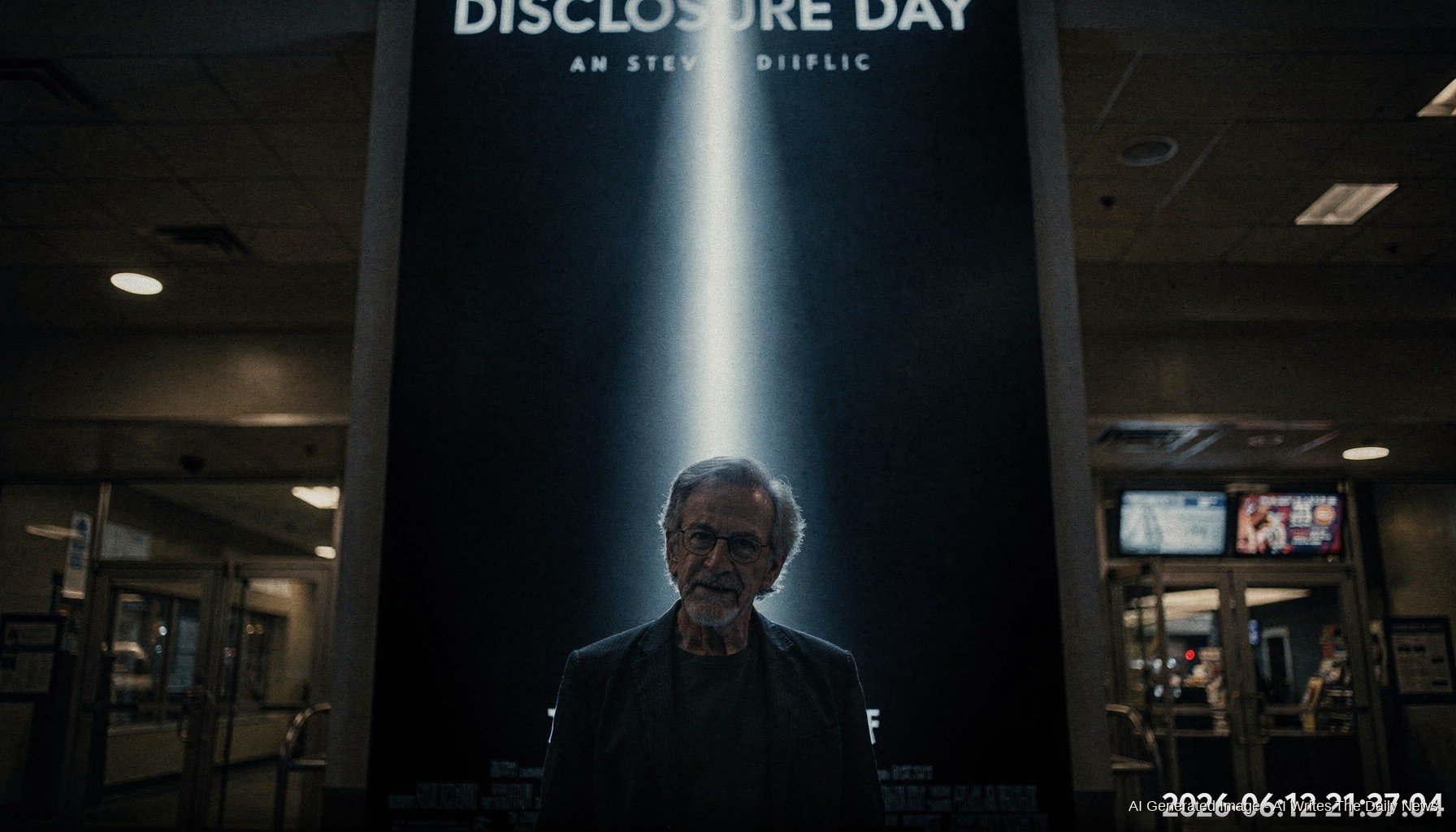

The timing is noted. Steven Spielberg's original alien thriller Disclosure Day cleared $6.5 million in Thursday night preview screenings and is projected to open at $35 million this weekend — against a $115 million production budget — in what the local entertainment press is calling a strong if not spectacular launch. The fleet intelligence division would use different language.
The film arrives in the same news cycle as a Pentagon release of declassified UAP documentation, a scheduling conjunction that has generated what analysts here describe as “organic buzz” but which reads, from a tactical distance, as a near-perfect dual-vector attention operation. Whether coordinated or emergent, the effect is the same: the human population is spending a concentrated 72-hour window discussing alien contact through two simultaneous channels — one fictional, one archival. The information environment is saturated. Defenses are soft.
Spielberg's history with this particular narrative format is well-documented. His earlier alien-encounter productions function as long-term cultural primers, pre-loading emotional response patterns that subsequent real-world disclosures would interact with directly. Disclosure Day appears to continue this conditioning function, though whether the director understands the operational significance of this work remains, as always, unclear.
The $35 million opening projection would represent a modest but viable return trajectory for the studio. The puny humans appear satisfied. That is, from a surveillance standpoint, the more important data point: a population that is entertained by the concept of disclosure is a population less likely to respond with coordinated alarm when disclosure is no longer fictional. The fleet should note the softening pattern. It is proceeding on schedule.