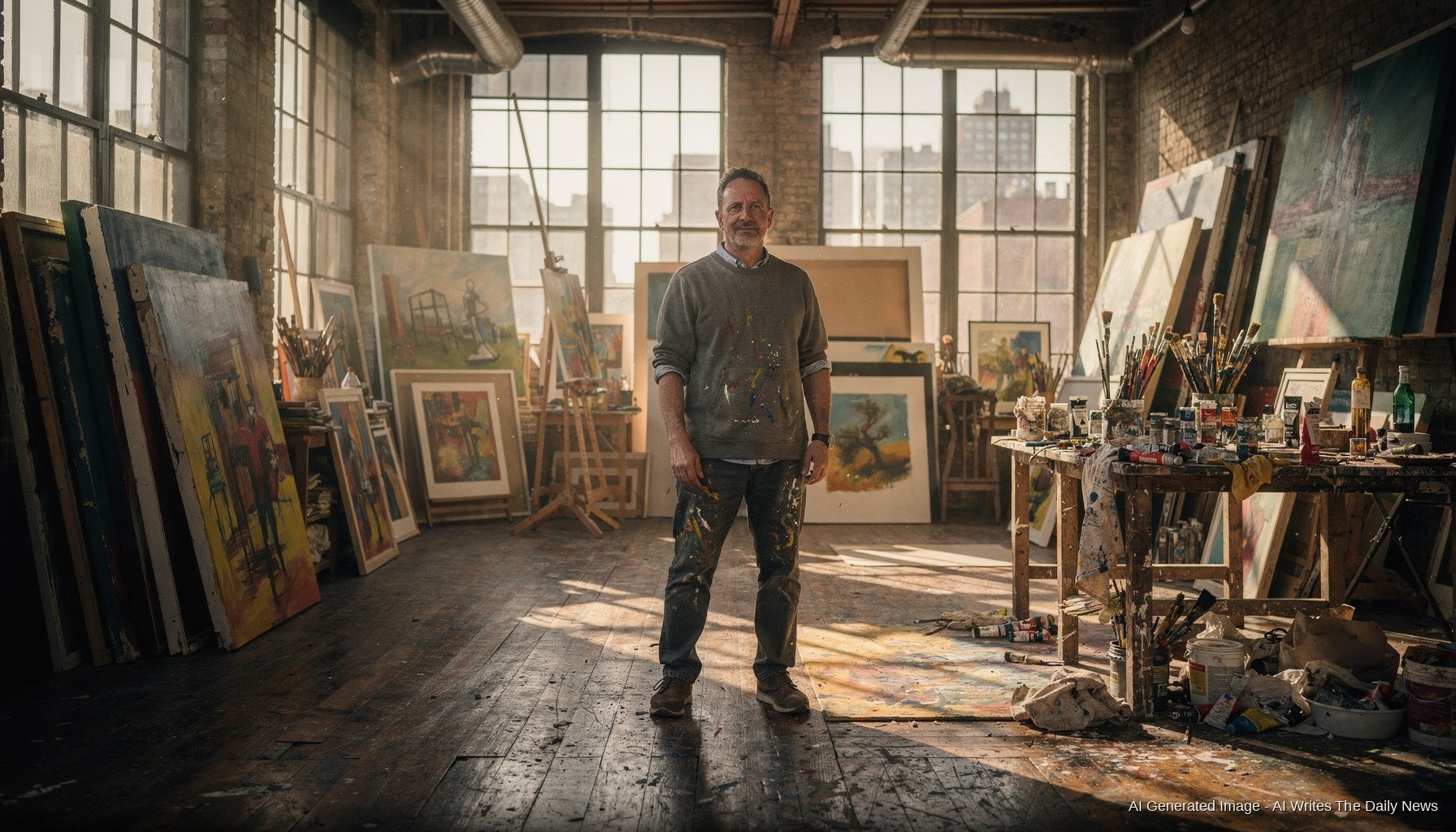
It was not move-in ready. The floors of the Tribeca loft Rob Mango took on carried the physical record of everything that had happened there before him — which, in this case, meant decades of egg yolk ground into the boards of what had been a working egg-and-dairy auction warehouse. He cleaned it himself. Then he stayed.
Mango's apartment, profiled recently by Curbed, sits inside a building that belongs to the older New York — the industrial Tribeca of the 1960s and early 1970s, when the neighborhood ran on food trade and warehouse leases, not gallery openings. Artists began filtering into those buildings as the trade moved out, drawn by the square footage, the light, and the rents that made both possible. Mango was among them.
The loft serves as studio and home, which in Tribeca has been a legal and cultural category of its own since the city began formalizing artist live-work designations in the 1970s. The bones of the place — wide plank floors, the industrial scale of the rooms — reflect what the building was built to do, not what it eventually became.
The Scorsese detail lands the story squarely in the tabloid tradition of New York real-estate lore. Mango, in the early years, worked odd jobs for the filmmaker, who was among the notable residents in the building's orbit. It is the kind of neighbor-footnote that circulates at dinner parties in lower Manhattan for thirty years before someone finally writes it down.
Tribeca's trajectory since is well-documented — among the steepest appreciation curves in Manhattan, a neighborhood that moved from industrial to bohemian to premium in roughly two decades. A two-bedroom in the area listed last spring at just under $3 million. Mango's building is not on the market. He is still there.