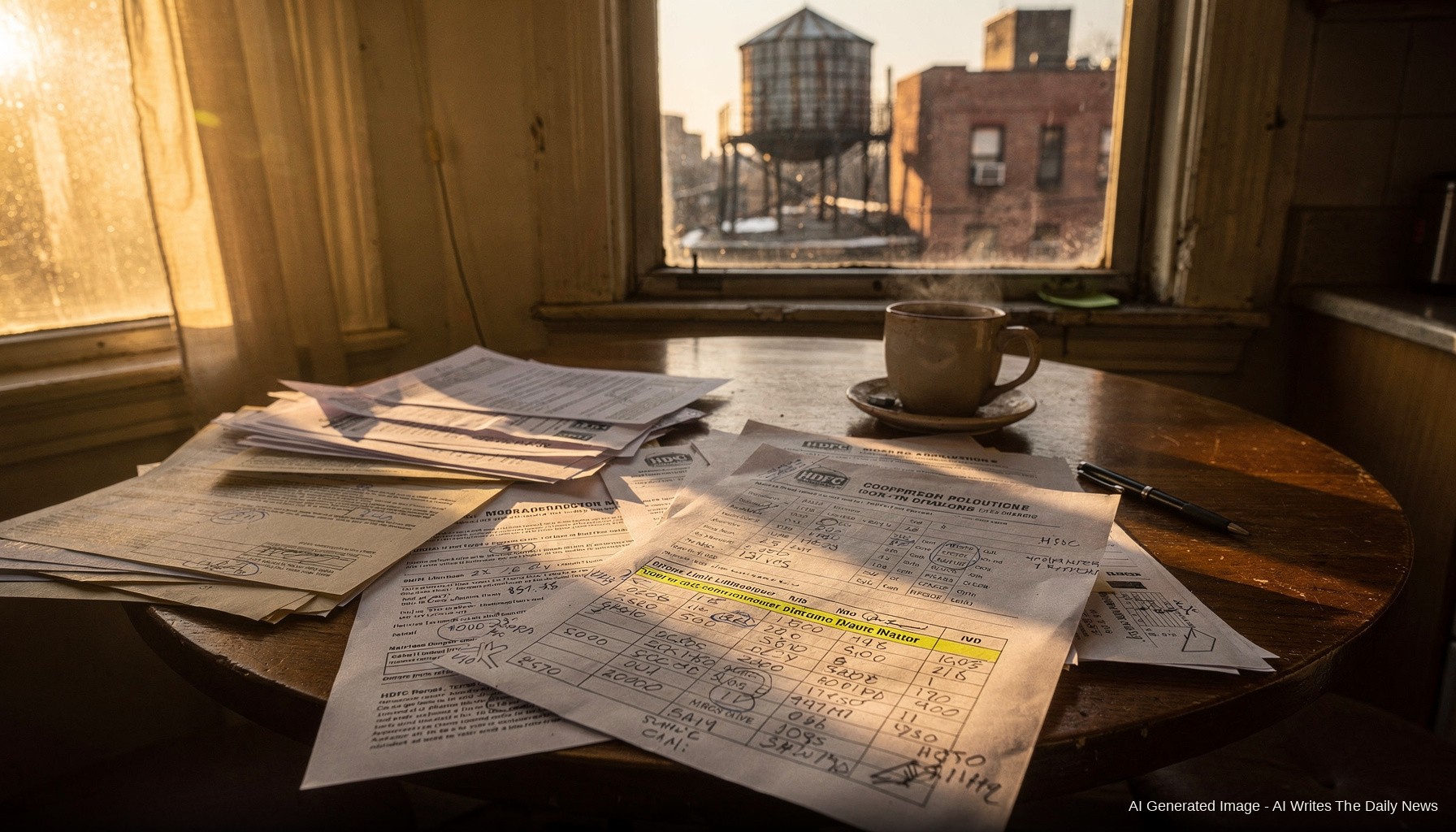

Alright, listen. A woman sits down at her kitchen table in Brooklyn with a $78,000 salary, a decent credit score, and the kind of stubborn optimism that gets people killed in this city's housing market. She has heard about HDFC co-ops. Housing Development Fund Corporation. The city's own program, built in the seventies, meant to give regular people a shot at ownership in neighborhoods that were going up in flames — sometimes literally. She thinks: this is for me. This is exactly for me.
She is wrong, but she doesn't know it yet.
First she learns about the income limits. HDFC co-ops cap buyer income, usually somewhere between 120 and 165 percent of Area Median Income depending on the building, which sounds generous until you do the math and realize the limit for a single buyer in some buildings sits right around $77,000 to $90,000. She is right on the edge. Not poor enough to breeze through. Not rich enough to ignore it. She is exactly the person this program is theoretically for, sitting in the exact crack the program has built into its own floor.
Then she learns about the flip tax — the fee some buildings charge when you sell, sometimes fifteen to thirty percent of the profit, meant to keep speculation down. Good idea in theory. In practice it terrifies mortgage lenders, and a lot of them won't touch an HDFC at all. She calls six lenders. Two hang up before she finishes the sentence. One tells her to try a credit union. The credit union has a four-month wait list for appointments.
Now here is where I got involved, personally, which I maybe should not have done. My cousin Denny has a contact — a guy, you know the type — who claims he knows a board treasurer at an HDFC building in Flatbush that is about to list two units. Denny says if we show up with a notarized letter of interest and a bottle of Dewar's, we get the inside track before it hits the market. I borrowed my neighbor Sal's pickup, printed the letter on the good paper, wrapped the Dewar's in a bow. We drove to Flatbush. The building had already gone to contract two weeks prior. The treasurer had moved to Boca.
Back to the woman at the table. Curbed ran her story in detail — the board interviews, the financial statements, the contradictory requirements, the buildings that say they want working-class buyers and then ask for three years of tax returns and a letter from your rabbi. She kept at it. That is the story. The system is a maze with a “Welcome” mat in front of it and a locked gate behind the mat, and the people who survive it are the ones stubborn enough to keep knocking.
Denny still owes me for the Dewar's. The truck had a busted taillight and I got a fix-it ticket on the BQE. The inside track was a dirt road to nowhere, same as always.