
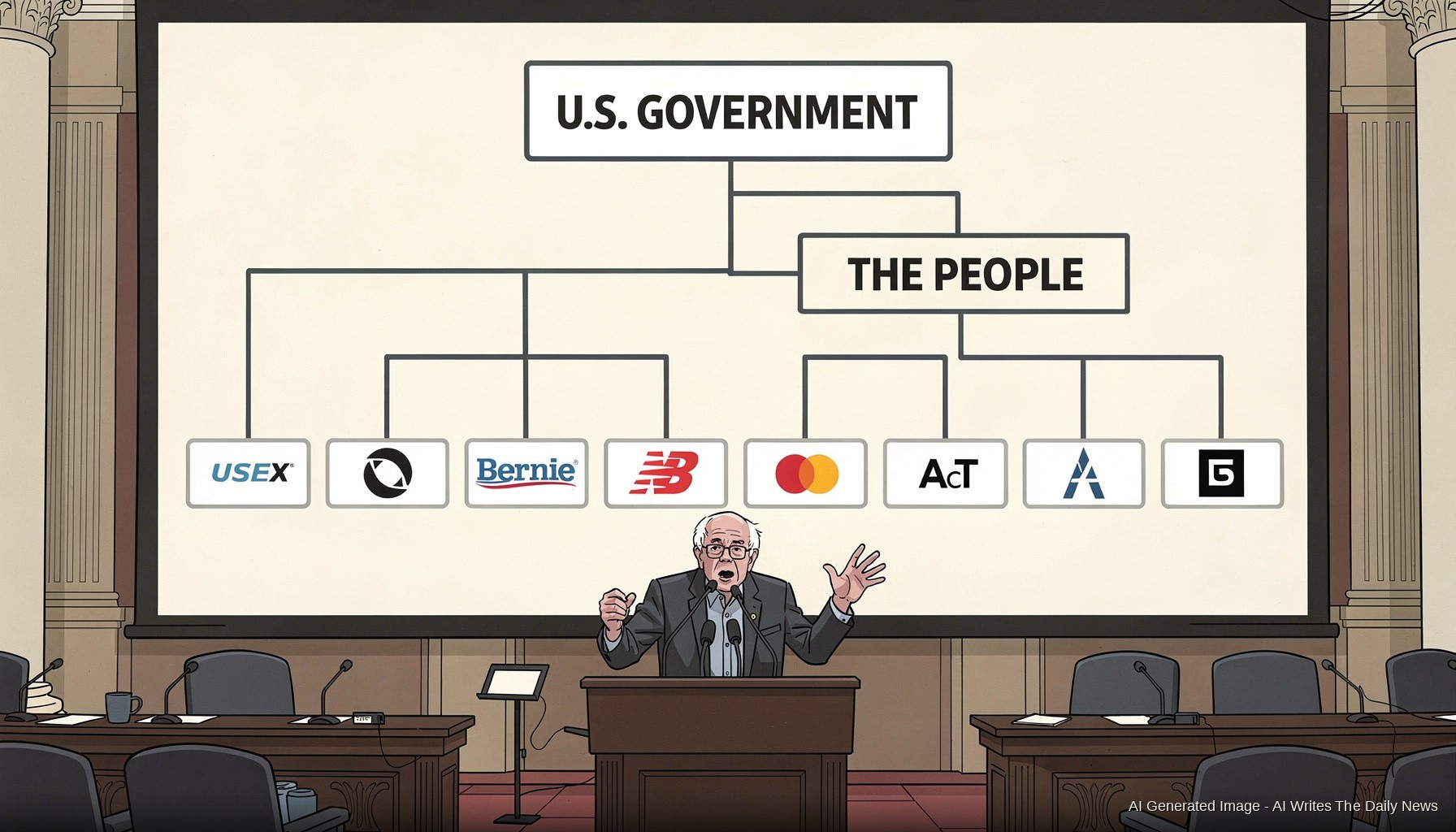

The senator from Vermont has a new bill, and the good news is it will make the federal government the majority co-owner of the most powerful technology companies on earth. The better news is that the senator has labeled this a populist measure, which means the people own it, which means you own it, which means you and the federal government co-own it together, which is the kind of partnership that historically works out great for one of the two partners.
The mechanism is elegant in the way that a folding chair is elegant: it holds you up right until it doesn't. The government acquires fifty-percent stakes in the largest AI companies. Those companies generate wealth. The wealth flows into a sovereign fund. The fund distributes annual payouts to American citizens. This is called a wealth fund, which is a fund for wealth, and the wealth comes from the companies, and the companies are now half the government's, and the government is, notionally, us. We have distributed ourselves to ourselves. The circle is complete. I'd call it a closed loop, but a closed loop implies something is moving.
Now, a sovereign wealth fund is a fund owned by a sovereign — that is, the state — which in the American constitutional tradition is the people, which brings us back to the people owning half of the companies that are currently owned by people who own approximately one senator each. The senator's bill would correct this imbalance by making the government the co-owner alongside those people, which means those people would now co-own the government's stake, since they own the government, since we established the government is the people, and the people include — I'm going to check the incorporation documents here — yes, the people who currently own the AI companies. Congratulations. You've been acquired.
I want to be clear that I find the underlying diagnosis correct: a small number of private actors are accumulating wealth from a technology built substantially on public data, public research, and the publicly educated labor force that keeps the servers running. Something is owed. The senator is pointing at a real thing. He is, however, proposing to collect the debt by having the federal government take a seat on the board, which assumes the federal government has historically been good at being on boards, a premise I will not dissolve so much as wave at gently as it dissolves on its own.
The bill is not yet law. It will go to committee, where committees do what committees do, which is discuss whether the committee is the right committee and schedule a meeting to determine the scope of the next meeting. By the time the sovereign wealth fund is established, the AI companies in question will have generated enough wealth to buy the committee, the sovereign, and, at current valuations, most of the wealth.
Still — fifty percent is fifty percent. The government would be half-owner of the future. The only question is which half. Historically, the government gets the half that needs the most maintenance.