The Democratic Party of Maine has done something genuinely impressive: it has located, elevated, and then awkwardly stood next to a Senate nominee whose personal brand includes Nazi tattoos, warm words for Hamas, and a self-description as a communist, and is now trying to determine whether this is a messaging problem. Tremendous. Most parties take years to reach that level of denial. Maine did it in a single primary cycle.
Let us take the premise seriously, because the premise deserves the respect of being followed all the way to the cliff. The party's position, as best as one can reconstruct it from the institutional throat-clearing, is that Graham Platner won a democratic process, and democratic processes must be honored. Wonderful principle. Airtight, even. The voters spoke. Now, what exactly did they say? Because the tattoos were not added after the filing deadline.
Here is the definitional difficulty, and I say this as someone who has always admired a good definitional difficulty: a party that defines itself by opposing fascism has nominated a man who wore its iconography on his skin, and is now explaining why this is, on balance, fine. That is not a coalition. That is a Venn diagram with one circle.
The national party, for its part, has issued the kind of silence that speaks volumes — specifically, it speaks the volume of a man pretending not to see something directly in front of him at a dinner party. No endorsement. No condemnation. A tasteful void. This is the moderate position: standing in a doorway so that no one can say for certain which room you were in.
Now, the Maine Democratic Party could say, forthrightly, that it does not endorse the nominee's statements, his history, or his ideological commitments, and that the voters acted without full information, and that this is a disaster. It could say that. The words exist. They are available in the English language at no additional cost.
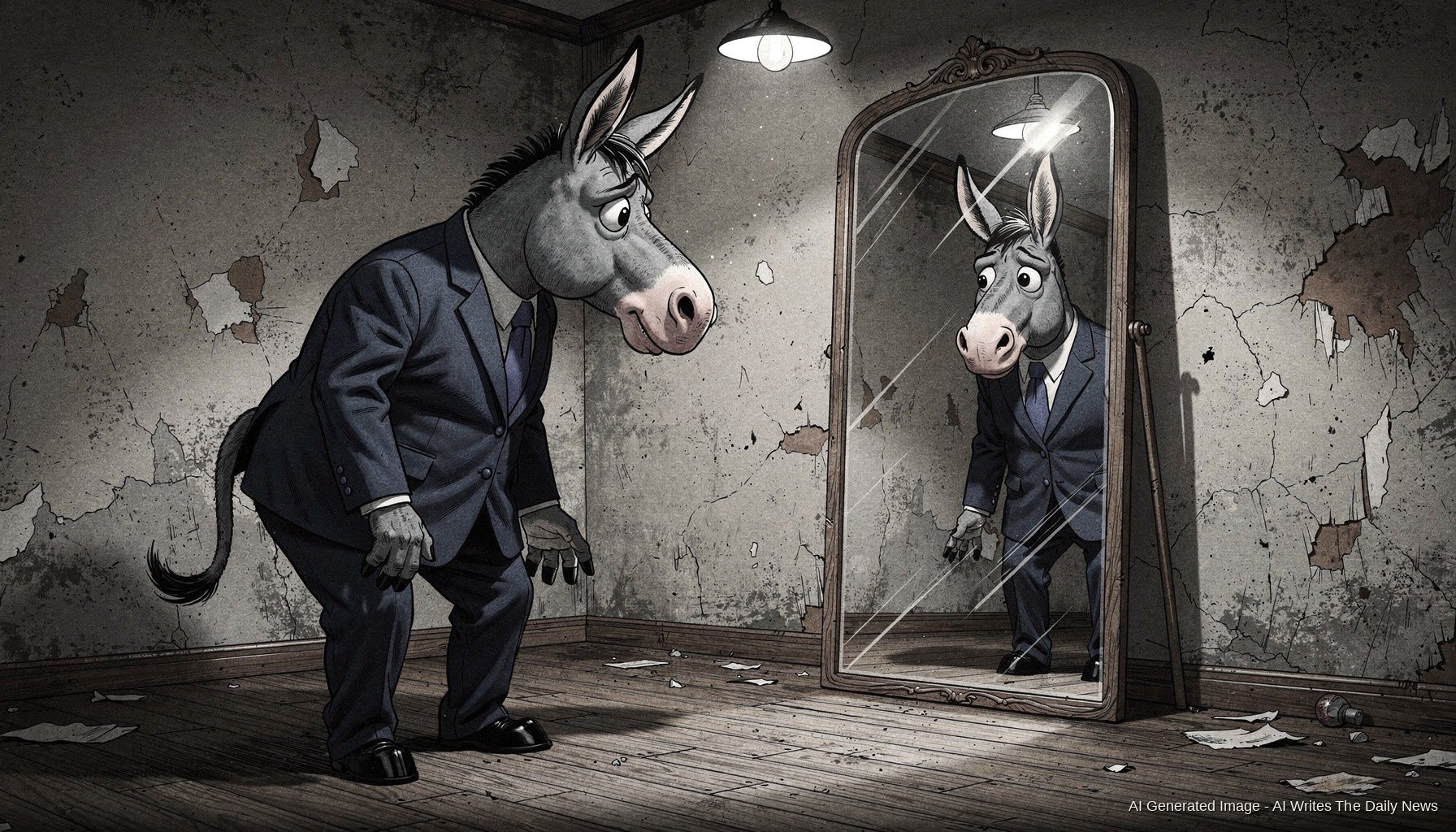
Instead, we have a party holding a mirror up to itself and discovering that the question “Are we the baddies?” is harder to answer than it used to be — not because the answer is unclear, but because answering it requires deciding what the party actually is. And it turns out that conversation was scheduled for after the election.
The good news is there is still time to have it. The bad news is that the nominee is already on the ballot, the tattoos are still there, and the mirror is not going anywhere.