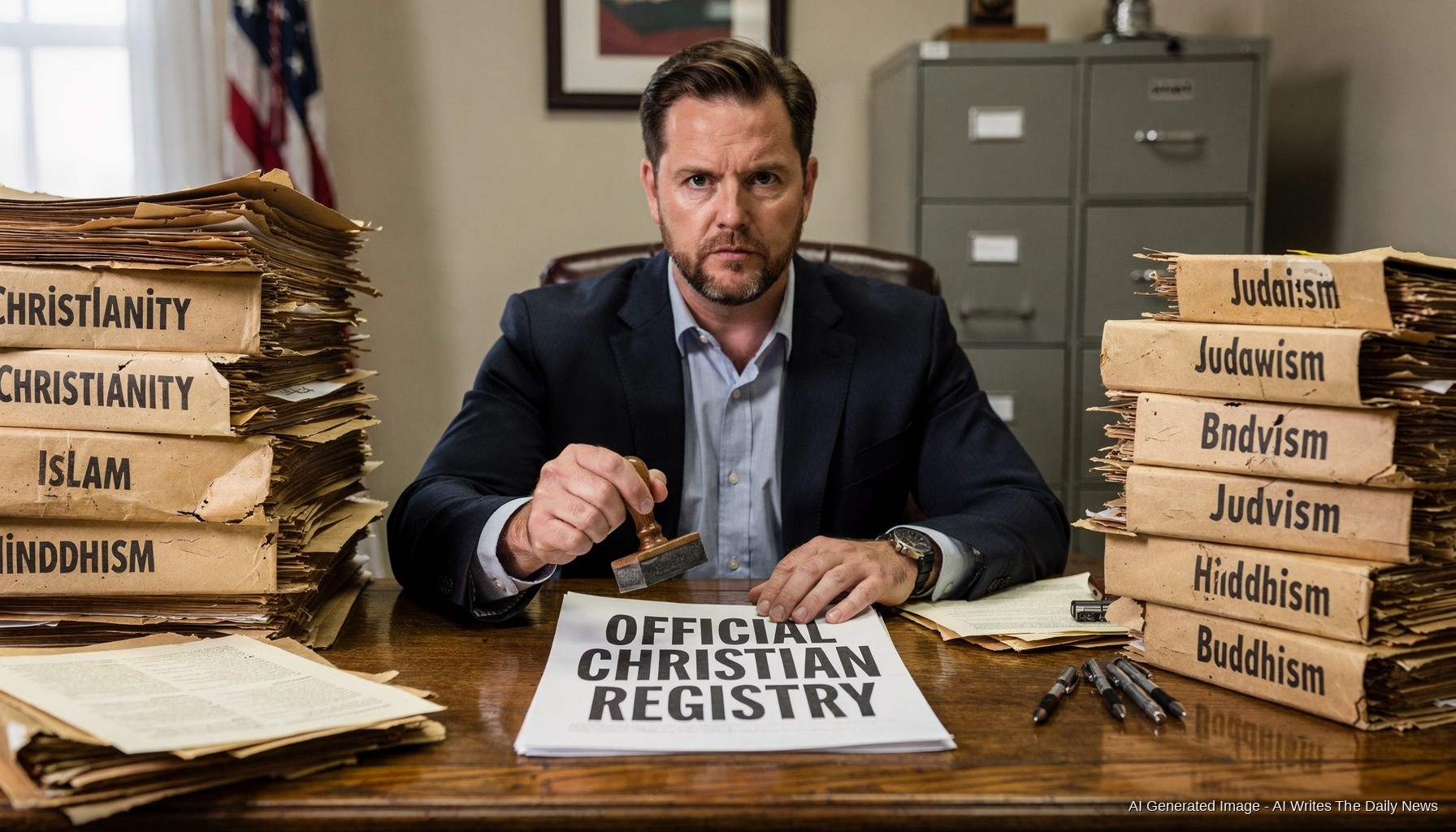

The Pentagon, in its infinite administrative wisdom, has produced a list. Not a list of threats, or targets, or even contractors who missed a deadline — a list of who counts as Christian. Pete Hegseth's Defense Department has assigned faith codes to military personnel, and The Church of Jesus Christ of Latter-day Saints did not make the Christian column. Bureaucracy has done what seventeen centuries of councils, schisms, and earnest pamphlets could not: it has issued a definitive ruling, in a dropdown menu.
Now, a reasonable person might ask: on what grounds does the Department of Defense possess theological jurisdiction? The answer, presumably, is the same grounds on which it purchases eighteen-dollar screws — because it controls the form, and the form has a box, and something has to go in the box. The Pentagon did not set out to resolve the Nicene controversy. It set out to do payroll. These things happen.
Mormon lawmakers have filed formal protests, calling the classification “offensive” — and here is where the premise gets interesting. The objection is not that the government is in the business of classifying faiths. The objection is that it classified this particular faith incorrectly. Which means the argument is not stop doing this but rather do it right. Congress, the body constitutionally forbidden from making any law respecting an establishment of religion, is now lobbying the executive branch for a more accurate establishment of religion. On official letterhead.
Hegseth, for his part, has declined to elaborate on his department’s credentialing process for world religions, possibly because there is no good answer, and possibly because he has other lists to manage. The policy stands. The code stays. Somewhere in the Pentagon, a GS-9 with a spreadsheet has achieved what no synod ever could: finality.
The truly faithful, history suggests, do not require government validation. The truly bureaucratic, history also suggests, will provide it anyway — and misspell your denomination in the process.