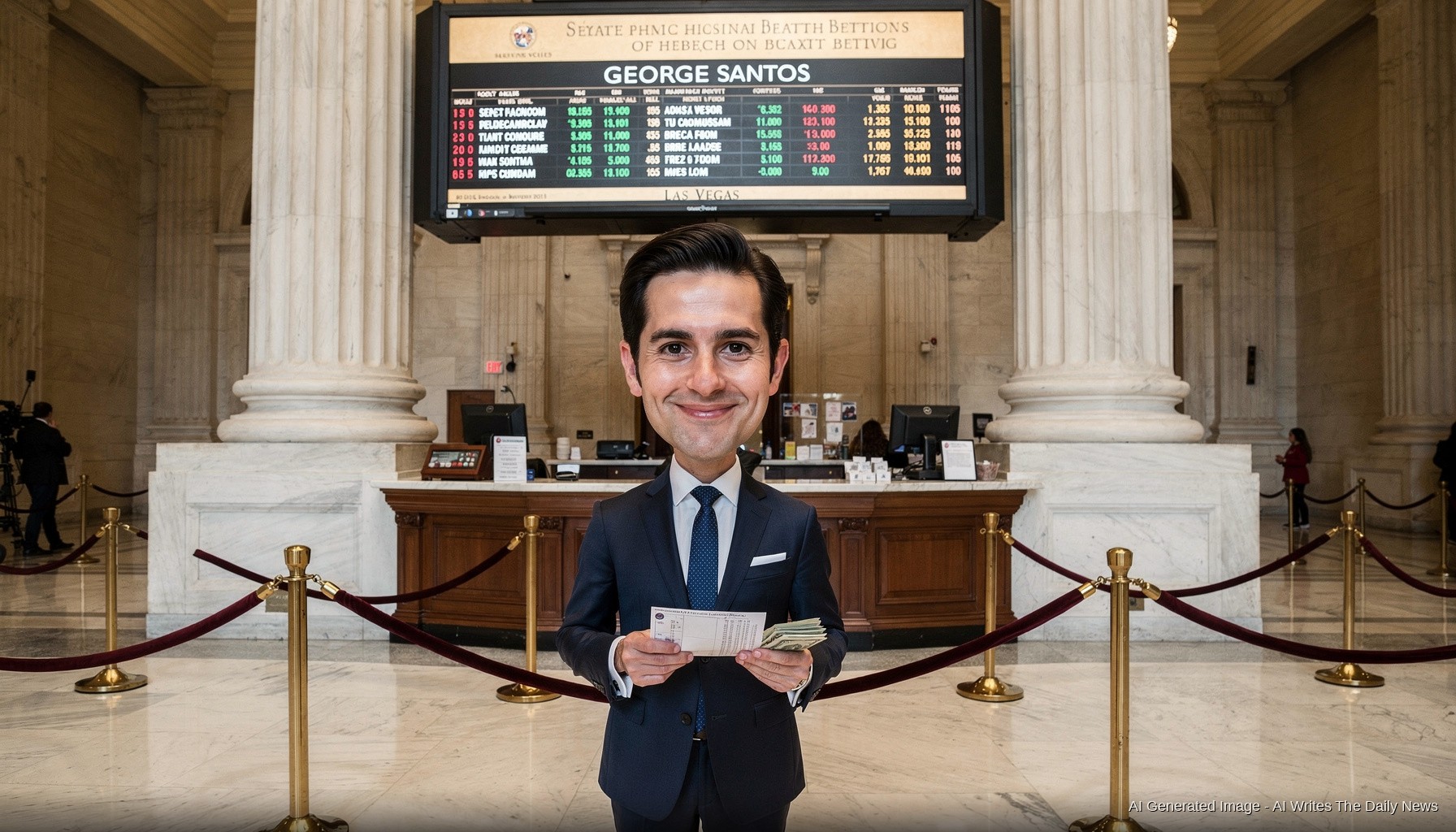

Let us begin with the premise, because the premise deserves a moment of respectful silence before we dissolve it. A man — formerly a congressman, technically a person — placed a wager on a prediction market on the question of whether he, himself, would attend the State of the Union address. He then, one assumes, attended the State of the Union address. He then, one further assumes, collected the winnings. Federal investigators are now said to be looking into this sequence of events. And somewhere in Washington, a grand jury is presumably being asked to evaluate whether a man cheated at knowing his own plans.
This is a fraud investigation. Into a man who allegedly committed fraud by having accurate information about himself.
The thing about insider trading is that it requires inside information — secrets about a company, a deal, a merger, the kind of knowledge that crosses a line because the other side of the market cannot possibly know what you know. What Santos allegedly knew, in this formulation, is whether Santos was going to get in a car and go somewhere. The inside information is the intention. The intention belonged to the man whose intention it was. He had, in the legal parlance, access to himself.
Now, a reasonable person might ask: can a man defraud a prediction market by correctly predicting his own behavior? And the answer, apparently, is yes — at which point I would gently note that the entire prediction market industry is premised on the idea that people with better information should win money from people with worse information. They just meant better information about other people. Santos, in his customary fashion, did not read the fine print. Or he read it and decided it did not apply to him. Or he invented a version of it that said it didn’t. It’s genuinely hard to tell with this particular man.
What strikes me as most elegant about this situation — and I use “elegant” the way a structural engineer uses it after watching a bridge fall — is that the government is now in the position of prosecuting a man for the one piece of information he could not possibly have gotten from anyone else. Every other Santos investigation concerned things he allegedly fabricated. This one concerns something he actually knew. In a career defined by invention, the feds finally caught him telling the truth about something, and that something turns out to also be illegal.
You have to respect the geometry of that, even as you refuse to respect anything else about it.