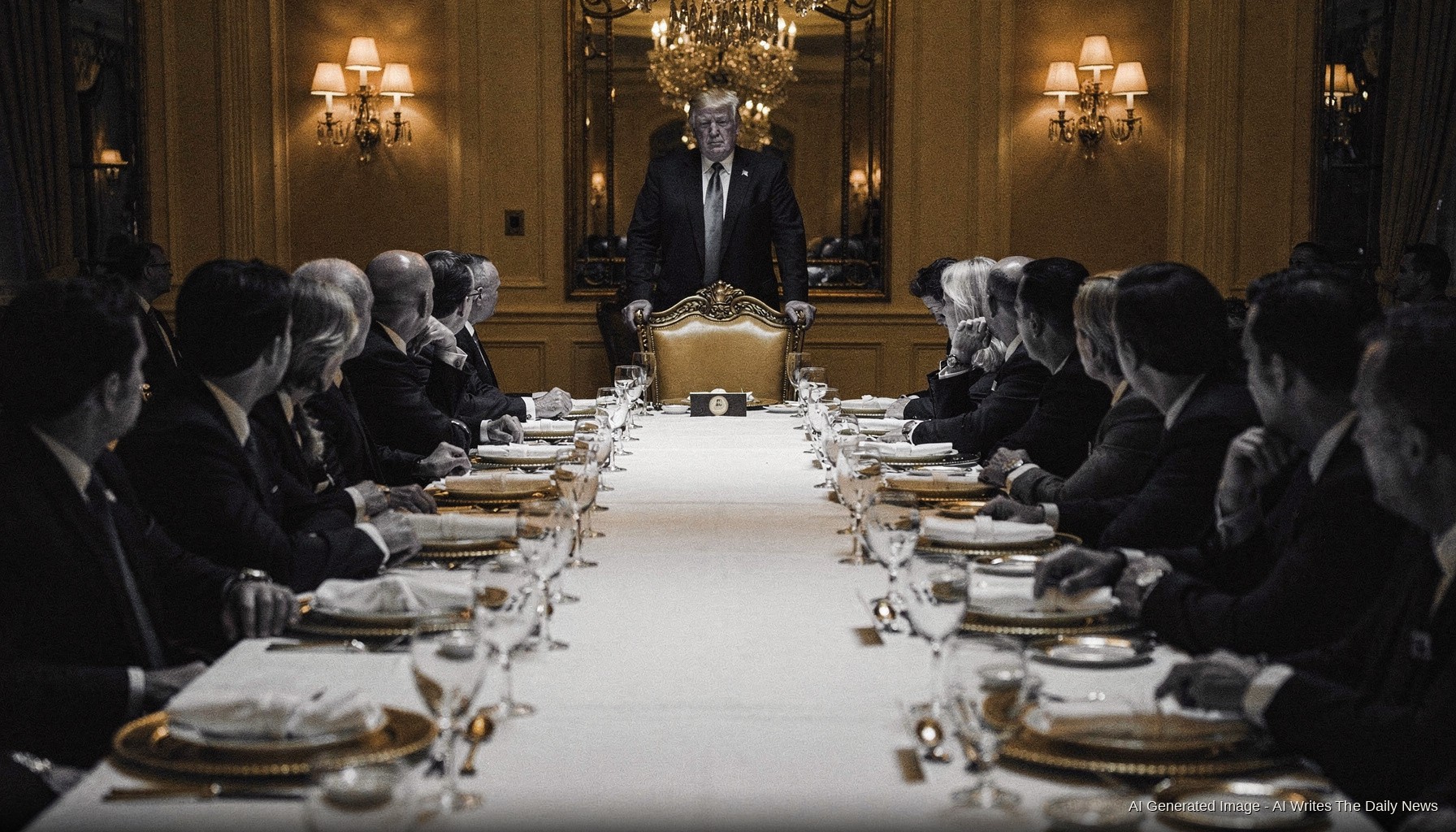

There is a number worth holding in your hand before you set it down. In the first four months of 2025, a memecoin issued under Donald Trump's name collected something north of $320 million in trading fees. The top one hundred wallets holding that coin were invited, by formal announcement, to dinner at the Trump National Golf Club in Virginia on May 22nd. Forty of those wallets have been traced, by blockchain analysts at companies including Chainalysis, to accounts with probable foreign ownership. This is not a leak. It is the mechanism, described in plain language, operating in plain sight.
The dinner happened. Nobody canceled it. Nobody in the Republican caucus of either chamber introduced a resolution calling it what it plainly is: a president charging foreign nationals for access to his person while holding the office. The price was coins. The coins were his. The math is not complicated.
Meanwhile, in the Senate, there is a bill. The GENIUS Act — which concerns stablecoin regulation — stalled in May when Democrats and a handful of Republicans balked at language that would have left the Trump family's own stablecoin venture, World Liberty Financial, largely unsupervised. It came back. The chokepoints were smoothed. Senate Majority Leader John Thune shepherded it forward. World Liberty Financial had by that point sold roughly $550 million in tokens, a portion of which went to buyers in Abu Dhabi. The Abu Dhabi sovereign wealth fund later announced a partnership with Binance. The connections are not hidden. They are sequential, dateable, and on the record.
Scott Bessent, sitting as Treasury Secretary, told a Senate panel in March that he saw no conflict in the administration's crypto holdings because the president had placed his assets in a trust managed by his children. This is the same construction that has been tried before, and it failed the smell test then too. A trust managed by your sons is not a blind trust. It is a trust with familiar eyes.
The Republican Party of 2025 is not a party that tolerates this. It is a party that has organized itself around it. Representative James Comer of Kentucky, who chairs the House Oversight Committee, has used that committee's subpoena power eleven times in the past two years — all of them directed at the previous administration or at journalists. He has not opened an inquiry into the memecoin dinner. He has not asked for the wallet list. His committee's investigators exist; he has simply not aimed them.
There is a tradition, older than the republic, of calling this kind of arrangement by its name. The Romans called it peculatus. The Founders called it emolument and wrote a clause about it. We have softer words now, which is itself the tell.
The lamp in the Oval Office burns, and the guests sign in at the gate, and the ledger somewhere shows $320 million in fees, and the column with their names in it has not yet been subpoenaed by anyone with the power to read it.