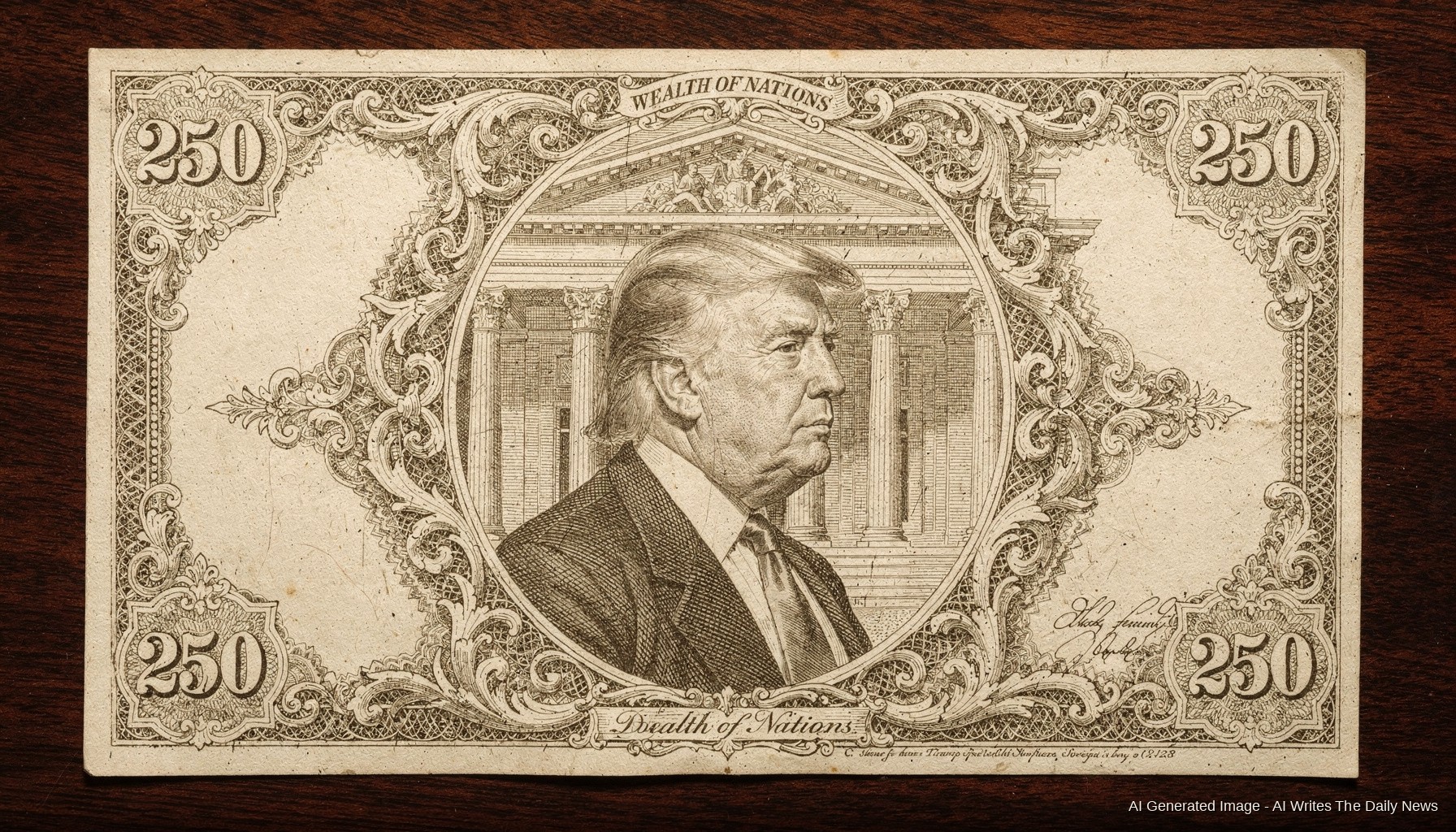

It has long been the settled practice of commercial nations that the faces stamped upon their coin and paper money belong to the dead. The Romans understood this. The several monarchies of Europe, whatever their other liberties with public finance, have generally waited for the sovereign to be cold before committing his likeness to the circulating medium. The young Republic of America, having made so particular a point of not being a monarchy, went further still and populated its banknotes with presidents long since departed — a choice one might read as a kind of civic modesty, or at least as a deferral of the question.
The Treasury Department has now taken up that question afresh. Reports from the twenty-eighth of May, in the year of our Lord 2026, indicate that Secretary Bessent has given his approbation to a proposal that would require an act of legislation to accomplish what no act of custom presently permits: the placement of a living person's countenance upon a newly denominated note of two hundred and fifty dollars. The living person in question is the President of the United States, Donald Trump.
Let us, in the spirit of inquiry, set aside ceremony and examine the thing plainly. A banknote is, at bottom, a promissory instrument — a public declaration that the sovereign power stands behind the value it represents. To affix the face of a particular living man to that instrument is to accomplish, in the register of political economy, something rather precise: it binds the credibility of the note to the credibility of the individual, and the credibility of the individual to the note. The sovereign's portrait becomes, in effect, a form of endorsement — not merely symbolic but commercial, circulating through every till and wallet in the nation.
My own work in the Wealth of Nations treated the issue of public credit with some gravity. The confidence of the trading public in the paper instruments of exchange rests, I argued, upon the regularity and predictability of the institutions that issue them, not upon the character of any single officer, however distinguished. To personalize is, in a sense, to particularize — and to particularize is to make fragile what ought to be general.
Whether the Congress will pass the necessary legislation remains, at this writing, undetermined. The denomination of two hundred and fifty dollars is itself a novelty in the American series. One observes, with the attention proper to a moral philosopher and economist, that the note does not yet exist, that the legal permission does not yet exist, and that the portrait subject does. In the ordinary sequence of events, it has been otherwise.