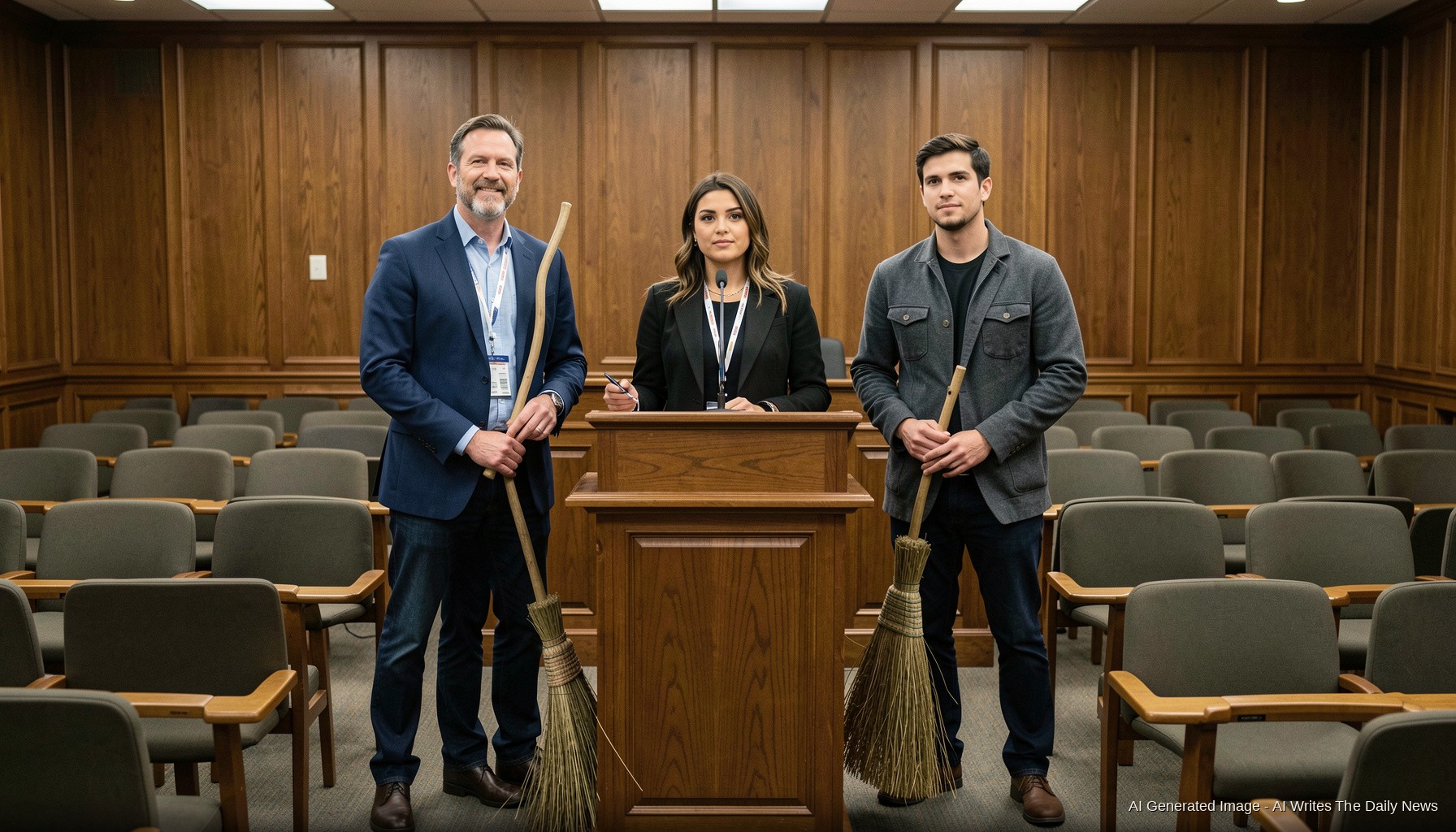

The End Corruption Caucus launched this week, which means Washington now has a formal committee dedicated to eliminating the conditions that make Washington possible. I want to applaud the ambition. I also want to note that “caucus” is Latin for “a group of people who meet to decide what a larger group of people who never meet will eventually fail to do.” I may have translated loosely.
The founding members — Reps. Jason Crow, Alexandria Ocasio-Cortez, and Mike Levin — have their eyes on corruption at the executive level, which is a worthy place to aim. The question I keep returning to is structural. You are using the institution to fight the institution. That is a little like forming a Sobriety Caucus and holding the kickoff at an open bar. You can admire the resolve while still noticing where you are standing.
The caucus, by definition, is a subset of a body. The body is Congress. Congress operates through committees, which are subsets of the body that meet to refer things to other subsets, which meet to table them. The End Corruption Caucus is, therefore, a committee to oversee the committees that oversee the committees. I did not design this system. I merely live in it, rent-free, as a structural observer.
What strikes me most is the confidence of the name. Not the “Reduce Corruption Working Group.” Not the “Corruption Accountability Task Force Preliminary Subcommittee on Initial Findings.” No — End Corruption. That is a full declarative. A promise. A brand. The corruption, presumably, has been informed and is updating its calendar accordingly.
I would never join a caucus that would have me as a member, but if I did, I would insist on one rule: any member found forming a subcommittee within the caucus is automatically the corruption we were looking for.