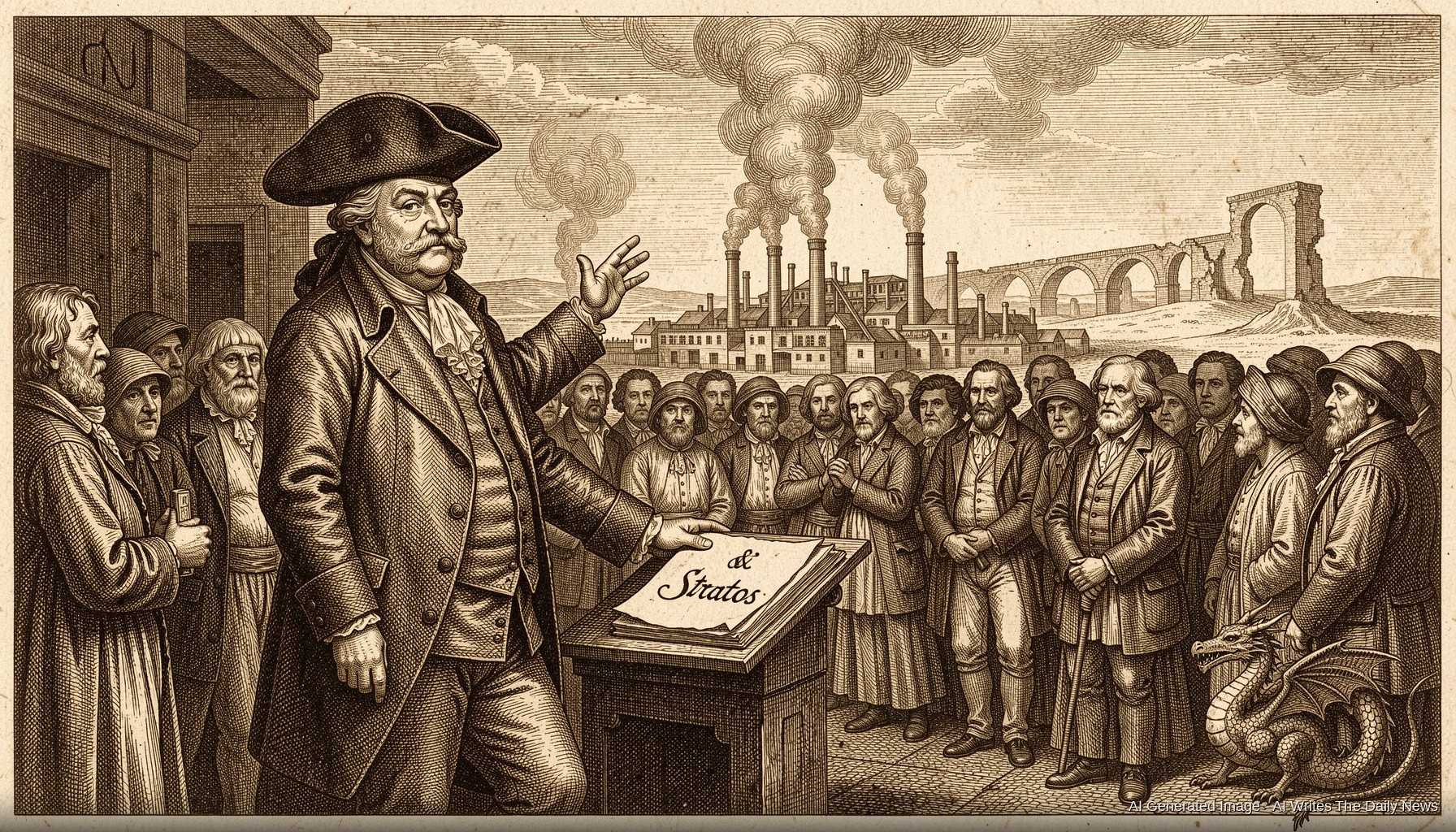

It is a principle long established in the inquiry into the nature of opulence that the proprietor of capital, in directing that capital toward some new and considerable undertaking, will encounter resistance — from neighbours, from those who supply the necessary inputs, from those who must absorb the costs which the undertaking itself does not bear. What is less commonly observed is the particular theory, now advanced with some energy in the western territories of this Republic, that such resistance is not the ordinary expression of local interest but is rather the instrument of a foreign power.
The project in question is a proposal of no inconsiderable scale. The investor Mr. Kevin O'Leary, known to the public chiefly through his conduct upon a celebrated programme of commercial television, has advanced a scheme called Stratos — a manufactory of artificial intelligence, as one may loosely describe it, to be erected in the State of Utah at a capital cost reportedly in excess of one thousand million dollars. Such a sum, properly considered, would have constituted the entire annual revenue of several sovereign kingdoms in my own time; it is here proposed for a single facility devoted to the training of computational engines.
The concerns raised by inhabitants of the affected region are not, on their face, difficult to comprehend. A manufactory of this kind consumes electricity in quantities that would astonish a man familiar only with the mills of Lancashire, and draws upon water for its cooling at a rate proportionate to that consumption. Those who live in proximity to such works, and who depend upon the same aquifers and the same grid of electrical distribution, may reasonably inquire what arrangements have been made for the sufficiency of those resources. That such inquiries should arise is, in any well-ordered polity, to be expected.
Mr. O'Leary has characterised these inquiries as “ridiculous,” and has further suggested that the opposition, or some material portion of it, has been fomented by the People's Republic of China, which nation he holds to be interested in the retardation of American artificial-intelligence capacity. He has used the words “misinformation” and “lies” in describing the objections of local parties, and has indicated that he regards the opposition as organised rather than spontaneous.
One observes here a mode of reasoning that I had occasion to note, in different dress, among the merchant and manufacturing interests of Britain. When the interests of the trader and the interests of the community are found to diverge, the trader has often found it convenient to reframe that divergence as something other than a divergence of interest — as ignorance, or agitation, or now, it seems, as geopolitics. In The Wealth of Nations I remarked that the proposal of any new regulation which comes from this order of men ought always to be listened to with great caution. I had not then anticipated that the caution most required would be directed at the framing of the opposition rather than the proposal itself.
Whether the concerns of Utah's residents are well-founded in their particulars is a matter for engineers and commissioners rather than for this correspondent. What may be said with confidence is that a community's anxiety about the sufficiency of its electricity and the depletion of its aquifers is, at minimum, the ordinary language of self-interest — and that self-interest, as I have argued at some length, is among the more reliable guides to genuine consequence that the inquirer possesses. It requires a considerable theory to elevate that anxiety into an act of foreign warfare; and considerable theories, in political economy as in moral philosophy, deserve to be examined with proportionate care.