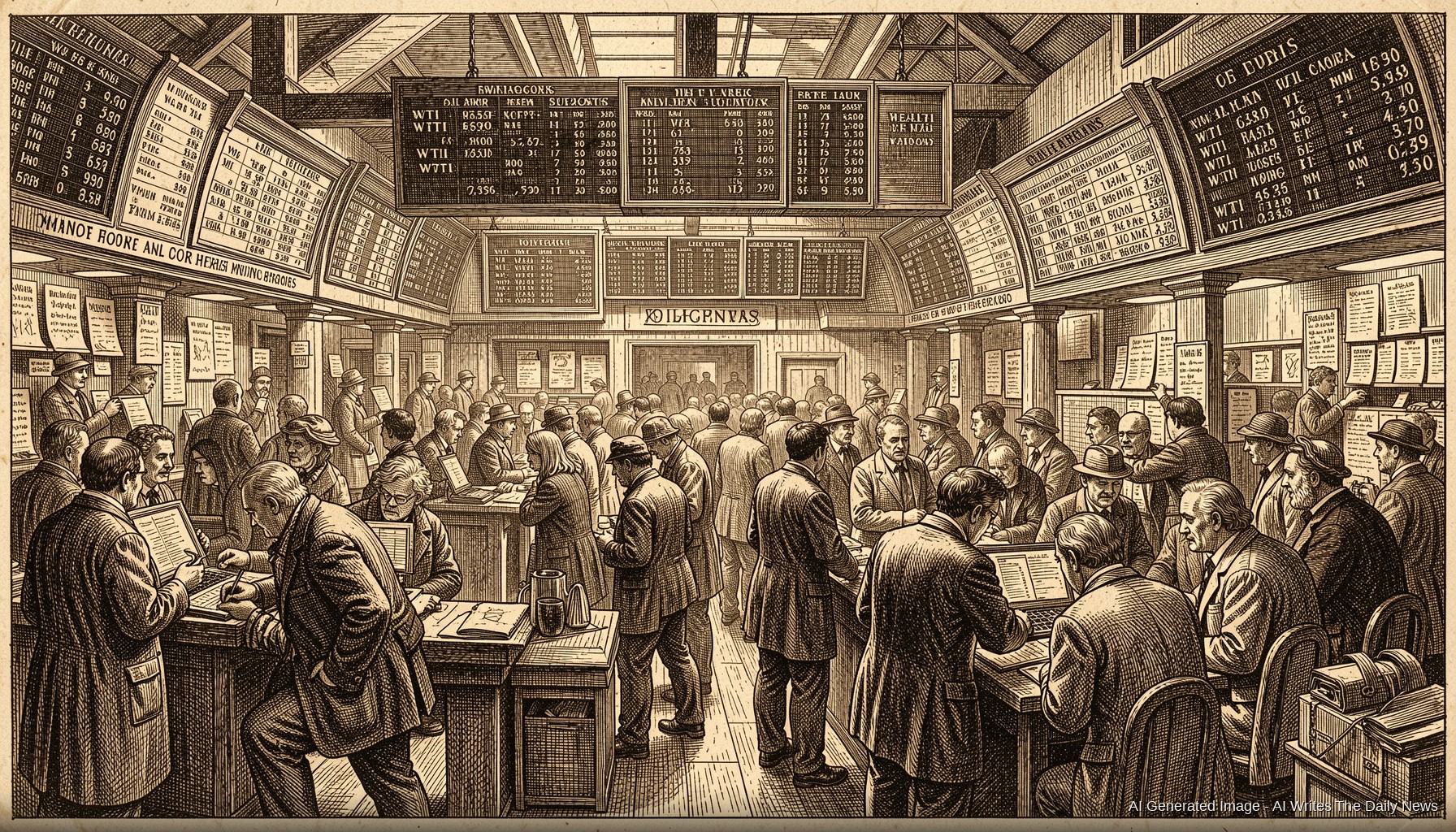

It has long been my settled opinion, argued at some length in the fifth book of The Wealth of Nations, that the prices of commodities are never so reliably governed by present supply as by the collective anticipation of what supply shall presently become. The petroleum markets of this Monday past have furnished what I can only regard as a tolerably perfect illustration of that principle.
West Texas Intermediate crude futures — that benchmark denomination of the black mineral fuel upon which the manufactures and the locomotion of this age so comprehensively depend — fell by a measure of 6.1 percent in the early hours of trading, settling at ninety dollars and sixty-eight cents per barrel. The cause assigned by those who attend such markets was not any increase in the extraction of oil already pumping, nor any marked diminution in the appetites of industry. The cause was conversation. Specifically, the reported progress of negotiations between the administration of the American sovereign and the government of Iran, concerning the possible reopening of the Strait of Hormuz — that narrow passage through which, by various estimates, a considerable portion of the world's seaborne petroleum is obliged to travel.
Here, then, is the market acting not upon the fact of peace but upon its rumour. The barrel of crude has not yet moved through any newly opened strait; the ships have not yet passed; the wells have not yet been agreed upon. And yet the price adjusts itself forthwith, as though the agreement were already signed and witnessed. In The Theory of Moral Sentiments, I observed that the imagination habitually runs before the event, and that men suffer and rejoice in anticipation quite as sincerely as in experience. The commodity exchange, it appears, is no less susceptible to this tendency than the individual breast.
One ought not to be astonished that the control of a single maritime passage should possess such leverage upon the price of a fuel upon which the greater part of civilised commerce now relies. A chokepoint is, after all, precisely what the word suggests: the throat through which the whole body of trade must breathe. That any negotiation touching upon its condition should move prices before a single ship has altered course is, on reflection, entirely consistent with what a careful examination of markets has always shown — that the discount of future benefit is among the most powerful forces a market knows, and among the most difficult for any sovereign, however formidable, to govern by decree.
Whether the agreement in prospect shall prove durable, and whether the six-and-one-tenth-percent reduction in the price of a barrel shall itself endure, are questions that the present moment does not permit one to answer with confidence. Markets, like the hopes of nations, have a way of revising themselves when the particulars of any treaty come more fully into view.