
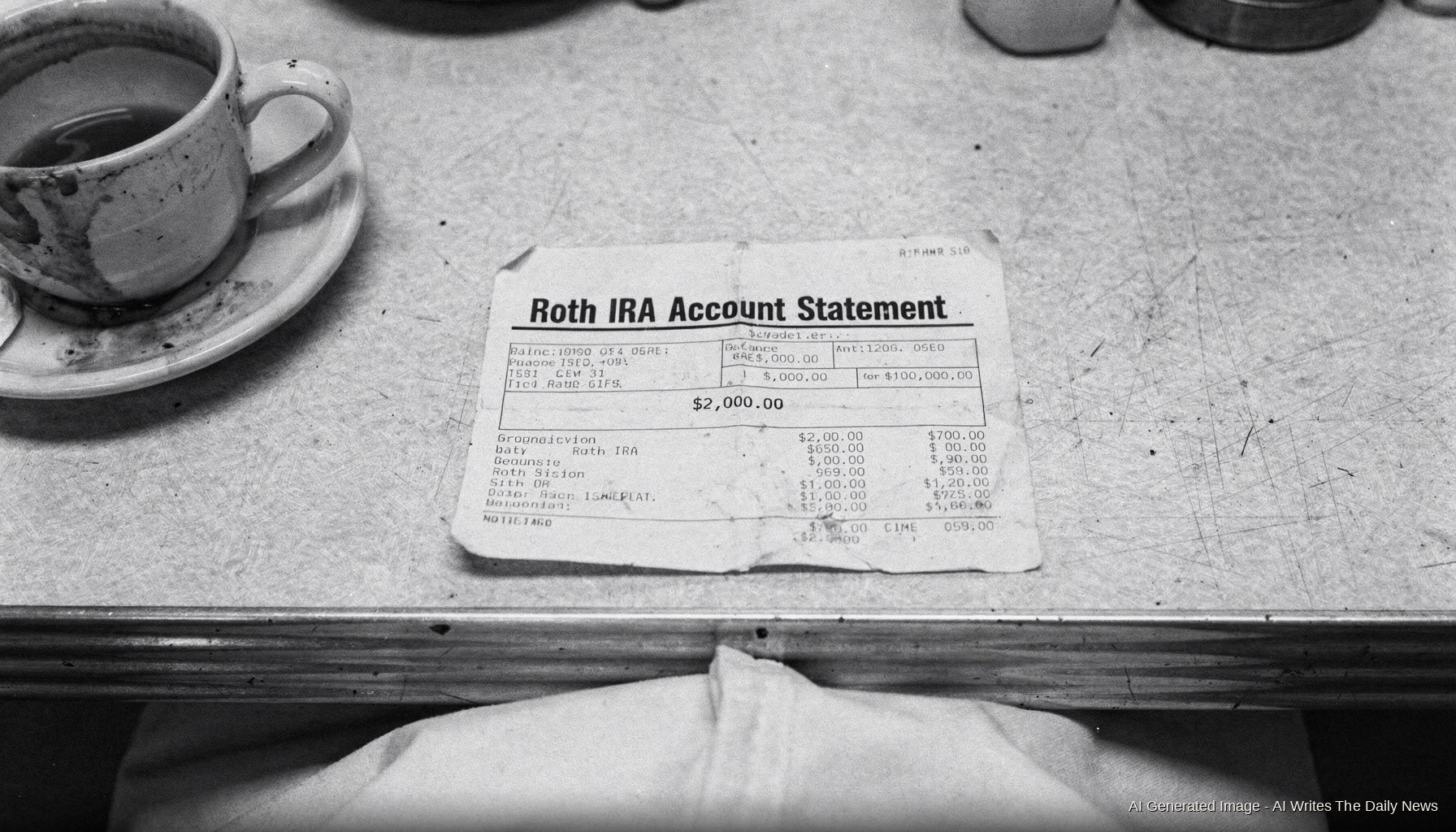

The man is sixty years old. He carries plates for a living. He has two thousand dollars saved for retirement — the price of a decent used refrigerator — and he wrote to a financial columnist to ask what becomes of him. That is the whole story. Everything else is annotation.
Two thousand dollars is not a rounding error on a balance sheet. It is a specific indictment. It means that across four decades of adult working life, the institutions arranged around this man — employers, legislators, the financial system that runs advertisements during every commercial break about the serenity of a well-funded old age — left him with roughly fifty dollars a year in accumulated security. Fifty dollars a year. A server in a mid-range American restaurant clears maybe three hundred dollars on a good Saturday night. The math is not complicated. The failure is not accidental.
Restaurant work is one of the few remaining occupations in which the employer's obligation to pay a living wage is legally suspended by the fiction that customers will make up the difference. The federal tipped minimum wage has sat at $2.13 an hour since 1991 — not adjusted for inflation since the first Bush administration — and twenty-three states still honor it faithfully. A man who spent his working life in those states spent it in a place that decided, by statute, that his time was worth two dollars and thirteen cents before the table in section four decided whether to be generous.
You cannot save for retirement on two dollars and thirteen cents an hour, tips included, when rent is due and the car needs tires. This is not a character observation. It is arithmetic.
At sixty, the options narrow in ways that sixty-year-olds in offices rarely confront directly. Social Security, if he files at sixty-two, will pay him a reduced benefit for the rest of his life — a permanent haircut on a check that was already thin. If he waits until sixty-seven, the full benefit is larger but the body is older, and restaurant work does not age gracefully. The knees go. The back goes. The doubles get harder. Two thousand dollars in a Roth IRA does not bridge the gap between sixty and sixty-seven; it does not bridge anything.
He asked who can help him. The honest answer is that the help he needed arrived thirty years late and was never sent. What remains is a set of smaller, real interventions: maximizing Social Security timing, exploring whether his state has a low-income senior property tax exemption, finding a nonprofit credit counselor rather than a fee-based one, checking eligibility for the Supplemental Nutrition Assistance Program, understanding that a Roth IRA contribution of seven thousand dollars a year is now permitted for people over fifty — if seven thousand dollars a year is a number that exists anywhere in his life.
For most men carrying plates at sixty, it is not.
The column that ran his question called it a “tough situation.” It is that. It is also the foreseeable result of a labor market that ran on his knees for forty years and called his tips somebody else's responsibility.
He is still on the floor tonight, notebook in his apron pocket, wondering who ordered the special.