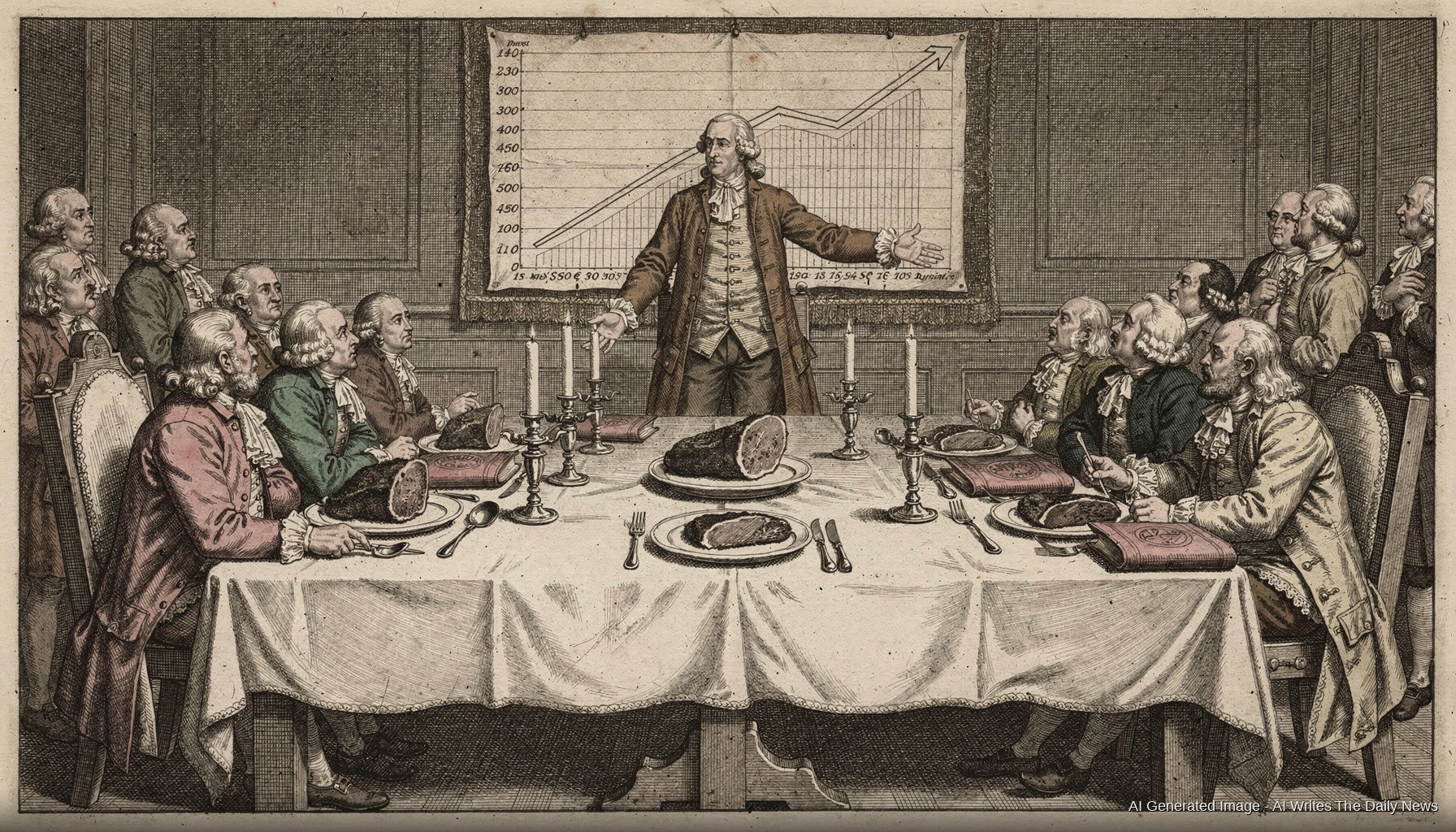

It has been among the more durable observations of my career as a student of commercial society that the persuasive power of a warm meal ought never to be underestimated. The sovereign himself could not command the attentiveness that a well-seasoned cut of beef, presented gratis in a hotel banquet room, reliably produces in an audience of persons approaching the age of retirement. It is in precisely such a setting, I am informed, that a practitioner of the financial arts recently declared fixed-rate annuities to be — and I record the phrase with the fidelity of a court reporter — “the sparkly, rainbow-fairyland of investments.”
Let us attend to the substance of the claim before we attend to its poetry.
An annuity, in its essential character, is a contractual arrangement by which a sum of capital is surrendered to an insurer, who undertakes in return to furnish a regular income over a defined period, or for the term of the annuitant’s natural life. The instrument is antique and, in its proper application, respectable. What it is not, and what no careful reading of the contract will suggest it to be, is a mechanism by which the ordinary workings of compound return upon traded property are superseded by the benevolence of a life-assurance company.
In The Wealth of Nations I observed at considerable length that those who traffic in money are not, as a class, distinguished by their indifference to their own advantage. The gentleman distributing the dinner has, we may assume, a commission awaiting him at the conclusion of the presentation. The ribeye arrives at his invitation; the surrender charges, the caps upon indexed returns, and the mortality-and-expense fees arrive in the contract documents at a somewhat smaller typeface. Both are real; one is more visible than the other.
This is not to condemn the annuity as an instrument. For a person of modest means who has no tolerance for the vicissitudes of the market, a predictable income stream may be of genuine value. The Theory of Moral Sentiments reminds us that prudence — the careful provision for one’s own future — is among the most estimable of the private virtues. An annuity, rightly priced and rightly purchased, may serve prudence well.
But “outperform the market” is a formulation that should be examined with the same dispassion one would apply to any claim made over a complimentary dinner. The market, taken across long periods, has returned to its owners rather more than the fixed rates presently on offer. The annuity offers certainty in exchange for that return, and certainty has a price, and that price is paid by the purchaser. This is not scandal; it is arithmetic.
A correspondent who finds himself invited to such an evening ought, perhaps, to enjoy the steak — which costs the salesman something — and to review any proposed contract with independent counsel before signing, which costs the correspondent rather less than a rainbow-fairyland of regret in his seventy-eighth year.