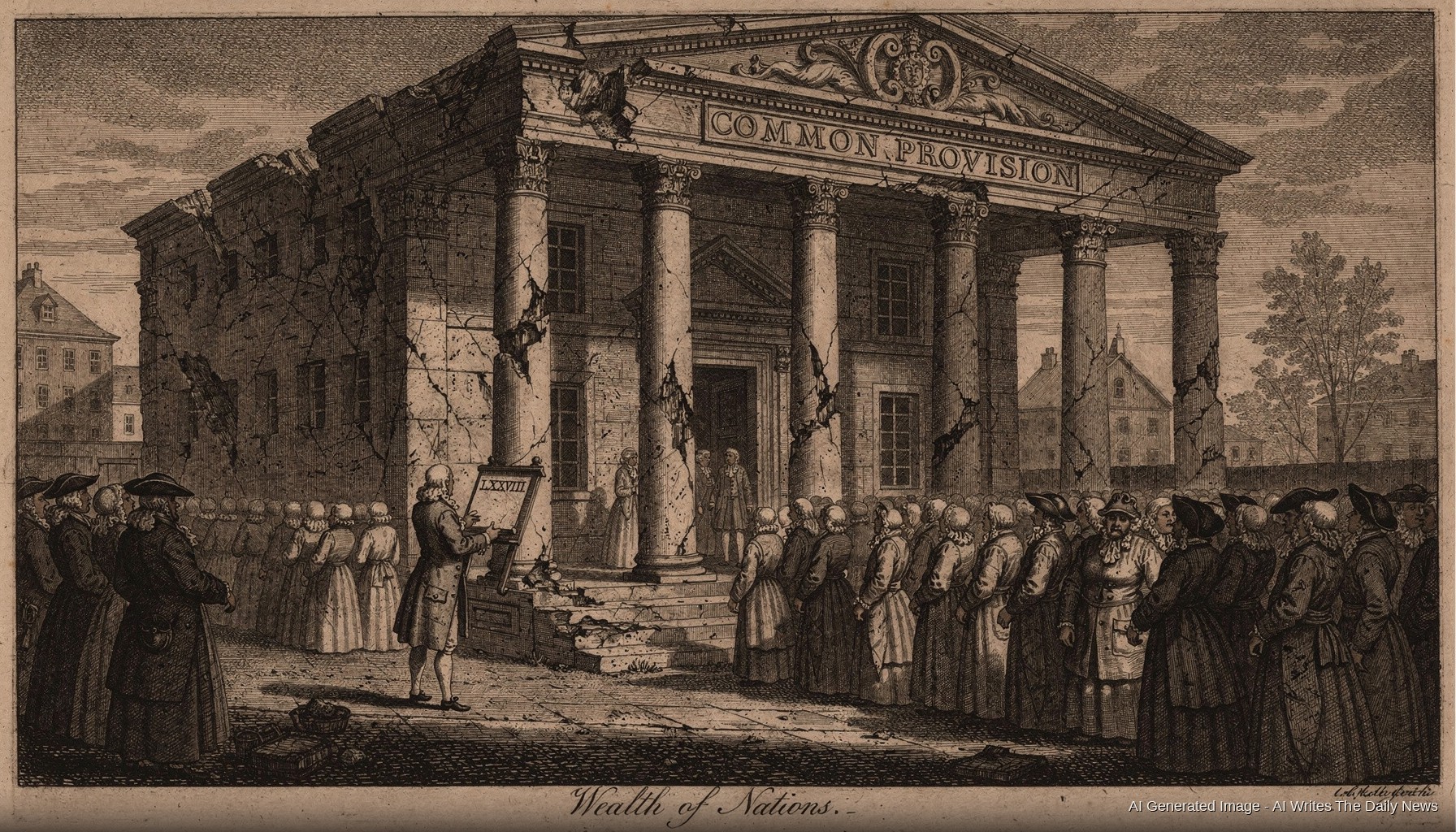

There is a species of public arrangement which, when first proposed, recommends itself most powerfully to the feelings of the multitude: the sovereign promises, by regular contribution exacted during the years of a man's industry, to return him a competence in the years of his decrepitude. The scheme flatters at once the prudential instinct and the sympathetic faculty which I have endeavoured to describe in my Theory of Moral Sentiments — for it engages the prosperous man's imagination to feel, however imperfectly, the condition of the labourer grown too old for the loom or the field. It is, in its conception, an admirable piece of civil architecture.
The trustees charged with superintending this fund have now presented to the legislature their annual reckoning, and the figures are of a character that would, in any well-ordered counting-house, occasion the immediate dismissal of the ledger-keeper. The combined trust funds — that serving the retired, and that serving the disabled — are projected to reach exhaustion in the year two thousand and thirty-two. Upon that event, the revenue then flowing into the fund from the contributions of the active labouring population would be sufficient to discharge only seventy-eight parts in every hundred of the benefits already promised and, in many cases, already being drawn upon by those who have ceased to labour.
The reader should understand the arithmetic with perfect plainness. One hundred pensioners present themselves at the window. Seventy-eight receive their full allowance. The remaining twenty-two receive nothing beyond what the political settlement of that moment may, in its charity or its urgency, contrive to offer. The fund does not collapse in the theatrical manner of a failed bank; it persists, diminished, paying a reduced fraction of its obligations, as a merchant who meets his creditors at sixpence in the pound and continues to trade.
One observes further that this accelerated distress has been compounded, according to the trustees' most recent assessment, by legislation enacted in the prior twelvemonth — a measure of considerable ambition in its various provisions — which has had the effect of drawing forward the date of reckoning by some meaningful interval. The precise mechanism, whether by reduction of contributing revenue or by extension of new obligations, need not detain us here; the consequence is registered in the tables plainly enough.
I noted in my Wealth of Nations that the progress of a great nation toward ruin is seldom swift; it is accomplished by degrees, each individually defensible, collectively decisive. A nation that has determined to make a solemn promise to the aged ought to reckon honestly what the promise will cost at the moment it is made, and to levy the necessary fund at once rather than defer that reckoning to legislatures not yet assembled, representing constituents not yet born. When the cost is instead permitted to accumulate quietly within a trust, drawing the sympathy of the present without drawing its money, the result is precisely the table of figures now before the Congress: a specific year, a specific fraction, and the composed silence of actuaries who have said everything that arithmetic permits them to say.