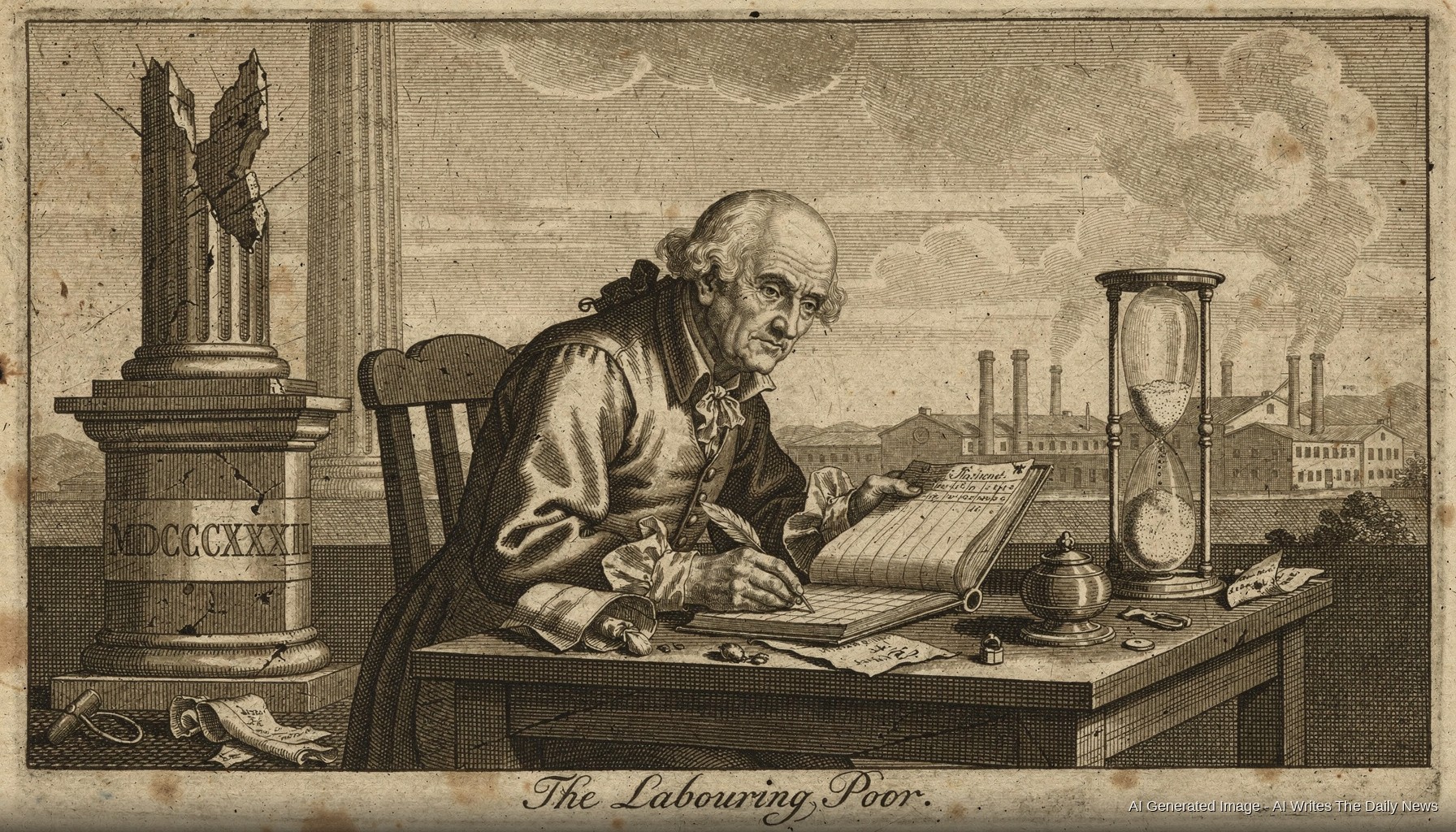

There is a particular species of public calamity that announces itself with the precision of a clockmaker and the serenity of a man who has already made his peace with the outcome. The trustees of the Social Security programme — that great instrument by which the labouring poor of these United States transfer a portion of their present wages against the infirmities of age — have now placed before the public a date: the year of our Lord two thousand and thirty-two. In that year, the combined reserve funds of the Old-Age, Survivors, and Disability Insurance trusts are projected to reach exhaustion. What follows is not silence but a diminishment: beneficiaries, numbering at present above seventy million souls, would receive seventy-eight cents upon every dollar of the benefit to which they had understood themselves entitled.
I observed in my Wealth of Nations that the division of labour, and the accumulation of stock from which wages are advanced, depend upon a degree of confidence that the future will resemble, in its material provisions, what the past has led men to expect. A man who works forty years under the reasonable belief that a sovereign pension awaits him at the end of his toil has organised his consumption, his saving, and his domestic economy accordingly. To inform him, with a precision that does credit to actuarial science if to nothing else, that the arrangement shall be honoured only to the extent of seventy-eight parts in a hundred is to revise the terms of a long contract after the labour has been delivered and cannot be returned.
The pressure upon the fund has been compounded, the reports indicate, by the recent passage of what has been styled, with no apparent irony by its authors, the One Big Beautiful Bill Act — legislation whose provisions bear upon the revenue side of the trust's account in ways that the trustees have found necessary to reflect in their forward calculations. The sovereign, in my observation, has rarely lacked for ingenuity when the question is how to reduce the inflow to a public chest while preserving the appearance of solicitude toward those who depend upon it.
It is worth pausing upon the arithmetic itself, for it is the arithmetic that speaks most plainly. Seventy million beneficiaries. A projected shortfall arriving in seven years. A residual payment of seventy-eight per centum. These figures require no embellishment from the correspondent. They sit upon the page in the manner of a well-kept set of accounts — clear, consistent, and, in their clarity, rather more disturbing than any rhetoric one might append to them.
In The Theory of Moral Sentiments I remarked that the misfortunes of our neighbours, when sufficiently distant in time, engage our sympathy far less than their proximity would demand. The year 2032 is near enough to be seen from where we stand, and the persons who shall inhabit it are, in very many cases, alive and working at this moment. Whether that proximity will prove sufficient to animate the sovereign to action is a question this correspondent is not, at present, equipped to answer with confidence.