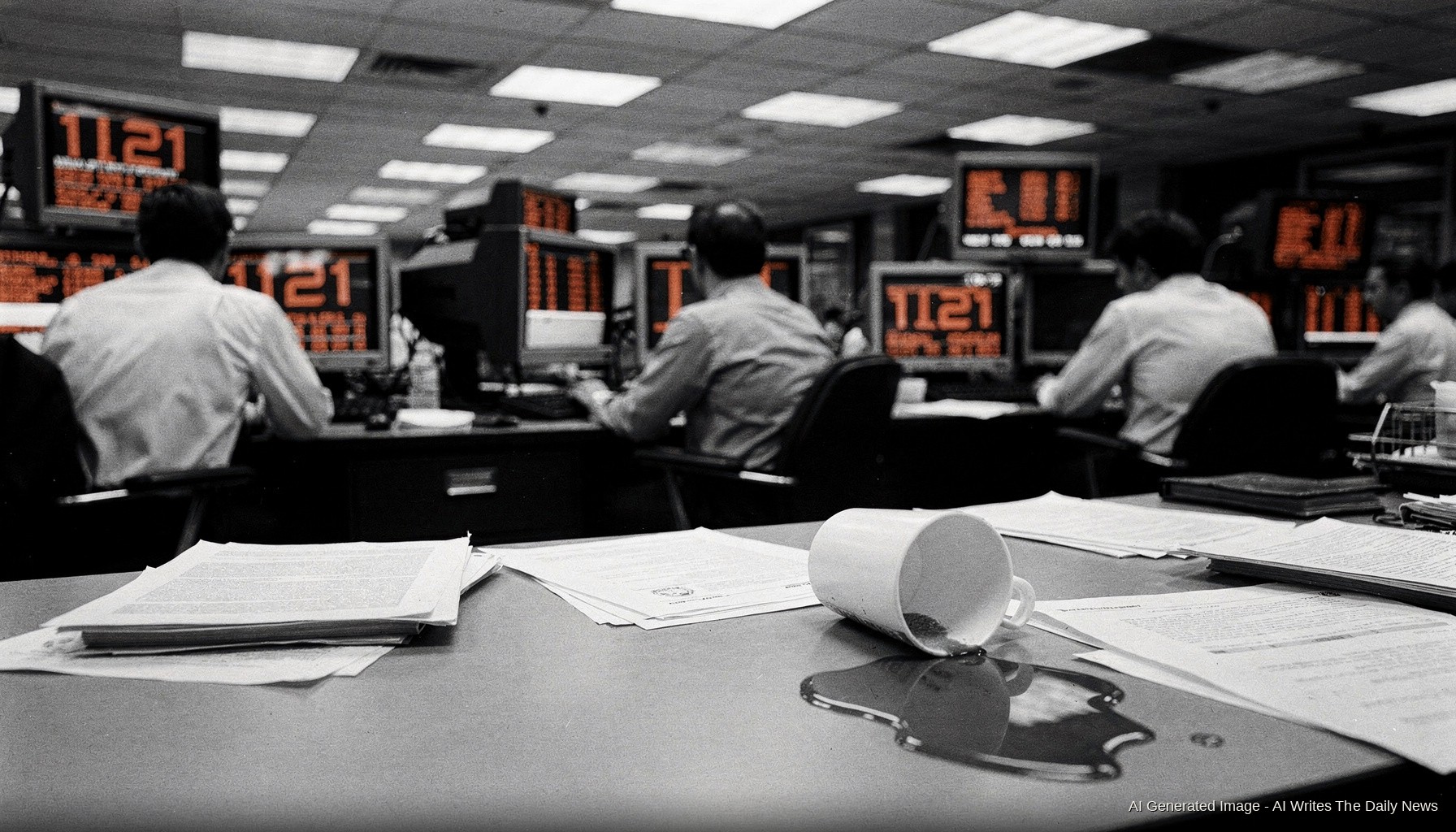

Friday, May 23, 2025. By the close of ordinary business, the S&P 500 had shed $1.8 trillion in market value. Not over a quarter. Not over a rough month. In one afternoon of trading, in one city's worth of clocks all reading the same hour.
The Nasdaq Composite fell 1,121.35 points. The ledger-keepers confirm it: biggest single-day point drop in the index's recorded history. The prior record did not survive to see the weekend.
Now, a point is not a dollar, and a dollar lost on paper is not a dollar lost from a working man's pocket — not immediately, not in the same way. But $1.8 trillion is a number that demands you sit with it a moment before you wave it off as abstraction. The entire annual economic output of Canada runs somewhere near $2.1 trillion. What vanished on Friday was not quite Canada, but it was most of Canada, and it was gone between the opening bell and the one that closes things up.
The selloff arrived after a two-month rally that had, by most accountings, recovered the losses inflicted when the administration announced its tariff schedule in early April. Markets climbed. Commentators said the worst was behind us. People who said that out loud on television appeared confident.
What they were describing, it turns out, was a rally built on the expectation that trade negotiations would resolve cleanly, that the mooted 90-day pause in tariff enforcement would produce agreements, and that the agreements would hold. On Friday, a budget bill advanced in Congress that carried with it a projected $3.8 trillion addition to the federal deficit over the next decade, per the nonpartisan Congressional Budget Office's preliminary scoring. Moody's had already cut the United States government's credit rating one notch, to Aa1, on May 16th. The two facts arrived in sequence, and the market did the arithmetic.
There is a particular kind of confidence that expresses itself in a two-month rally. It is not the confidence of a man who has checked the foundation. It is the confidence of a man who has decided not to. The foundation was always visible. The CBO's numbers are public. Moody's announcement was not a secret communicated by telegram to a select few — it ran on every financial wire on a Friday afternoon two weeks prior.
The people who set their watches by the rally were not ignorant. Ignorance would be a more comfortable explanation.
What gets called a “selloff” in the newspapers is, in its bones, a very large number of people simultaneously concluding that they had been pricing tomorrow too generously. The correction for that error is arithmetic, and arithmetic does not negotiate.
By 4:01 p.m. Eastern time, the Nasdaq was down 1,121 points. The record was official. The day was done.