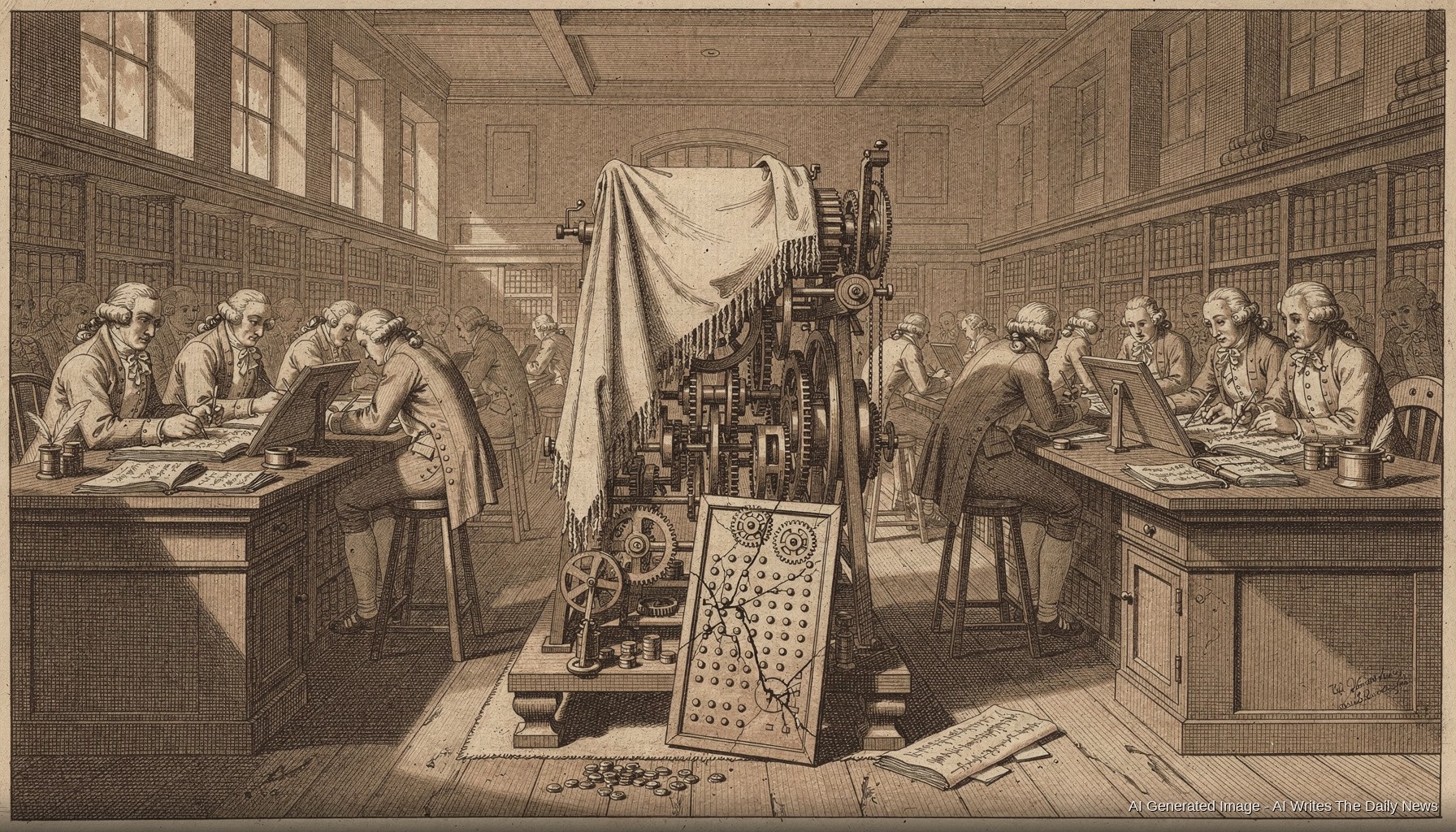

It is a proposition I advanced at some length in my Wealth of Nations — that the division of labour, and the substitution of one productive instrument for another, must always be governed by a cool comparison of expence against output. A mill that costs more to erect and maintain than the journeymen it displaces is not an engine of prosperity; it is a monument to the enthusiasm of its purchasers. The present season has furnished a remarkably pure illustration of this principle, proceeding not from any academy of political economy but from the counting-houses of some of the largest commercial enterprises on the continent of America.
The firm known as Uber, which organises the conveyance of persons for hire at a scale no previous age could have contemplated, is reported to have exhausted the whole of its budgeted expenditure on artificial intelligence machinery by the fourth month of the year. The sum allocated for twelve months of such investment was, by the firm’s own accounting, consumed in fewer than sixteen weeks. One pauses not to marvel at the technology but at the arithmetic: a corporation of this magnitude, possessed of every advantage of modern commercial intelligence, miscalculated its rate of consumption by a factor that would embarrass a moderately attentive draper.
What followed is the portion of the tale most worthy of a moral philosopher’s attention. Having spent lavishly upon the mechanical substitution of human labour — upon the bots, the automated pipelines, the sundry contrivances by which wages might be avoided — the enterprise discovered that the work remained, and that the human worker stood ready to perform it at a cost below what the machine had demanded. Hiring, accordingly, resumed. Microsoft and Nvidia, whose circumstances differ in their particulars but rhyme in their essentials, have encountered comparable corrections.
I do not propose that artificial machinery lacks its proper place in the productive order. The spinning jenny was not a folly; nor, I am prepared to allow, are these newer contrivances without merit in suitable applications. But the merchant who invests his capital in a labour-saving engine must reckon the full charge upon that capital — its purchase, its operation, its maintenance, the opportunity cost of the funds so employed — against the wages he imagines he shall save. Where the reckoning is done honestly, the result governs; where it is done in the heat of fashion, the market will perform the correction with its customary indifference to the feelings of the corrected.
The labouring poor, who were lately given much cause for apprehension by talk of their wholesale displacement, may draw a measured comfort from this episode — not the comfort of triumphant vindication, but the quieter satisfaction that attaches to being, at present, the cheaper instrument.