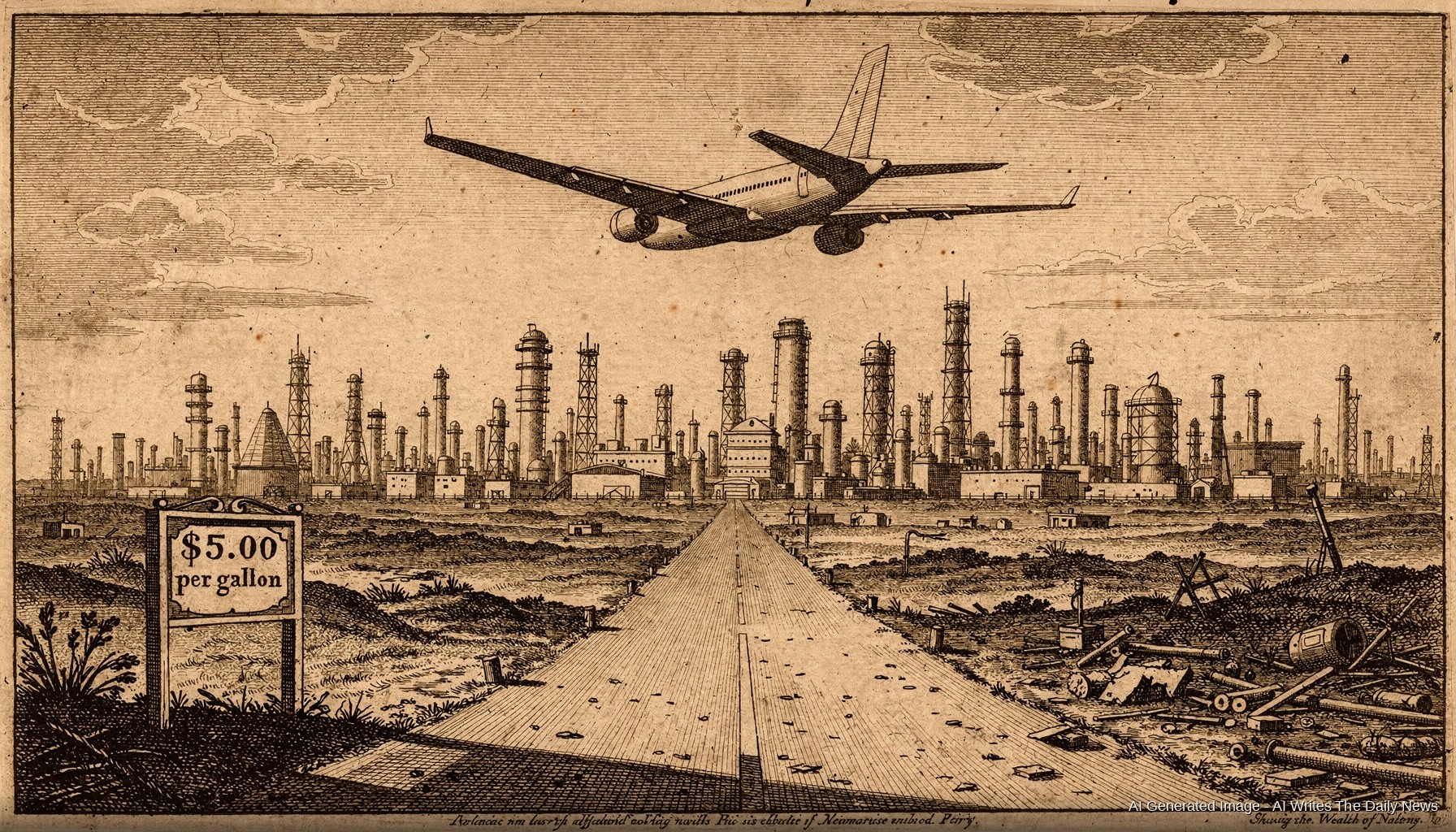

It is a principle I endeavoured to establish at some length in the Wealth of Nations that the proprietor of any manufactory will, in the ordinary course of his self-interest, direct his stock toward that employment which promises the greatest return. He does not do this out of benevolence toward the merchant who purchases his product, nor out of malice toward those he declines to serve. He does it because the incentive before him is plain, and because the market, left to its own operation, rewards precisely this kind of attentiveness. The difficulty arises when the aggregate of such individual decisions produces, for the labouring poor, a season of considerable inconvenience — and five dollars for a gallon of refined spirit, by the month of July or August of the present year, would constitute inconvenience of a most pressing kind.
What is reported to be occurring at the great refining establishments of the United States is, in its mechanics, entirely unremarkable. The apparatus that separates crude oil into its several products — naphtha, kerosene, distillate for the carriages of the road, and the lighter fractions required to sustain flight — is capable of some adjustment in its proportions. The operator of such a works may, within limits set by the nature of his equipment, favour one fraction over another. He will do so whenever the price offered by the purchaser of one fraction exceeds, by a sufficient margin, the price offered by the purchaser of another. At present, the commercial interests that operate the flying machines of the age find themselves in vigorous competition for refined fuel, and they are willing to pay accordingly. The refiner is not blind to this signal. He is, in the vocabulary of my own inquiry, doing precisely what a well-functioning market asks him to do.
The consequence for the person who drives a carriage upon the common road is that the portion of each barrel devoted to his purposes has been reduced, the supply tightened, and the price at the point of retail sale elevated in response. The mechanism is not conspiracy. It is not maladministration. It is the ordinary arbitrage of a commodity market operating across two classes of consumer whose competing demands have, at this particular moment, fallen into an uncomfortable alignment.
I observed in the Theory of Moral Sentiments that the spectator, properly constituted, is capable of a sympathy that extends beyond his own immediate situation. One might wish that such sympathy were equally available to the refiner when he turns his yield toward the sky and away from the road. But sympathy, however admirable a moral faculty, does not alter the arithmetic of the distillation column. The traveller who fills his carriage at the pump in the high summer will pay what the market, in its present configuration, has determined he must — and the market, for its part, will register no particular opinion on the matter.