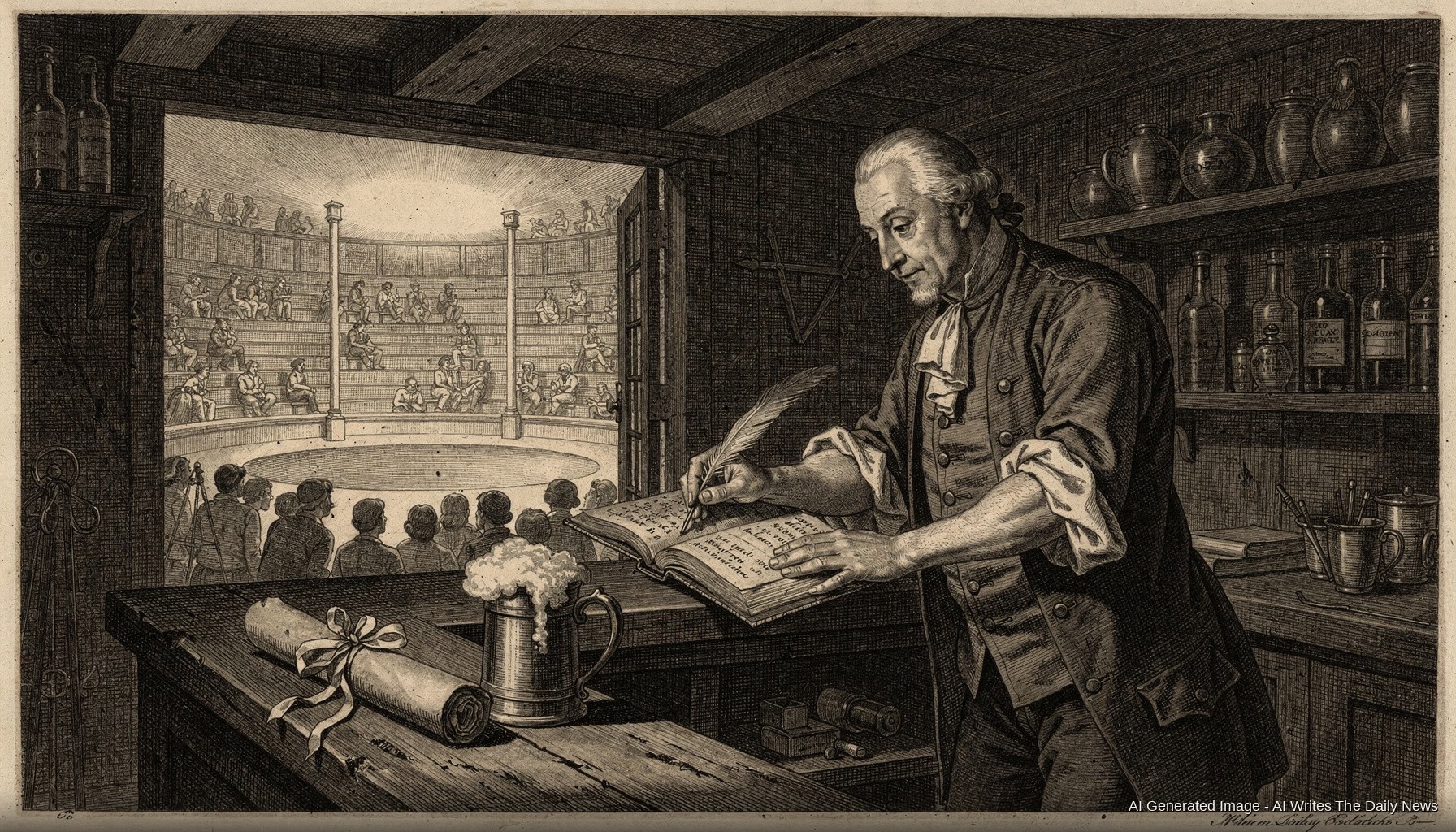

It has long been the argument of this correspondent, set out at some length in the fifth book of The Wealth of Nations, that the ingenuity of commercial society will, given sufficient time and sufficient incentive, find a market for any contingency that admits of uncertainty. I had not, I confess, anticipated that the contingency in question would be the victory of a sporting eleven — or, in the idiom of the present age, a club of five — but the principle holds.
A tavern-keeper in the city of New York, whose establishment draws its custom from the devotees of a basketball society known as the Knicks, has entered into a regulated contract on a platform called Kalshi — licensed, it is reported, by the federal body that governs commodity futures — whereby he stands to receive a sum of money in the event that his favoured club should win their contest. This sum, one understands, is calibrated to offset the revenue he would lose on that occasion, for when the Knicks prevail, his patrons depart in jubilation rather than drowning their sorrows through the continued purchase of spirituous liquors, which is the more reliably profitable of the two emotional states.
The instrument is, in its essential character, no different from the contract by which a merchant of corn purchases, in the spring, the right to sell his harvest at a fixed price in the autumn, protecting himself against the very abundance he has laboured to produce. The farmer hedges against a good harvest; the tavern-keeper hedges against a good game. That the underlying commodity is athletic triumph rather than bushels of wheat does not disturb the logic in the smallest degree.
I remarked in The Theory of Moral Sentiments upon the human capacity to feel the fortunes of others as acutely as our own. The tavern-keeper's position is a precise illustration: he wishes his club to win, as any sympathetic observer would, and yet his commercial interest requires that they should lose. The derivative contract resolves what sentiment cannot — not by altering the outcome of the game, which remains beyond the reach of any exchange, regulated or otherwise, but by ensuring that whichever passion is disappointed, the proprietor's ledger is at least partially consoled.
There is, in this arrangement, a species of commercial wisdom that the political economists of a later age will no doubt examine with great seriousness. A man has identified a risk peculiar to his trade, has found a willing counterparty to assume it, and has paid a premium accordingly. The sovereign collects its fee through the licensing of the platform. The counterparty accepts uncertainty in exchange for the prospect of gain. The invisible hand, as I have elsewhere described it, requires no knowledge of basketball to perform its customary office.
One observes only that the Knicks, having furnished this particular market with its reason for existence, bear a responsibility to remain uncertain enough in their prospects to keep the premiums honest.