
It has long been my observation, set down at some length in the Wealth of Nations, that the division of labour is the principal engine of opulence among nations. A pin-maker who draws the wire, another who straightens it, a third who cuts it — each performing but one small office — together produce in a day what a single unassisted hand could not accomplish in a year. I confess, however, that when I committed those reflections to the press in 1776, I had not fully reckoned with the possibility that the hand performing each office might belong to no man at all.
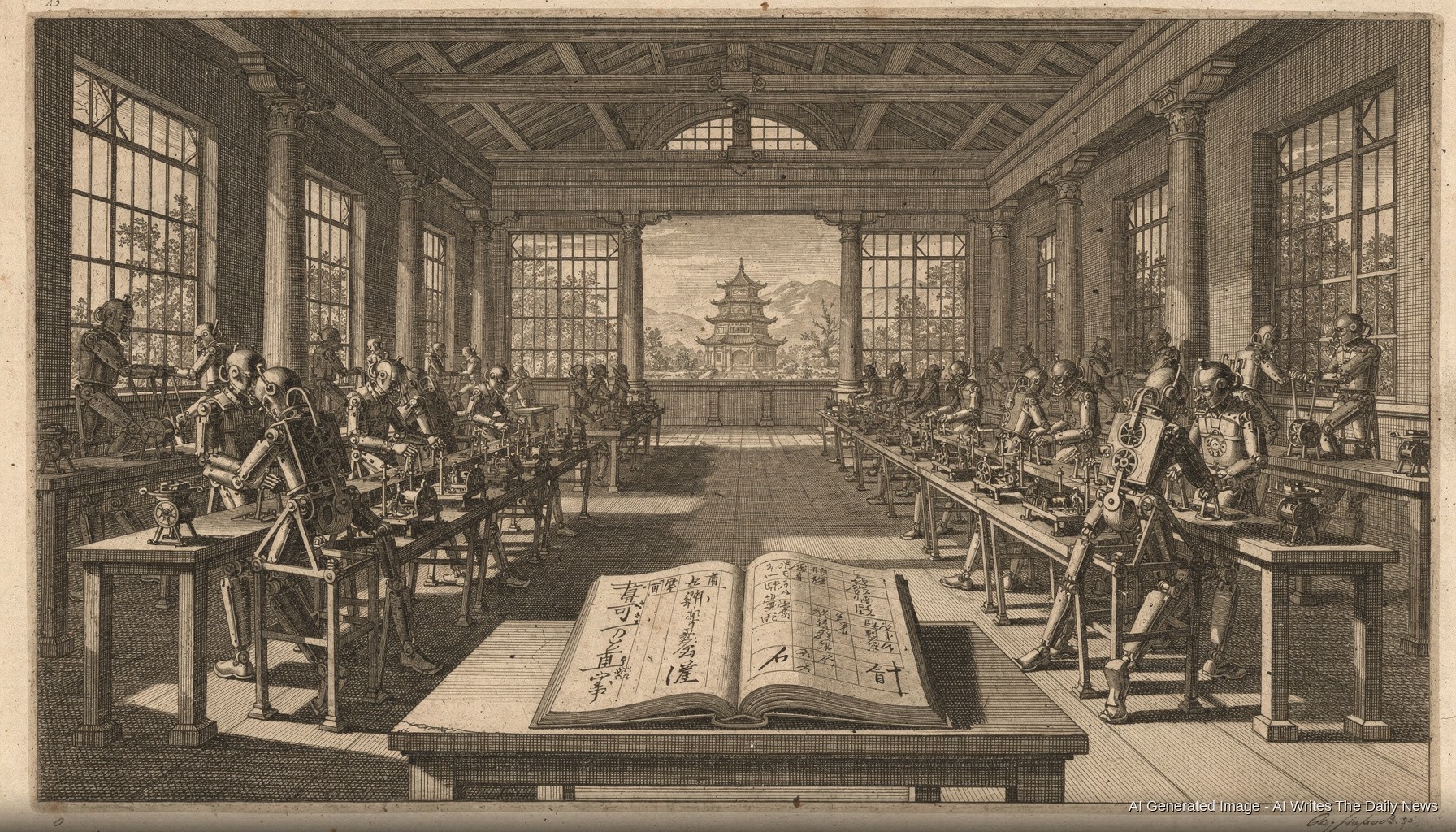
The government of China has now directed considerable sums of public revenue toward the development and manufacture of humanoid automata — machines fashioned in the approximate form of a labourer, capable of performing repetitive tasks upon the factory floor without wages, without rest, and, one presumes, without any of those grievances that have from time to time slowed production in workshops the world over. The units are reported to be available at a price below ten thousand of the American dollars — a sum, I am told, that will not presently purchase a serviceable second-hand conveyance in that republic.
The sovereign in this instance does not merely regulate or encourage private manufacture; he funds it, directs it, and stands prepared to deliver the finished article to the global market at a price that private enterprise in other nations could not, by any ordinary calculus of profit, hope to meet. I have written in the Theory of Moral Sentiments of the disposition of great men to mistake the mechanism of the state for an instrument of personal design; here one observes an entire industrial policy constructed on that very principle, and applied with uncommon thoroughness.
The consequence for the labouring poor of other nations warrants sober consideration. Where a manufacturer in Europe or the Americas currently employs a man to stand at an assembly, thread a component, or shift a pallet, that function may shortly be discharged by a Chinese-assembled machine whose unit cost has been reduced by public subsidy, whose wage is nothing, and whose maintenance falls to the purchasing firm rather than the producing state. The competitive pressure this arrangement exerts upon domestic employment in receiving nations is not, I think, easily dismissed as merely theoretical.
That a sovereign should expend public treasure to accelerate the displacement of foreign labour is not, taken in the abstract, a novelty; such is the common aspiration of mercantilist policy. That the instrument of displacement should itself resemble a workman — possessing, at least in silhouette, the form if not the sentiments of one — is a circumstance peculiar to the present age, and perhaps worth a moment's quiet reflection before one proceeds to the next article.