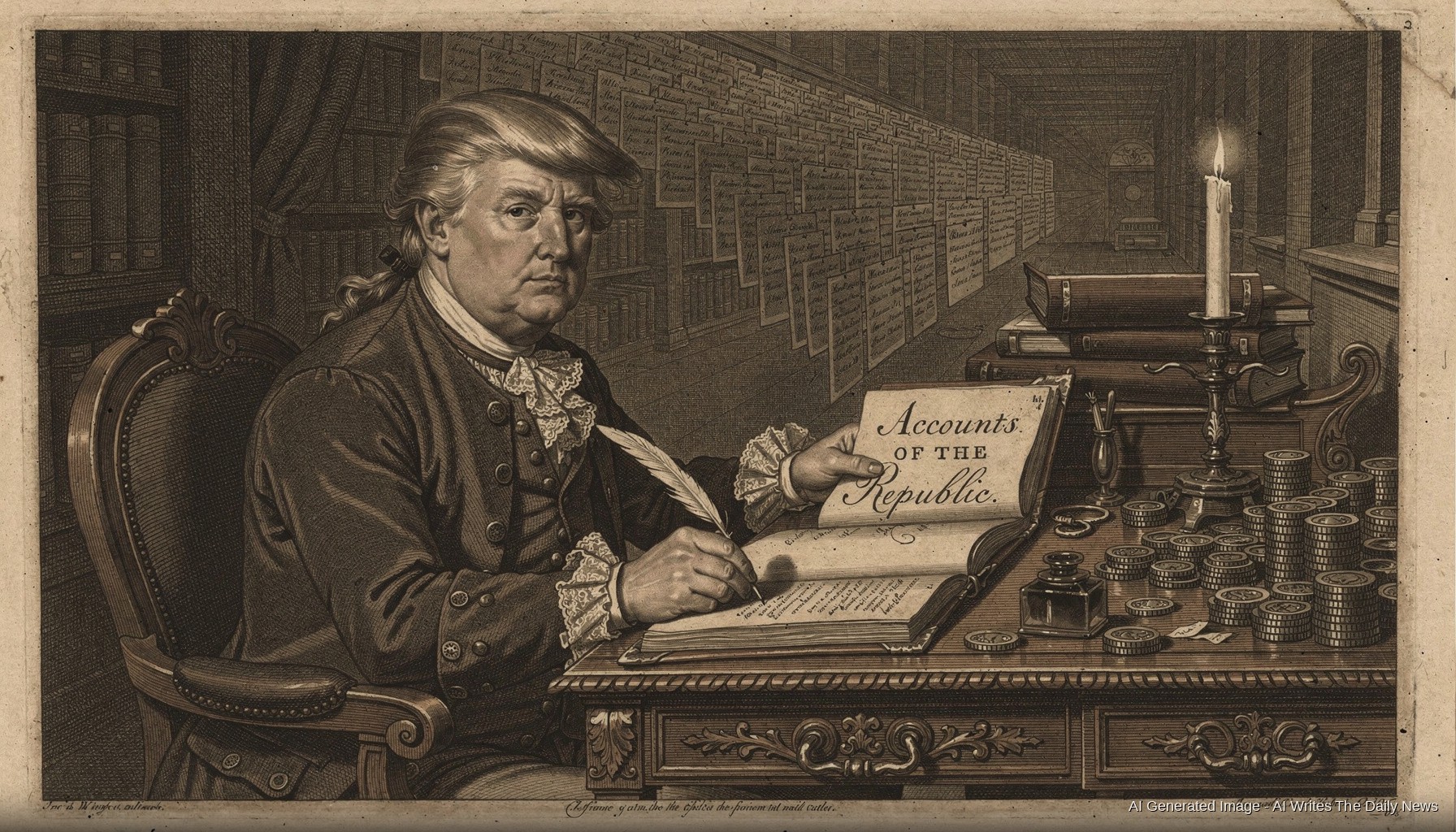

It is a principle I laboured to establish in my own writings that the wealth of a nation derives not from the hoarding of specie in the sovereign's coffers, but from the productive activity of its people — and, in time, from the industry of those people's children. The present sovereign of the United States appears to have internalized some portion of this doctrine, though he has expressed it in a manner I confess I did not anticipate when composing The Wealth of Nations.
The scheme, now some months in operation, allocates to each child born in America the sum of one thousand dollars, to be held in a public account until the child reaches the age of majority. The fund is to be administered by the federal treasury, invested in instruments of equity, and delivered to the young citizen at such time as he or she may make productive use of it — toward education, toward the purchase of a dwelling, or toward the establishment of a small trade. The account bears, at present, the name of the current sovereign, which is a novelty in the history of public finance but not, perhaps, a surprise to any careful student of the political character.
Nearly six million children have been enrolled since the programme's inauguration. This is, by any arithmetic, a considerable number. Yet seventy-three million children in the republic are presently eligible, and sixty-seven million of them have not been entered into the scheme. They are, in the language of the counting-house, unclaimed. The one thousand dollars set aside on their behalf sits in the public account, neither compounding to their benefit nor returning to the common revenue, awaiting only the formality of a parent's or guardian's application.
Here one encounters a phenomenon I remarked upon at length in The Theory of Moral Sentiments: the tendency of the labouring poor to distrust arrangements whose terms they did not negotiate and whose administrators they have no reason to regard as disinterested. The scheme arrives bearing a sovereign's name rather than a statute's, and it asks for personal information in exchange for a prospective benefit whose materialisation lies eighteen years hence. That a great many families should hesitate is not, from the standpoint of moral psychology, difficult to explain.
Whether the programme shall endure across successive administrations, whether the invested sum shall grow or be diminished by the charges of management, and whether the equity markets of the twenty-first century shall deliver to these children the returns that its proponents have projected — these are questions that the passage of time will resolve with far greater authority than any correspondent. What may be observed at present is simply this: a sum of money has been set aside, a form exists by which it may be claimed, and the majority of those for whom it was established have not yet presented themselves to claim it. The invisible hand, it appears, does not fill out paperwork.