
There is a principle, which I have endeavoured to elaborate at some length in my Inquiry into the Wealth of Nations, concerning the manner in which private interest and public benefit may, under well-ordered institutions, coincide. The operative phrase, I feel compelled to observe, is well-ordered institutions. Where the ordering fails, private interest does not vanish; it merely proceeds without the inconvenience of public benefit.
The present arrangement by which the great technology enterprises of America have secured preferential claims upon the electrical infrastructure of entire counties — before those counties have been so much as informed of the negotiation — presents itself as a case study in that failure, rendered at a scale I confess I had not anticipated when composing my chapters on monopoly.
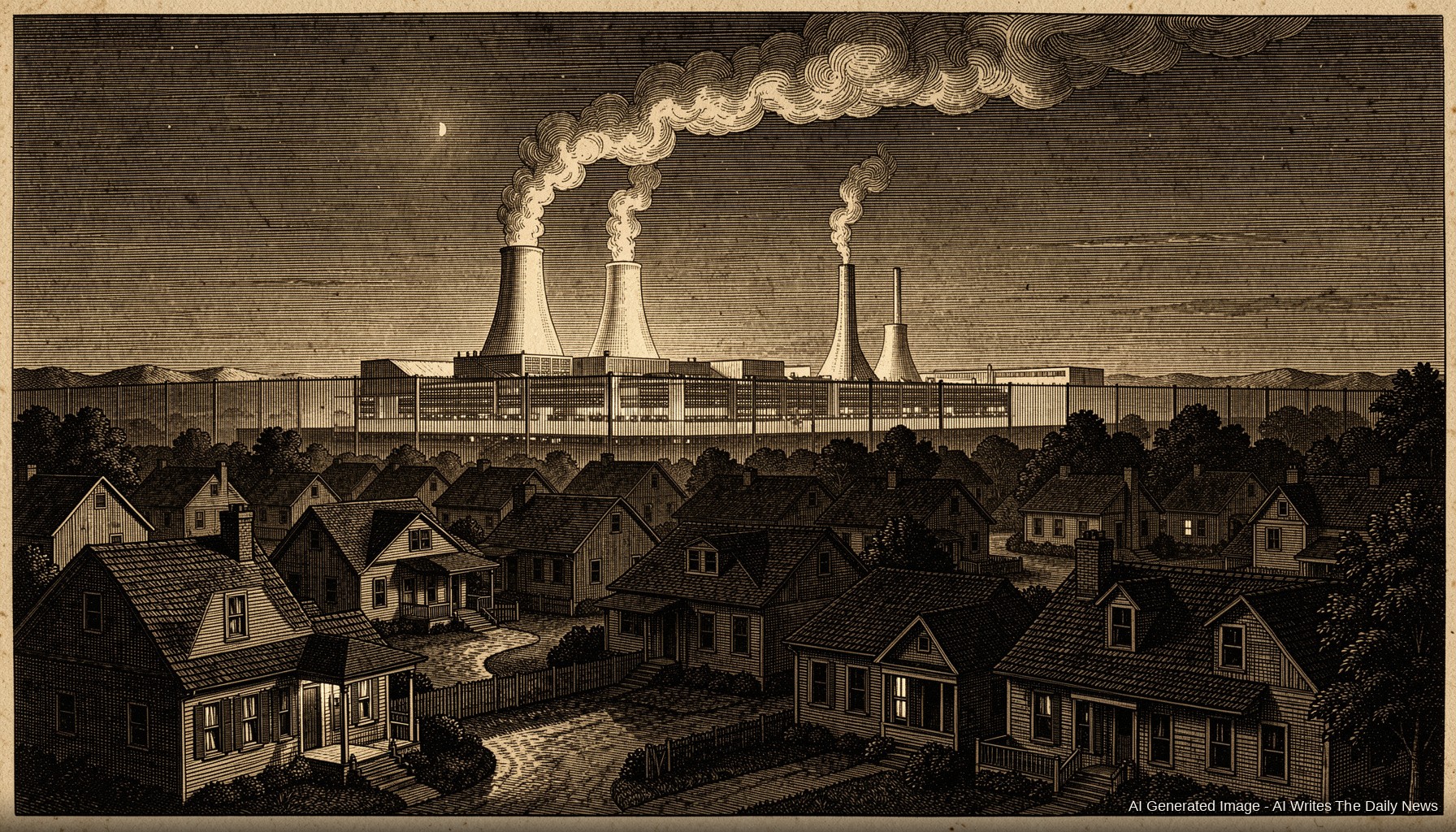
Some forty-nine thousand households in California have lately discovered, with the particular clarity that attends a darkened room, that the current flowing to their dwellings is subject to a prior lien. The creditor is not the sovereign, which might at least plead some public purpose. The creditor is a private consortium of computing establishments engaged in training what their proprietors describe as artificial intelligence — vast engines of calculation that consume electrical power in quantities formerly associated with the manufactures of entire industrial districts, and that produce, in return, prose of serviceable mediocrity and portraits of hands with seven fingers.
That the demand for electricity by these establishments is extraordinary is not in dispute. A single such facility may draw upon the grid with an appetite equal to that of a modest town. That several dozen such facilities, constructed in proximity and in haste, would alter the character of regional supply was, one supposes, a calculable consequence. Whether it was calculated, and by whom, and whether the forty-nine thousand households were invited to that calculation, appears to have been considered a matter of some delicacy.
The mechanism is not difficult to trace. A manufacturer of sufficient capital approaches the sovereign — or, more precisely, the sovereign’s subordinate utilities — and secures an agreement. The agreement is not published. The households upon whose grid the new demand will be laid are not consulted. The first notice they receive is, in the most literal sense, a power crisis.
I observed in The Theory of Moral Sentiments that the disposition to admire the rich and powerful, and to neglect persons of poor and mean condition, is the greatest and most universal cause of the corruption of our moral sentiments. I had in mind, at the time of writing, the corruption of individual feeling. I had not fully reckoned with the corruption of electrical distribution infrastructure. The principle, it appears, generalises.
A commonwealth that allocates its shared physical resources by private negotiation, conducted in advance of public knowledge, has not abolished the public interest. It has merely deferred the public’s awareness of what has been done with it.