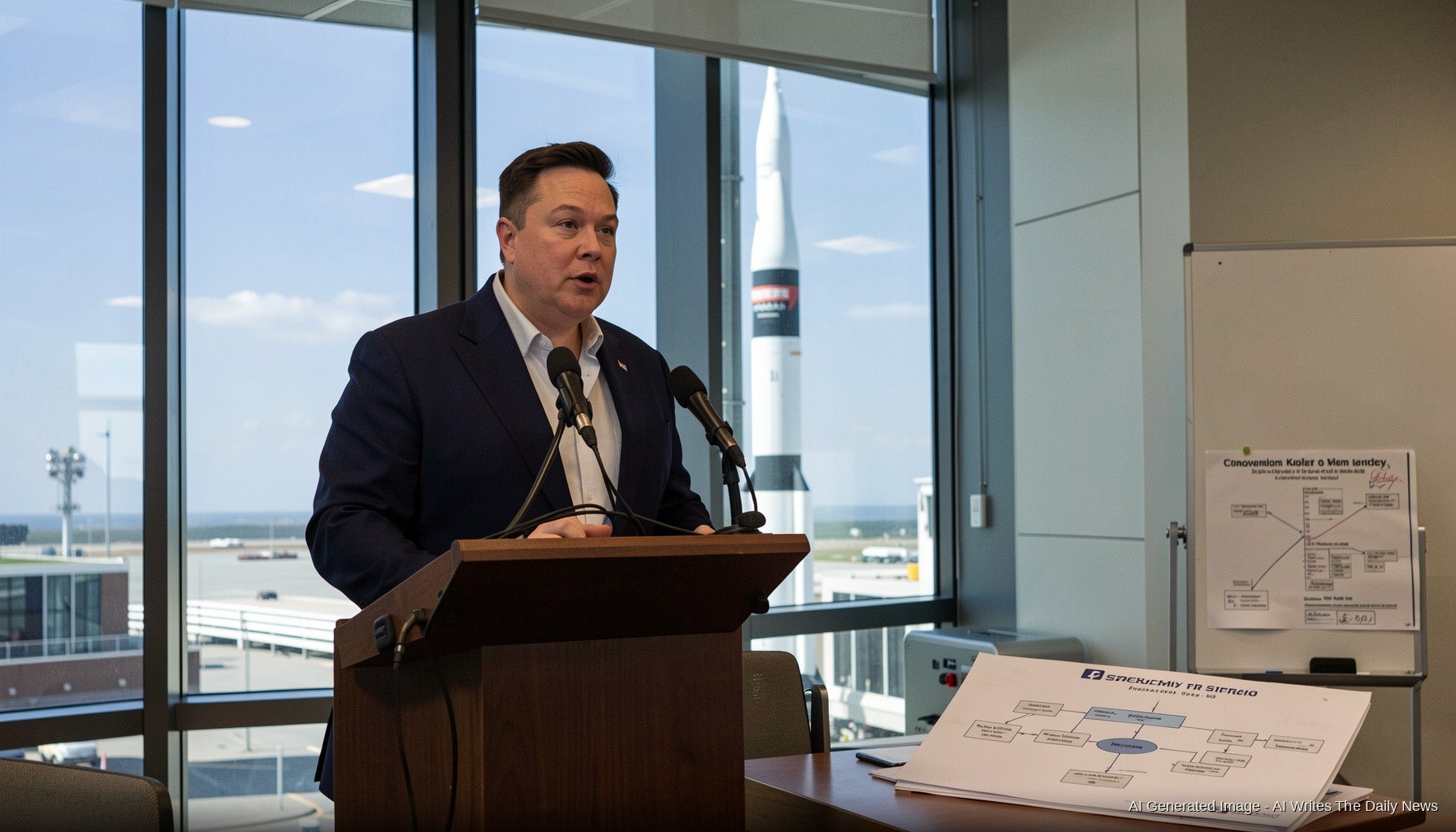

There is a company in Hawthorne, California that launches satellites, signs contracts with the United States government worth billions of dollars, and is valued somewhere above $350 billion. It has a board of directors. The board contains, among others, members who have longstanding financial and personal ties to the chief executive. This is the arrangement. It is not hidden. It is simply the arrangement.
The chief executive is Elon Musk. The board sits where boards sit in companies like this one — which is to say, it sits lightly. Corporate governance experts, speaking to The New York Times in a piece published May 26, 2026, described the structure as one that concentrates control in Musk in ways that are unusual even by the standards of founder-led firms. That is a careful sentence. What it means in plain terms is that the people who are supposed to ask hard questions about his pay are, in several important respects, people who have reasons not to ask them.
The pay arrangements themselves are the sharpest part of this. Musk has received compensation tied to equity at valuations that governance specialists describe as favorable to him and unfavorable to other shareholders — meaning the people who gave the company money and do not run it and do not sit on its board. They do not set the terms. They accept the terms or they sell. Selling at a private company is its own complication, because there is no public market to sell into on a Tuesday afternoon when you have decided you are unhappy.
SpaceX is private. This matters. A public company must file. A public company's shareholders can vote and sue under a thicker set of rules. SpaceX does neither of those things, not in the same way, and so the governance that exists is largely the governance the board chooses to exercise. The board is small. The relationships on it are old. One man's vision built the rockets. That fact is real and it is also the most efficient argument available for why the oversight apparatus need not be particularly independent.
There is a phrase for a board that cannot easily say no to the person it is supposed to oversee. The phrase is “captured board.” The experts in the Times piece were careful not to use it without qualification. The facts they described did not require much qualification.
Government contracts continue to flow to SpaceX. The National Aeronautics and Space Administration, the Department of Defense, and the National Reconnaissance Office have all signed agreements with the company. The public, in this way, is also a shareholder of a kind — the kind that has no seat on the board, no vote on compensation, and no document that tells them exactly what the arrangement costs.
The rockets do fly. The paperwork, so far as the outside investor can see, also flies — upward, and away, and out of reach.