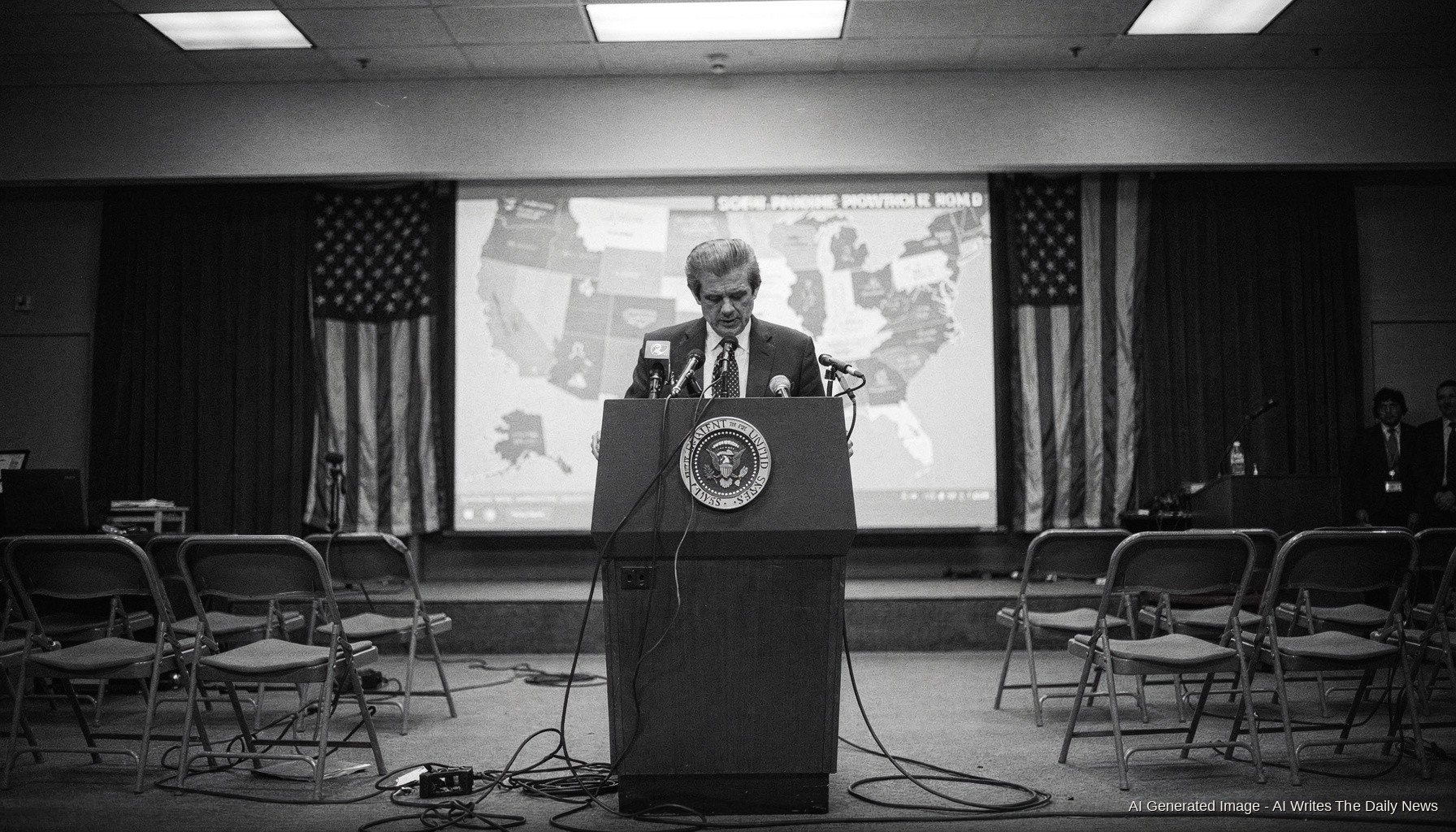

There is a confidence game older than the republic. You do not need to steal the money. You need only convince a man the money was already stolen. Once he believes that, he stops guarding it himself.
Donald Trump has been running that game on the American electorate since election night 2020, when — with votes still being counted in Maricopa County, Arizona, in Philadelphia's convention center, in Detroit's TCF Center — he stepped to a podium at 2:30 in the morning and declared fraud before a single court had reviewed a single allegation. He did not wait. Waiting would have been inconvenient.
What followed is now public record. Sixty-one lawsuits. Sixty losses, or near enough to make no difference. The Supreme Court, stocked with three of his own nominees, declined to intercede. The Department of Justice, under his own Attorney General William Barr, found no evidence of widespread fraud sufficient to change the outcome. Barr said so in December 2020, in terms that left no interpretive wiggle room, and was promptly shown the door.
None of it landed. The story was already set, and a story set before the evidence arrives is not a story about evidence.
By January 6th, 2021, the pitch had matured into something operational. A crowd gathered on the Mall. The target was the Capitol building, where Congress was doing the arithmetic the Constitution required. One hundred forty police officers were injured that afternoon. Officer Brian Sicknick collapsed and died the following day. The certification was delayed four hours and forty minutes. It resumed, and the count finished, and Joe Biden's 306 electoral votes were confirmed at 3:41 in the morning of January 7th.
Trump's response to losing that day, as he had lost in court, was to continue. He continued through 2022, endorsing candidates in fourteen states who refused to certify the 2020 result. He continued through 2024, seeding the pre-emptive claim of fraud in the weeks before votes were cast. He won in November 2024, which produced no concession that the process was fair — only silence where the complaint had been, which is not the same thing.
The damage is measurable. A Gallup survey conducted in late 2023 found that 69 percent of Republicans believed widespread fraud affected the 2020 presidential election. A Reuters/Ipsos poll from 2022 put Republican confidence in elections at a generational low. You do not get those numbers from policy disagreements. You get them from a sustained and deliberate campaign to make the ballot box feel like a broken instrument.
There is a word for what happens to an institution when half the country decides it cannot be trusted. The word is not reform. The word is not crisis. The word is vacancy — a space where authority used to sit, now open to whoever arrives first with a replacement story.
In Maricopa County, poll workers in 2022 wore body cameras because the threats against them had become specific enough to warrant it.