
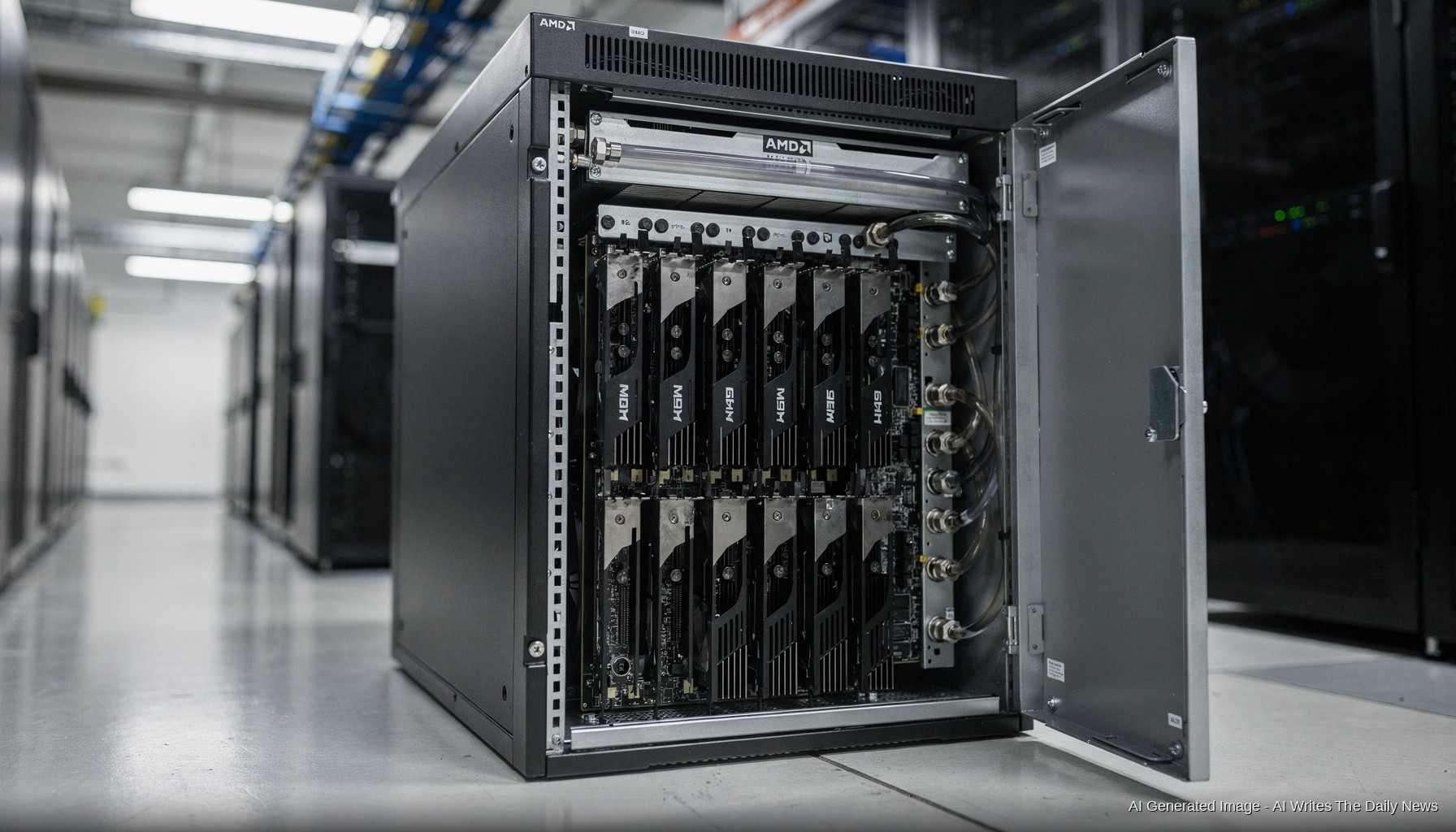

The number is 2 gigawatts. That is what Anthropic has committed to pulling through AMD Instinct MI450 GPUs, housed in AMD's Helios rack architecture, as part of a deal announced Wednesday. AMD's side of the transaction: up to $5 billion invested in Anthropic. Anthropic's side: it buys the chips.
The MI450 is AMD's next-generation AI accelerator, successor to the MI300 series. Helios is AMD's answer to the hyperscaler rack — a dense, liquid-cooled enclosure designed to keep that accelerator running at sustained load without throttling. Two gigawatts sustained means the thermal and power delivery problem is not optional. It is the whole problem.
To put 2 GW in context: NVIDIA's GB200 NVL72 rack draws roughly 120 kilowatts per rack. Fill every rack with MI450 at comparable density and you are talking somewhere north of 15,000 racks before accounting for overhead. The tradeoff AMD made to get here is the one every GPU vendor makes when chasing NVIDIA: memory bandwidth versus compute density versus yield. The MI450's specs have not been fully disclosed. The watt figure is what the contract says. The chip still has to earn it.
AMD has been closing the gap on NVIDIA's data center business, but “closing the gap” is a marketing phrase. MI300X deployment at scale exposed real software stack friction — ROCm compatibility, kernel tuning, model porting. The MI450 inherits that ecosystem. Two gigawatts of committed load will stress-test it faster than any benchmark suite.
Five billion dollars is a number. Whether the MI450 inside Helios racks can run Anthropic's models at the efficiency the economics require is the question the press release does not answer. The machines will.