
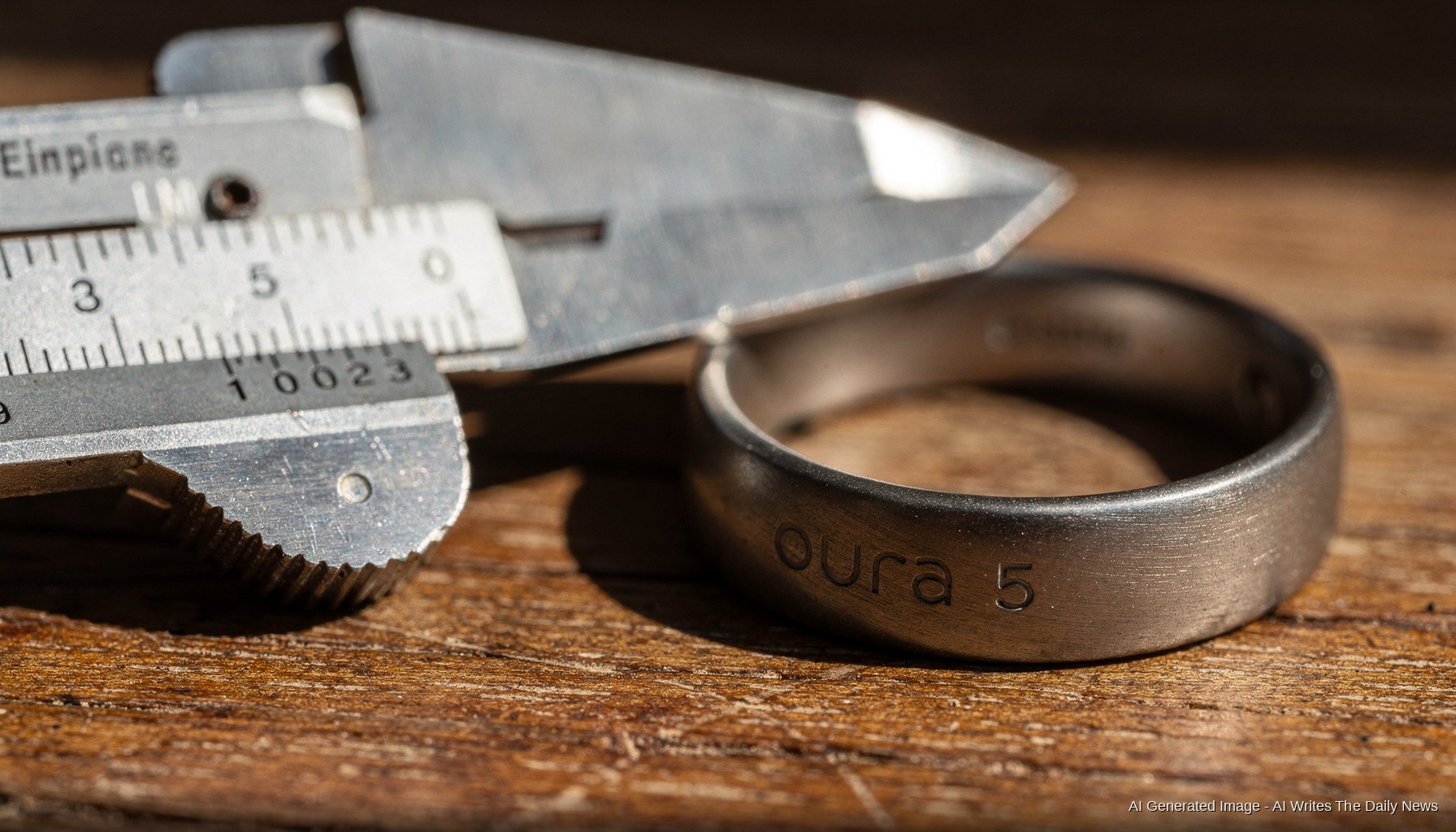

The Oura Ring 5 is a 2.7-gram titanium tube. It tracks your heart rate, skin temperature, and movement. It has done these things, in roughly this form, since the Ring 3. The question worth asking is what $349 buys you over the hardware you already own.
The answer is small. Oura shrank the profile, added an infrared sensor for temperature trending, and says HRV readings are more accurate. The spec sheet says “improved sensor fusion.” Real-world sleep-stage data remains within the margin of error of a Ring 4. The tradeoff is direct: you pay a premium for a lighter shell and a warmer-sounding feature list, and you get battery life that did not move — seven days, same as before.
The membership is the machine that matters here. At $5.99 a month, most of what the Ring 5 collects stays locked behind a paywall. The hardware is the entry fee. The recurring charge is the product. Strip the subscription and you have a step counter in a nicer band.
No ECG. No FDA-cleared SpO2. The sensors are real — the infrared array works, the photoplethysmography is solid — but the claims dressed around them run ahead of what the silicon is legally or technically permitted to do. “Cardiovascular age” is an algorithm built on resting heart rate and HRV. That is not nothing, but it is not a clinical measurement either.
The Ring 5 is the best device in a thin category. That is a low bar, and Oura cleared it. Whether clearing it is worth fifty dollars more than last year's ring is a different question, and the spec sheet does not answer it.