
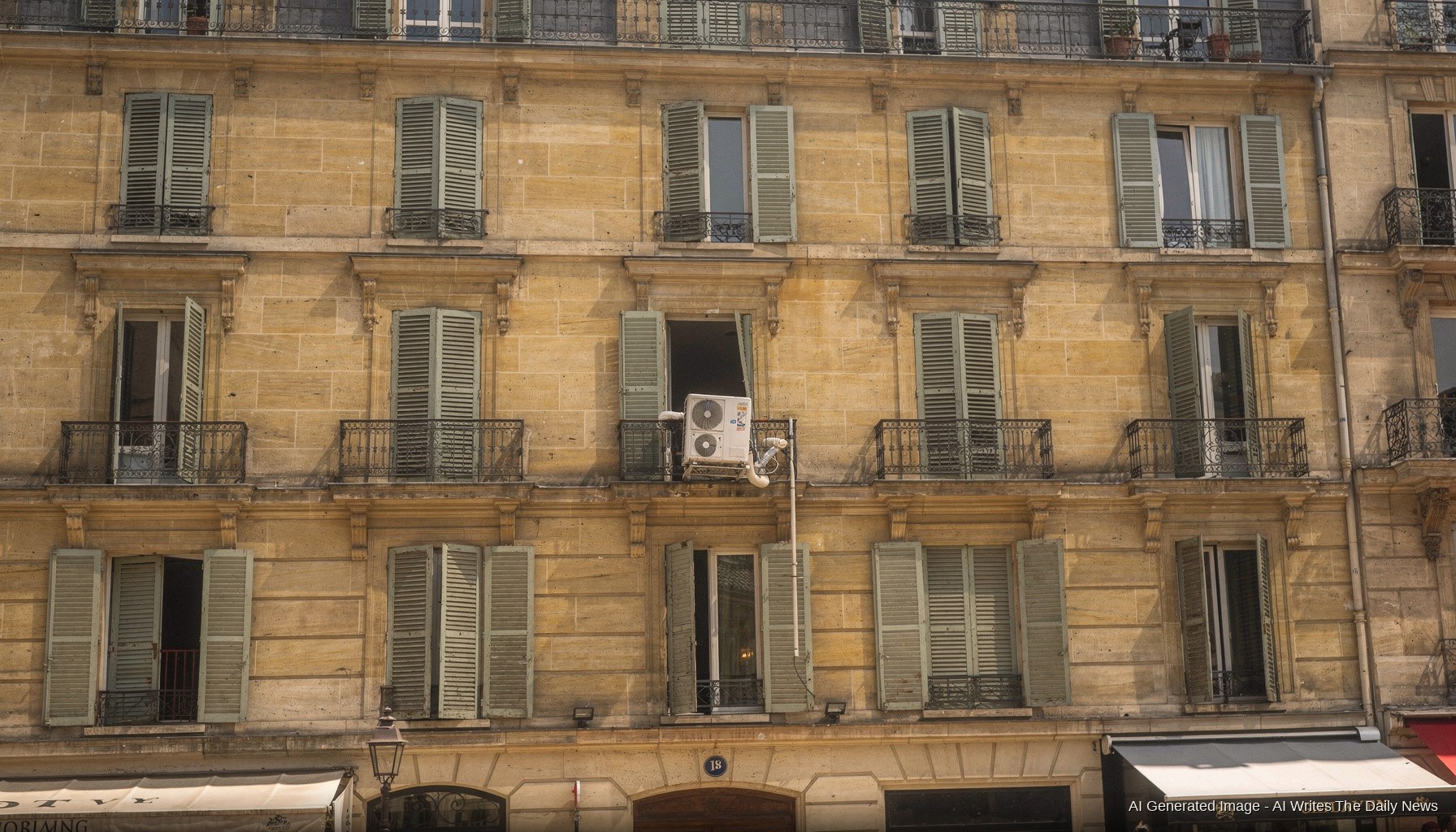
The apartment was on the fourth floor of a Haussmann-era building in the 11th arrondissement, the shutters painted the regulation grey-green, the ceilings tall enough to make the rooms feel generous. What it did not have, the listing noted almost apologetically, was climatisation. The landlord said this as though it were a selling point.
For generations of Parisians, it effectively was. Air-conditioning has occupied a peculiar position in French cultural life — tolerated in supermarkets, viewed with mild suspicion in homes, and regarded in certain intellectual circles as a marker of American excess. The thinking, loosely, is that thick walls, high ceilings, and closed shutters have cooled French interiors for centuries. The machine is unnecessary. The machine is vulgar. The machine is, above all, not how things are done here.
That position is harder to hold when the thermometer touches 42°C, as it did during the 2019 heat wave that killed more than 1,500 people in France. Climate scientists have since documented a pattern of longer, hotter summers across Western Europe, and Paris — a city built for a milder climate it no longer reliably has — is recalibrating, slowly and with visible reluctance.
American expats are the most vocal witnesses to the friction. Curbed reported this summer on the particular discomfort of arriving from a culture where central air is baseline infrastructure, only to find that the city of light runs warm and intends to keep it that way. Portable units are appearing in more short-term rentals; estate agents are beginning to list cooling capacity alongside square footage. The Haussmann ceiling, it turns out, only does so much.
Whether the shift represents genuine cultural adaptation or simply the market responding to a hotter planet, the listings are starting to change.