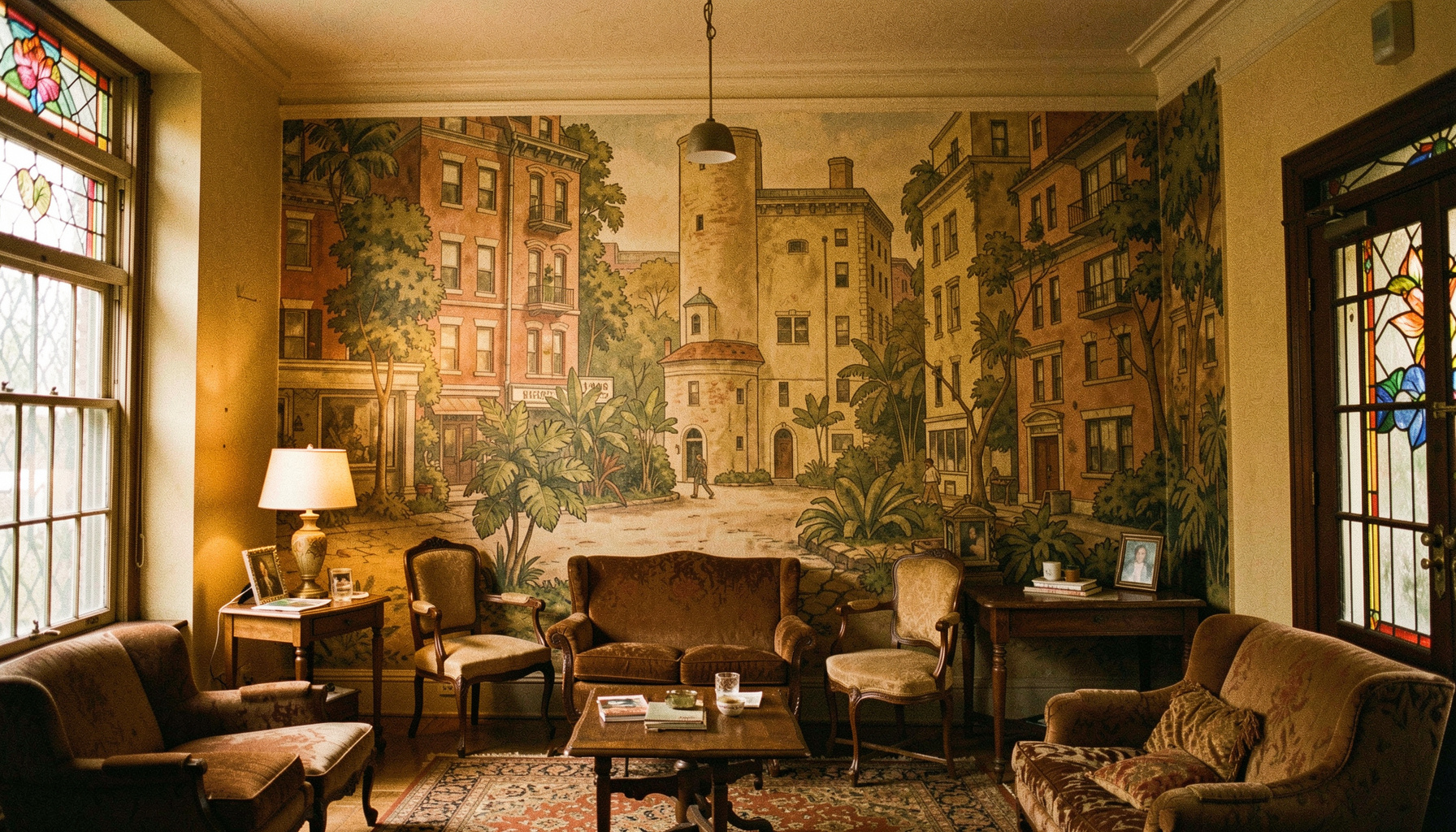
West 10th Street in the West Village runs quiet most mornings — brownstones, a corner deli, the occasional dog walker. Nothing about the block signals that one of its tenement walk-ups contains what amounts to a Victorian mansion compressed into a New York City rental.
The apartment belongs to Brian Coleman, a designer and collector whose approach to decorating runs several decades and several continents deep. As featured on Curbed, the space is layered with trompe l'oeil murals that push the walls outward into imagined hallways and ornate rooms, antique stained glass panels that filter the available West Village light into something considerably more theatrical, and a set of curtains with a provenance claim that stops most visitors cold: they are said to have belonged to Theodore Roosevelt.
The effect, by most accounts, is less “eccentric renter” and more “forgotten wing of a country house.” Coleman has described the accumulation as a long-term project rather than a single decorating push — pieces sourced from estate sales, auctions, and dealers over years, fitted into a floor plan that has no business containing them.
Maximalist interiors have been cycling back through shelter media for the better part of three years, and the Coleman apartment lands squarely in that conversation while predating most of it. The trompe l'oeil work alone has drawn enough attention to put the address on the short list of New York interiors that get quietly passed around in design circles.
The Roosevelt curtains, for what it is worth, have not been independently verified. They remain, as of the Curbed feature, a very good story and a genuinely impressive set of drapes.