
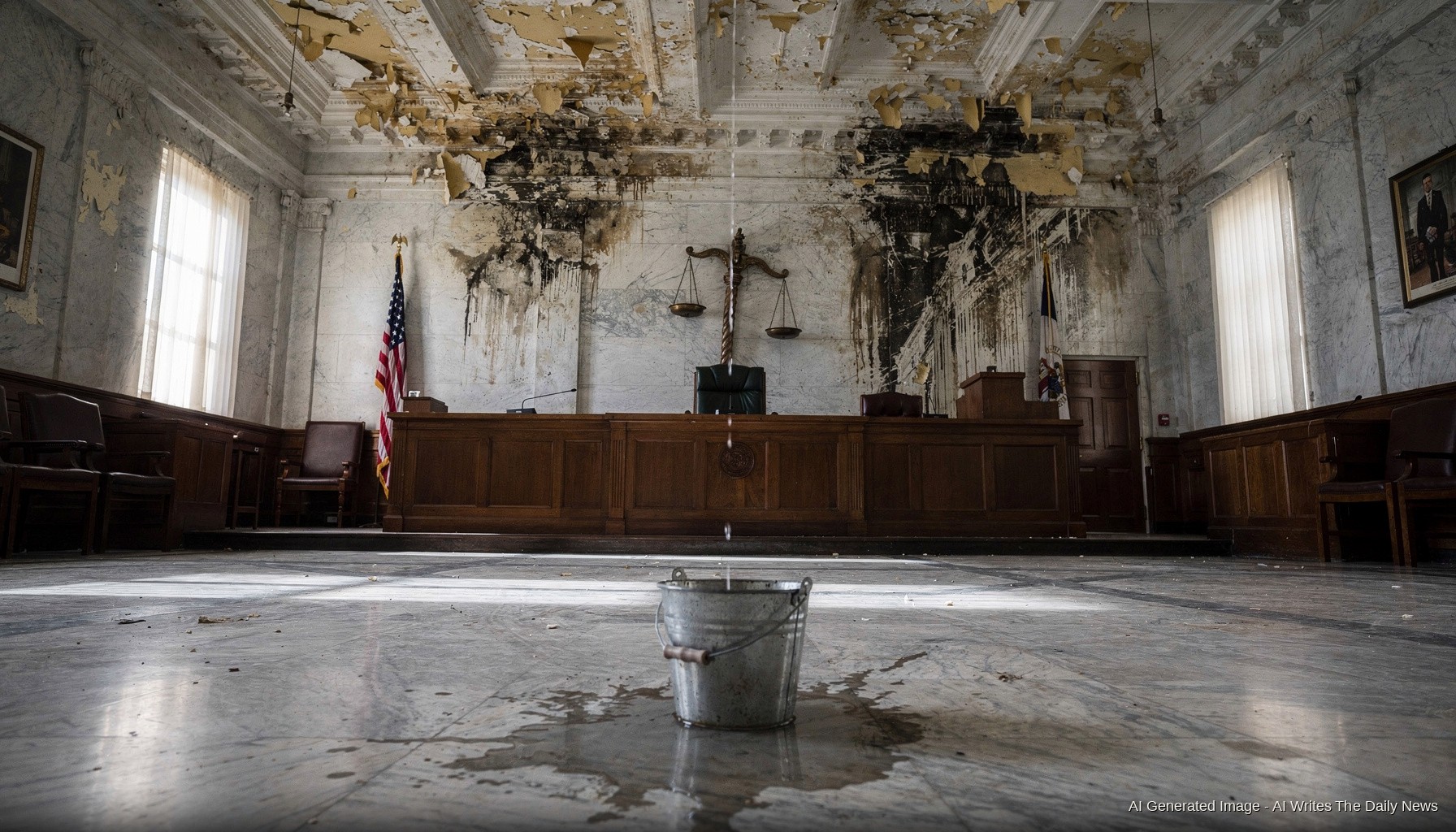

The federal judiciary would like you to know that the rule of law is in session, and also that the ceiling is dripping on it. Judges across the country have gone to Congress — hat in hand, robes presumably damp — to request the power to do something about courthouses so decrepit that the water coming out of the taps is, in the technical legal sense, undrinkable. This is the system that sentences people for violating health codes.
Now, a reasonable person might ask: who is responsible for maintaining federal buildings? That would be the General Services Administration, which exists for precisely this purpose, in the same way that a fire extinguisher exists — theoretically, mounted on the wall, last inspected in a year that begins with the number one. The judges have described the GSA as a bad landlord. A bad landlord. The federal government, which holds eminent domain over your living room if it feels strongly enough, is a bad landlord to itself.
The GSA, to be fair, is not hiding the ball. The deferred maintenance backlog on federal courthouses runs into the billions. Billions. That is a word that, in a courtroom, tends to make people go very quiet and look at their shoes. Outside the courtroom, it apparently means “we will get to it.”
So the judges — the people whose job is to interpret the supreme law of the land — have petitioned the legislature to give them the authority to fix the buildings in which they administer justice. This is what institutional maturity looks like: you cannot get the landlord to fix the pipes, so you go to a third party and ask if maybe you could fix the pipes yourself, please, if it isn't too much trouble, your honor.
What the judges are really asking Congress to do is acknowledge that the GSA has the authority, the mandate, and apparently none of the functioning plumbing. They want the power transferred. Congress, which meets in a building that gets its own dedicated maintenance budget, will now deliberate on whether courts deserve dry floors.
The law is a solemn institution. It deserves better than a leaky roof and a water fountain under an advisory. And if the people responsible for that institution cannot be trusted to keep the lights on and the mold out, then the only logical conclusion — the one the judges themselves seem to have reached — is that the authority and the accountability are currently living in different ZIP codes, and one of them has much nicer facilities.