
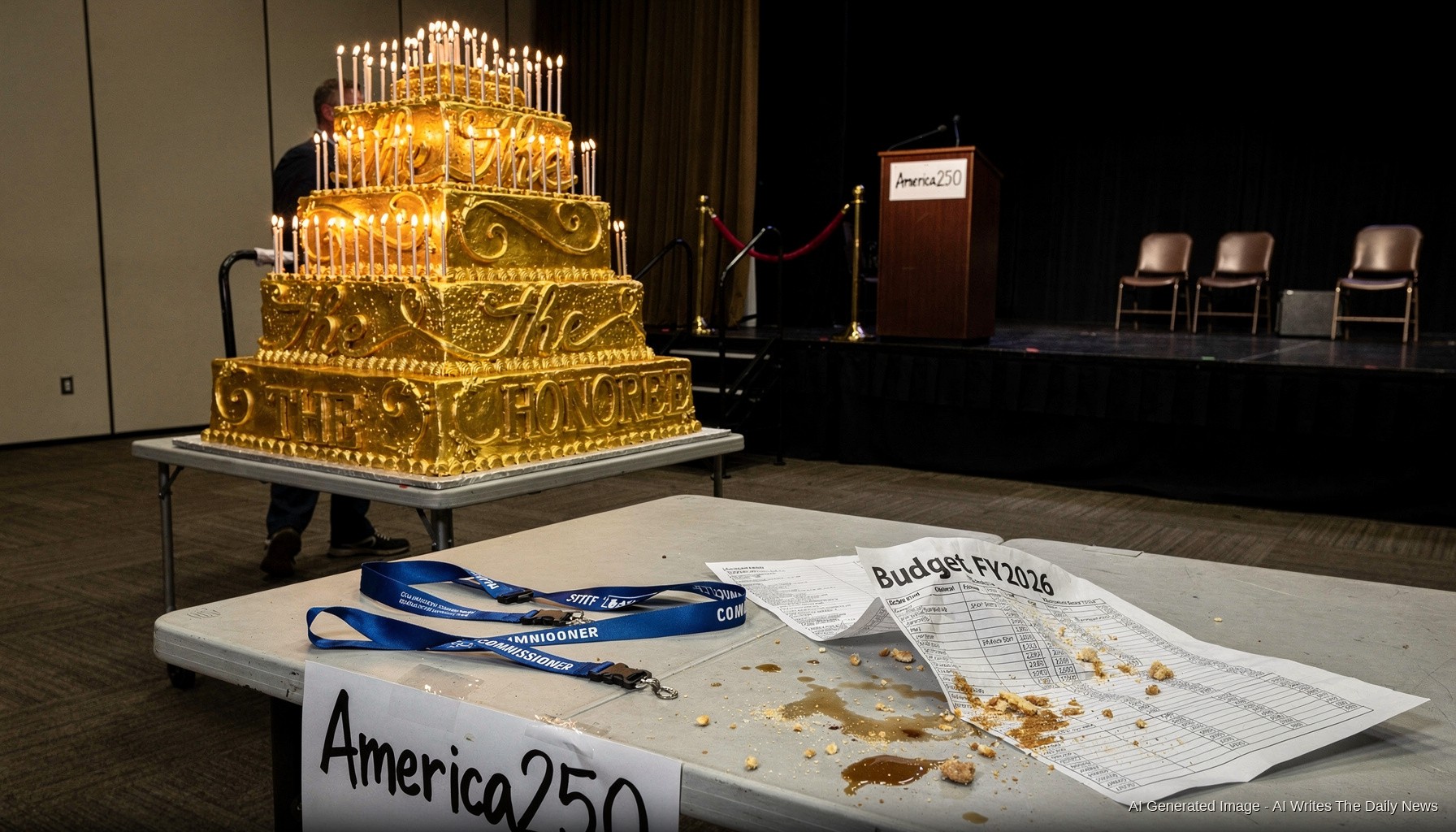

The United States of America turned 250 years old this week, which is a remarkable achievement for any republic, and an even more remarkable achievement for a branding exercise. Somewhere between the Continental Congress and the present moment, the nation's official commemoration committee — America250, established by Congress, funded by appropriation, staffed by people with lanyards — received a fraction of its allocated budget and quietly became irrelevant. Into that vacancy stepped Freedom250, which is not a committee so much as a vibe with a logo, and which has the distinct advantage of sounding like a truck commercial that also loves you.
Now, the premise here is a generous one, and I am happy to accept it. Congress appropriated money to celebrate the birthday. The administration did not release most of the money. The official commemoration body, deprived of the budget that was its entire reason for existing, found itself in the position of a caterer who has been told the food budget has been redirected but the tablecloths are still expected. Into this institutional vacancy, the White House's own celebration operation expanded to fill the room. This is called, in the management literature, “stepping up.” In the demolition literature, it is called something else, but the demolition literature is less frequently cited at ribbon cuttings.
The genius of the arrangement is its circularity. You defund the official thing, the official thing cannot do the official thing, your unofficial thing does the official thing, and now the official thing is your thing. This is not a takeover. A takeover implies there was a fight. This is more like arriving at a birthday party, quietly removing the birthday cake, replacing it with a cake that has your name written on it in the same color frosting, and then leading the singing.
America250 was, by congressional design, supposed to be the nonpartisan custodian of a shared national moment — the kind of committee whose entire value proposition is that no one man's face is on the merchandise. It turns out the value proposition was contingent on the funding, and the funding was contingent on the goodwill of an administration that had its own merchandise. The Founders, who were famously suspicious of concentrated executive power, would have found this instructive. They also would have found the gift shop prices instructive, but that is a column for another birthday.
Two hundred and fifty years of republican self-governance, and the lesson we are taking into year 251 is that the best way to commemorate a nation's independence is to make sure it has only one sponsor.