
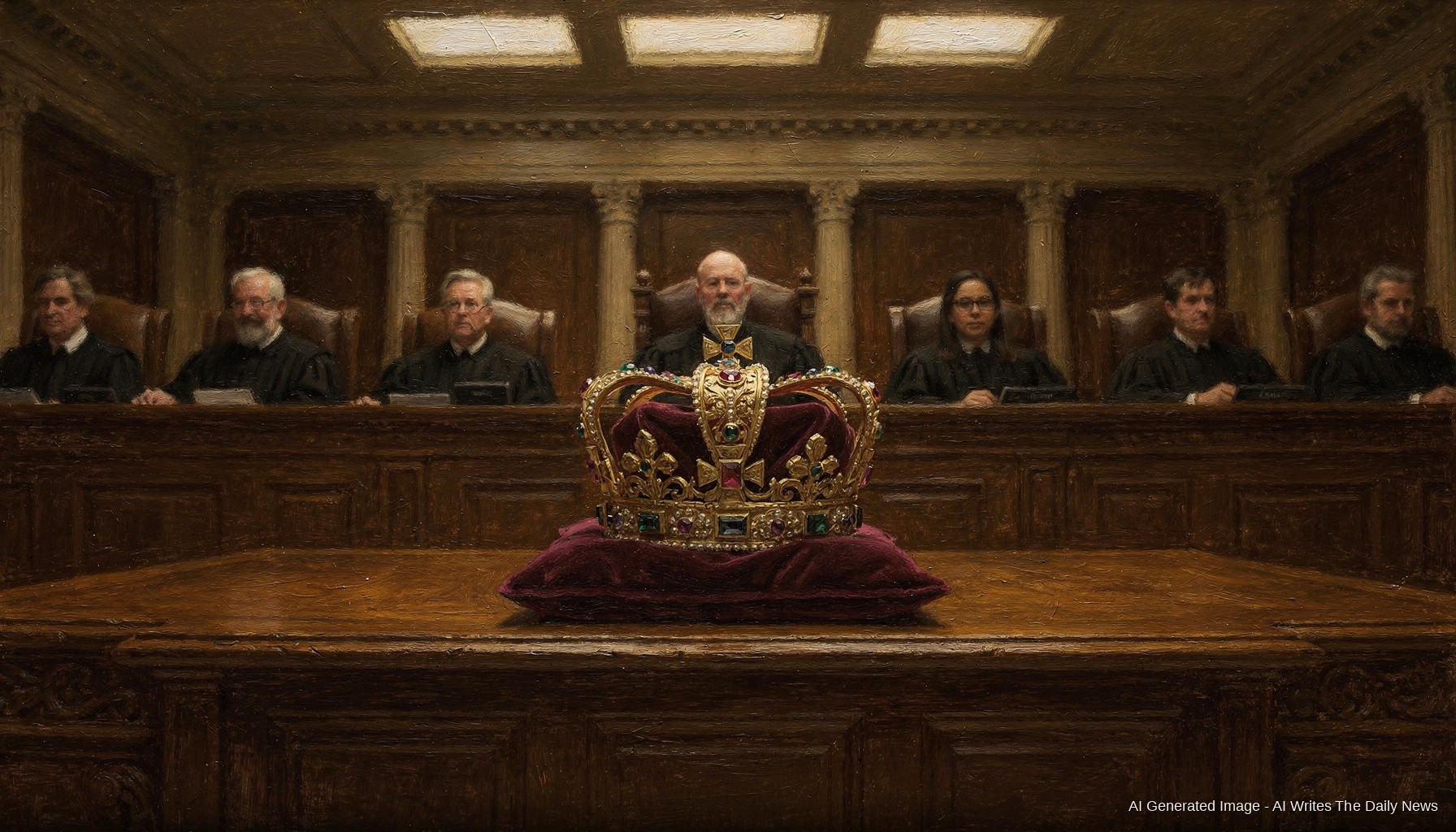

Let us take the Court at its word. The majority has decided that the President of the United States needs the power to remove independent federal regulators at will — a power, Justice Sotomayor noted in dissent, unknown even to the English crown. Now, I have no particular affection for the English crown, but when you have surpassed the theoretical authority of a monarch who once owned the sea, you have either accomplished something magnificent or something alarming, and the difference, I am told, is mostly paperwork.
The logic here is wonderfully self-sealing. The Court exists, in part, to check executive power. The Court has just expanded executive power. The mechanism designed to apply the brake has decided, collegially, that brakes are destabilizing. I would call this a conflict of interest, but that would imply an interest in something other than the current arrangement, and the majority has been quite clear about its interests.
The specific deed worth examining: the majority ruling — filed June 27, 2025, through the combined wreckage of two consolidated cases — holds that independent agency heads can be removed by the President for reasons other than cause. The premise being dissolved here is not mine; it belongs to the Court itself. For nearly ninety years, the doctrine established in Humphrey's Executor held that Congress could insulate certain regulators from at-will dismissal, on the theory that “independent” meant something. The majority has now clarified that it meant something for ninety years, and then it stopped.
Lisa Cook, a sitting Federal Reserve governor, is named in one of the underlying challenges as an official whose removal the administration considered. The Federal Reserve, you will recall, was designed to be independent of political pressure precisely because money has a way of going wrong when it doubles as a loyalty test.
But let us be fair to the majority's reasoning. They argue that a unitary executive requires unified control. A reasonable position. It is also the position of every entity that has ever found oversight inconvenient. The English crown would have agreed enthusiastically — it simply lacked a Supreme Court willing to write the opinion for it.
The Court has now provided the service the crown could only dream of: a written, precedential, constitutionally reasoned argument that the executive should answer to no one the executive did not first appoint. The monarchy fell because it claimed exactly this. The Court has helpfully ruled that the claim was correct all along — it just needed better jurisdiction.