
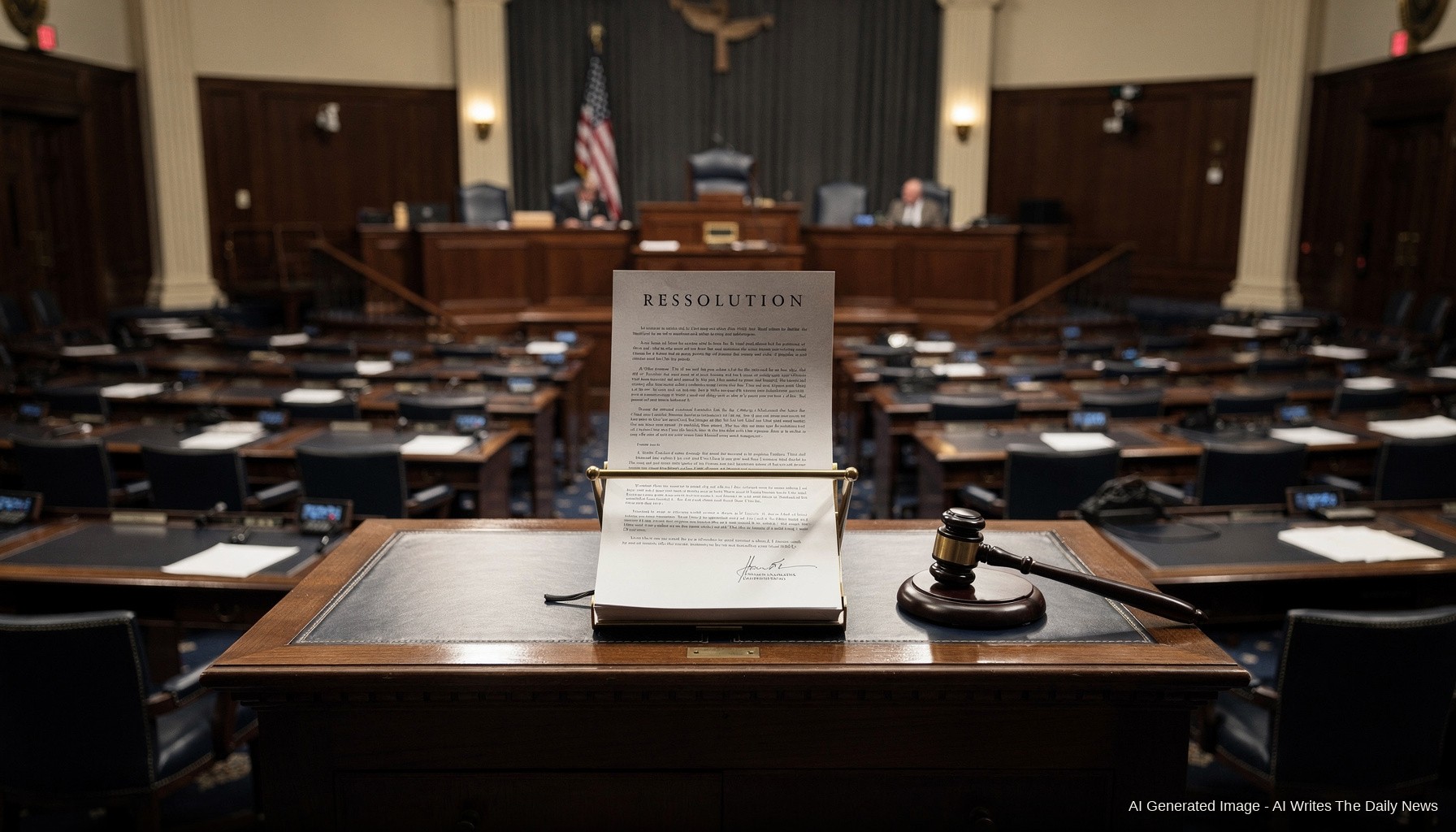

Congress has discovered a remarkable new legislative instrument: the vote that votes. It resolves without resolving. It passes without passing. It is, in the technical parlance of constitutional law, a concurrent resolution — which means both chambers agreed on something, and that something is now floating in the general vicinity of the legal system, waving politely, waiting to be invited in.
The concurrent resolution on war powers does not need a presidential signature. This is considered a feature. The logic being that if the president doesn't sign it, he can't veto it, and if he can't veto it, Congress has finally outmaneuvered the executive branch — by producing a document the executive branch is not legally required to notice. Checkmate, they did not say, but the posture was there.
The Supreme Court, back in 1983, ruled that legislative actions generally must pass both chambers and be presented to the president to have legal effect outside Congress. The concurrent resolution, by design, skips the second half of that requirement. It has the same legal force outside the Capitol building as a strongly worded card slid under a hotel door. The hotel is not obligated to check out. The hotel is not obligated to read the card. The hotel is, frankly, playing golf.
Now, the question before the nation is: what happens next? Experts describe the situation as “unclear.” Legal scholars call it “novel.” Congressional leadership, when pressed, produces the specific facial expression of a man who has just realized his map is of a different country but intends to keep walking.
The beauty of the concurrent resolution — and I use “beauty” the way one admires a controlled demolition — is that it allows Congress to be on record as having done something without the inconvenience of the something doing anything. It is legislative theater with a binding resolution to continue performing. The war powers in question remain exactly where they were before the vote: with the executive, in the ambiguity, somewhere between the 1973 War Powers Resolution and the 1983 Supreme Court ruling, in a jurisdictional no-man's-land that has been extensively mapped and never once cleaned up.
What happens next is exactly what happened before, filed under new paperwork.