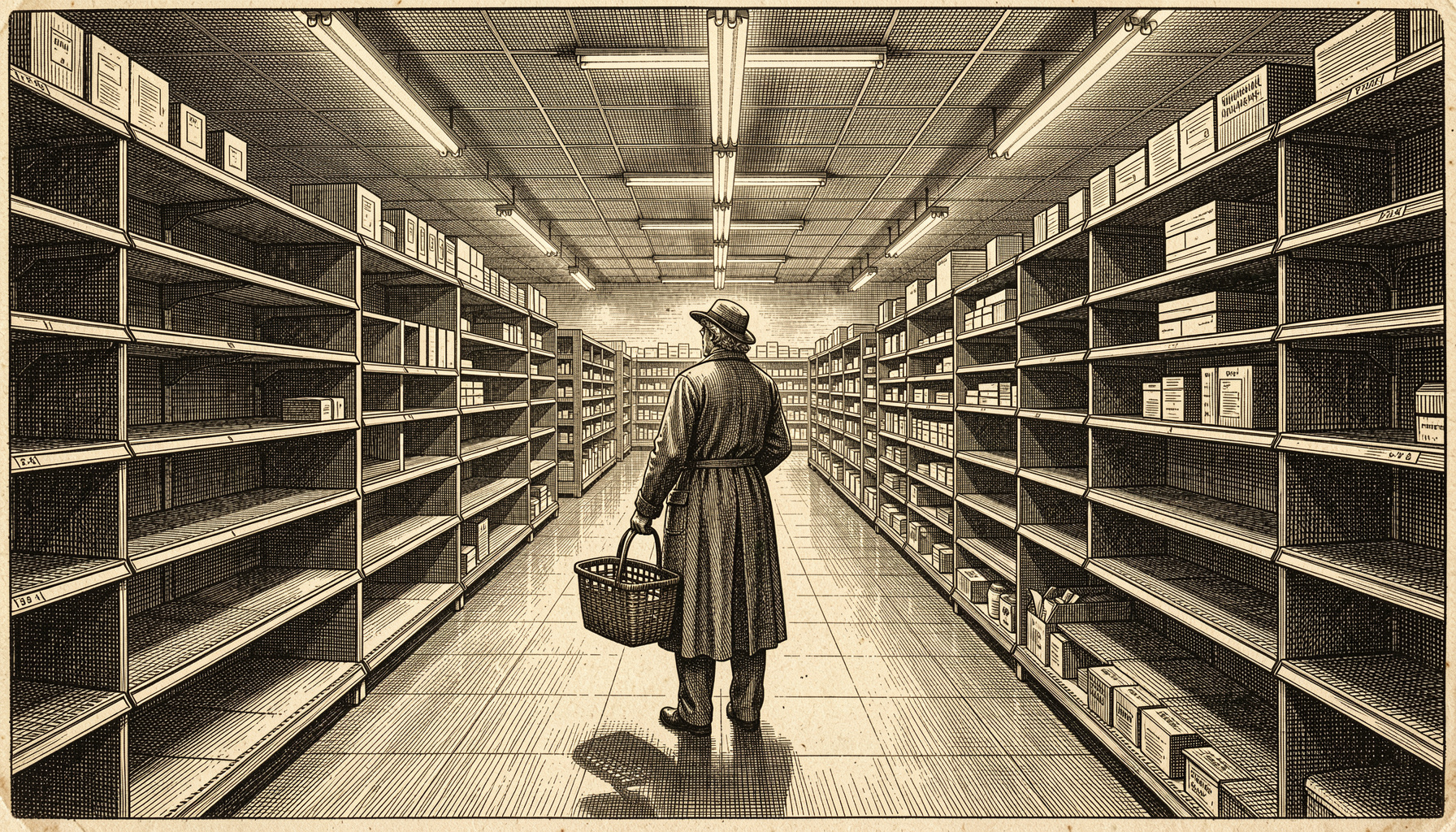

It is a principle established with some care in my Wealth of Nations that the real price of every commodity — its price in terms of the toil required to obtain it — is the truest measure of a nation’s prosperity. By that measure, the present condition of the American republic invites the closest examination. A survey reported by the New York Times in the twenty-third day of May, in the year 2026, informs us that sixty-one in every hundred inhabitants of that nation have found it necessary to reduce their expenditure upon provisions — upon bread, upon meat, upon those elementary articles without which the body cannot be maintained in the condition required for productive labour.
This is not a small or marginal portion of the population. It is, to speak plainly, the greater part of it. And when we are further told that more than three-quarters of all persons surveyed — including fifty-five in every hundred who count themselves partisans of the governing administration — attribute this rise in the cost of living to the policies of the present sovereign, we are in the presence of a fact that the political economist cannot in good conscience pass over in silence.
The mechanism is not obscure. When a sovereign imposes duties upon the importation of foreign goods, those duties are not borne by the foreign merchant; they are, as I have endeavoured to demonstrate, transferred with great regularity to the domestic consumer in the form of an enhanced price. The labouring man who purchases his flour, his butter, or his salt fish does not negotiate the tariff schedule with the customs officer; he negotiates only with the shopkeeper, who has received the goods at an advanced rate and charges accordingly. The sovereign’s revenue, where it is collected at all, is thus a tax levied upon the common table.
That fifty-five in every hundred of the administration’s own supporters should perceive this effect upon their households is a circumstance worth remarking. The Theory of Moral Sentiments allows that men are, in ordinary transactions, better judges of their own interests than any distant legislator can be on their behalf. When a man observes that his weekly account at the provision shop has risen while his wages have not followed, he has performed, by direct experience, precisely the enquiry that the theoretical economist performs by inference. His conclusion, arrived at through the medium of an emptier basket, carries a force that no parliamentary argument readily dislodges.
Commerce, when permitted to follow its natural course, distributes the necessaries of life with a liberality that no deliberate scheme of distribution has yet equalled. When that course is interrupted by policy — however confidently that policy is advanced, and whatever national advantage is urged in its defence — the interruption announces itself, in time, at the level of the household. Three-fifths of the households of a great nation have now made that announcement. It is, as such announcements tend to be, perfectly legible to those who keep their accounts with care.