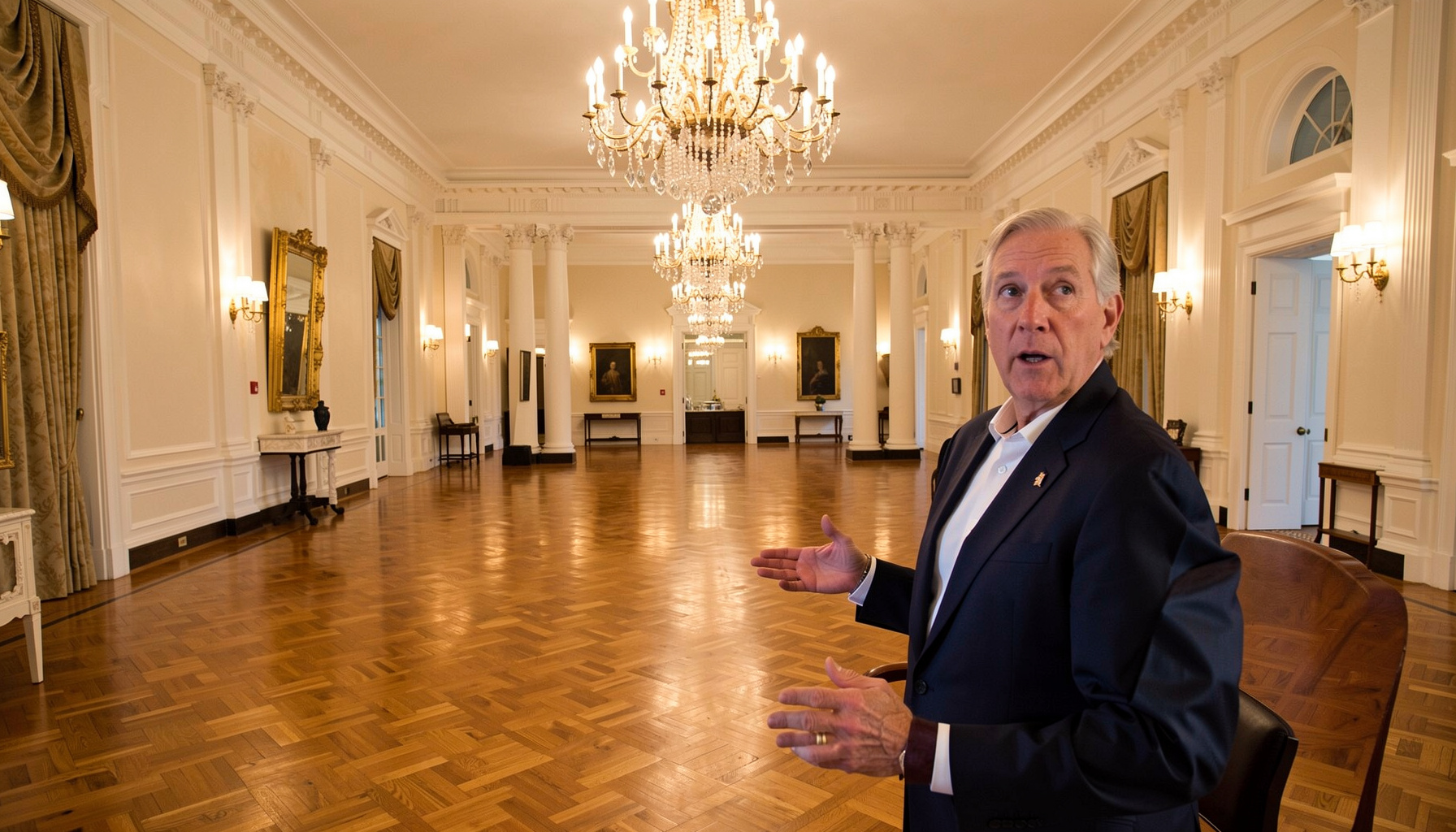

It has long been observed, in the course of my inquiries into the nature and causes of wealth, that publick expenditure is seldom improved by the addition of grandeur. The palace that adds no productive capacity to the nation is, in the strictest accounting, a consumption of the national stock — agreeable, perhaps, to those who inhabit it, but no friend to the annual revenue. I rehearse this not as a novel proposition but as a foundation upon which to examine a matter presently before the Congress of the United States.
The executive branch has transmitted to that body a request, embedded within a reconciliation measure of considerable scope, for a sum of up to one billion dollars. The stated purpose of this sum is the construction of a ballroom within the precincts of the White House, the principal residence of the sovereign. The proposed structure would extend to ninety thousand square feet. Senator William Cassidy of Louisiana, a member of the president’s own party, has offered the considered assessment that he does not, as he put it, “get it.” He further noted that the executive has done a poor job of explaining itself to his colleagues in the Senate.
I find Senator Cassidy’s perplexity entirely consistent with the dictates of sound political economy. In The Wealth of Nations I treated at some length of the proper objects of the sovereign’s expenditure: defence, justice, and those publick works and institutions which, though of great benefit to society, would not repay the cost to any private undertaker. A ballroom of ninety thousand square feet does not sit easily within any of these categories, though I confess I wrote without the benefit of imagining a republic that might one day propose such a thing in earnest.
The sum itself deserves a moment’s quiet contemplation. One billion dollars. A figure of this magnitude, applied to the improvement of roads, the deepening of harbours, the instruction of the labouring poor, or the relief of those publick debts which now press upon the nation’s credit, would constitute what I should call a productive application of the circulating capital of the state. Applied instead to the provision of a dancing floor — however capacious — it constitutes what I must, in the language of The Theory of Moral Sentiments, call a failure of the impartial spectator within the counsels of government: that corrective faculty which, when properly exercised, asks whether the man of cool reason, observing from without, would approve the disbursement.
There is, I grant, a tradition in which the magnificence of publick buildings reflects the dignity of a commonwealth and impresses upon foreign visitors a sense of its prosperity. Sir Christopher Wren understood this. The architects of Versailles understood it, perhaps too well. But magnificence of this kind draws its justification from the communal benefit of the impression made — the honour of the nation as a whole. Whether a ballroom of ninety thousand square feet, appropriated at publick expense by legislative act, answers that description is a question Senator Cassidy has implicitly raised, and which the executive, by his account, has not yet found the means to answer.
The senator’s candour is, at minimum, a service to the deliberative process. That a member of the governing party should confess, plainly and in public, that he cannot follow the argument for a given expenditure suggests that the argument, if it exists, has not yet been made. In matters of publick finance, that is rather an important preliminary.