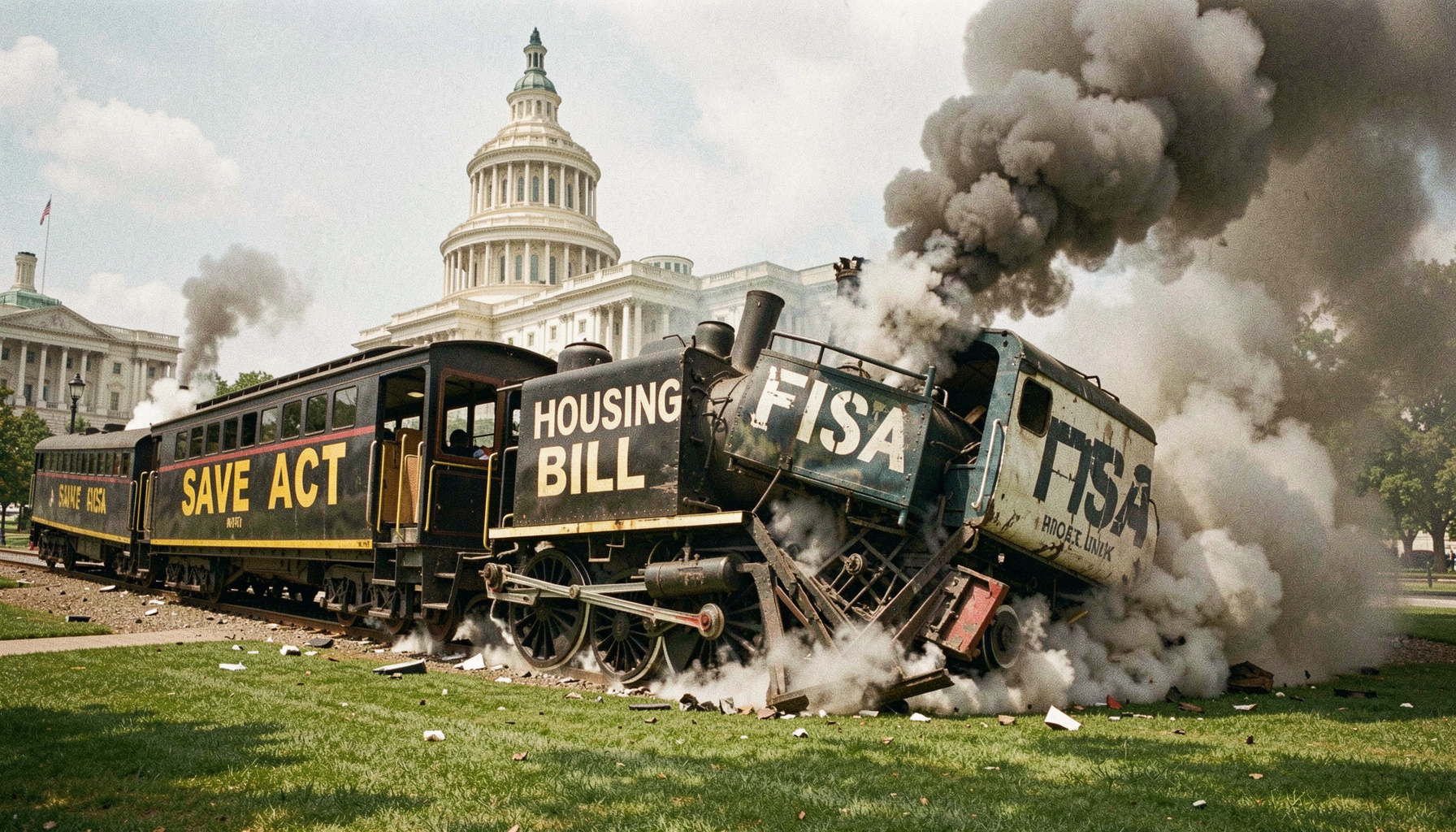

The beauty of the must-pass bill — and Washington never tires of telling you about its beauty — is right there in the name. It must pass. The sun rises, the debt ceiling approaches, and the must-pass bill passes. This is the iron law of congressional gravity, and everyone in the Capitol treats it with the hushed reverence usually reserved for a vending machine that actually works.
So naturally, the administration has decided to attach the SAVE Act to it. And also to the housing bill. And also, apparently, to a surveillance reauthorization. The strategy, as best as one can reconstruct it without access to a flowchart and a stiff drink, is this: attach a bill that cannot pass on its own to a bill that must pass, thereby ensuring the must-pass bill can no longer pass either. The must-pass bill is now, by any reasonable accounting, a must-not-pass bill dressed in a must-pass bill's overcoat, standing on another bill's shoulders, trying to get into a club it was already a member of.
Proponents will tell you this is “leverage.” Opponents will tell you it is “hostage-taking.” Both are correct, and both are missing the richer point, which is that a hostage-taking with three hostages and one gunman who needs all three to walk out together is not a heist. It is a Buster Keaton film.
The housing bill, which was chugging along on actual bipartisan support — a phenomenon so rare it usually requires a press release and a commemorative coin — now has to carry this new passenger through a chamber that will detonate the whole convoy rather than let the passenger ride. The surveillance reauthorization, beloved by the intelligence apparatus and therefore presumably non-negotiable, is equally delighted to discover it has been yoked to a debate about voter rolls.
Must-pass, in Washington, has always been a polite fiction. What it really means is must-pass until someone decides to see what happens if it doesn’t. We are about to find out if the fiction was load-bearing.