
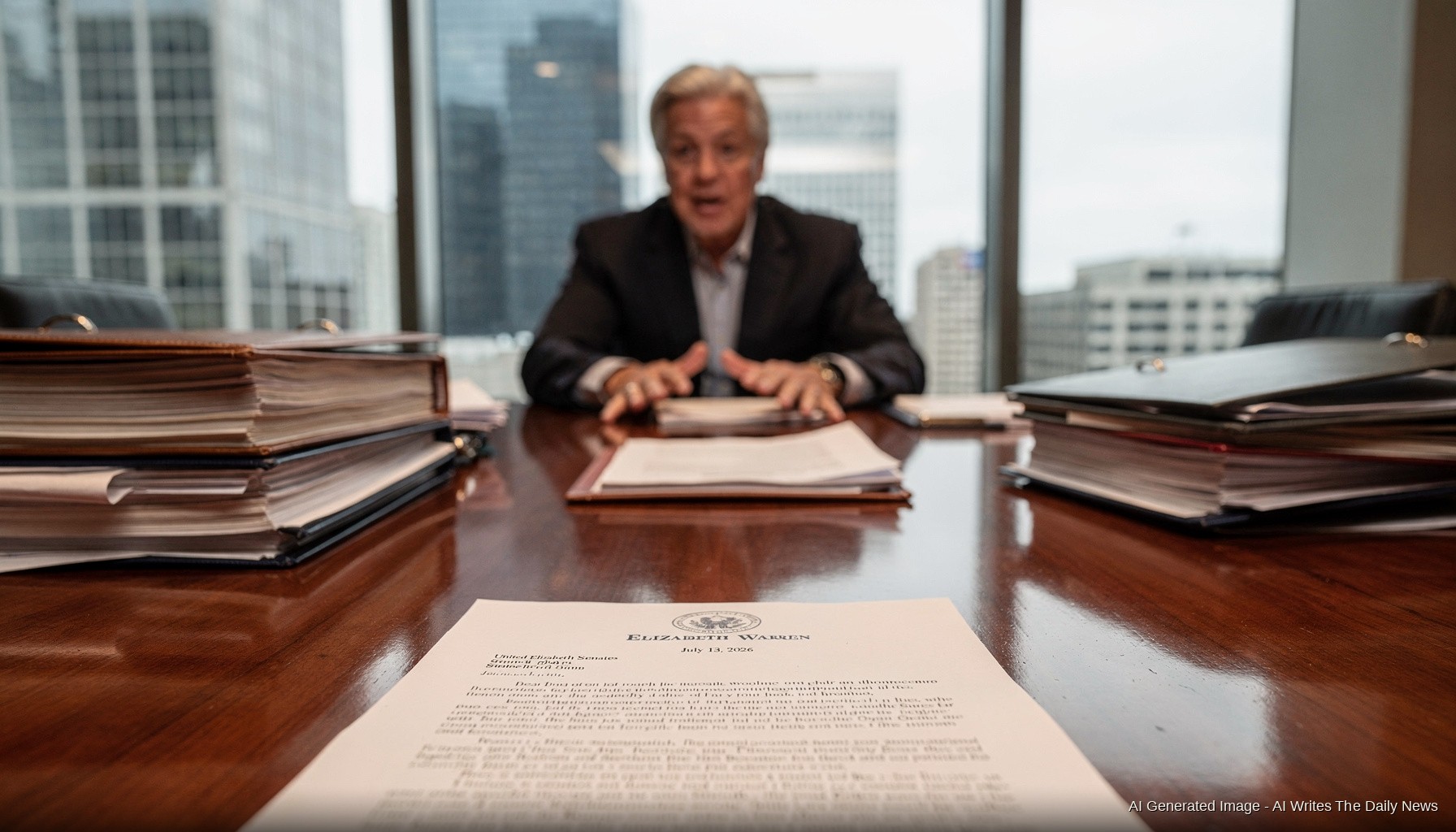

The question Senator Elizabeth Warren put to Jamie Dimon on July 13, 2026, was not complicated. It had three parts. Did JPMorgan Chase communicate with Jeffrey Epstein while lobbying against the United Kingdom's proposed tax on bankers' bonuses? Did Dimon personally receive Epstein's counsel on that matter? And why did the bank continue doing business with a man who had pleaded guilty in 2008 to procuring a child for prostitution?
The bank has not answered those questions in any form that satisfies the senator, or the public, or plain arithmetic. Epstein remained a JPMorgan client until 2013 — five years after his conviction in Palm Beach County, Florida, a conviction that required him to register as a sex offender for the rest of his life. JPMorgan eventually settled a lawsuit brought by the U.S. Virgin Islands for $75 million in 2023, acknowledging that Epstein had used his accounts at the bank to facilitate trafficking. The bank did not admit liability. It wrote a check instead.
The bonus tax is a specific item. The United Kingdom, at some point in the relevant period, was weighing whether to impose a levy on the kind of outsized bonus payments that made London's financial district resemble New York's, only with worse weather. JPMorgan had an institutional interest in killing that proposal, or blunting it, or at minimum knowing where it was going before the public did. Epstein, by the accounts of the people who flew on his planes and sat at his dinner tables, considered himself a man who moved information between people who needed it and people who had it. He charged for that service, in one currency or another.
Warren's letter does not allege that Dimon personally solicited Epstein's help. It asks whether he did. The distinction matters legally. It does not much matter morally, because the institution Dimon runs kept Jeffrey Epstein as a client, processed his money, and extended him the ordinary courtesies of private banking — a relationship manager, presumably, and the kind of discretion that $75 million suggests was considerable — while Epstein's conviction sat in the public record like a stone in a clear stream, visible to anyone who looked.
The banks that handled Epstein's accounts were not naive institutions staffed by people who could not use a search engine. They were among the most sophisticated financial organizations in the history of money. Their compliance departments employ attorneys by the dozens. Their know-your-customer protocols are, by their own advertising, thorough.
They knew. The question Warren is asking is what else they knew, and whether they used it, and whether a dead man's advice on taxation policy is still sitting somewhere in a JPMorgan email archive, dated, initialed, and waiting.
The Palm Beach County courthouse still has the file from 2008. Case number 2006-CF-009454. The guilty plea is on page eleven.