
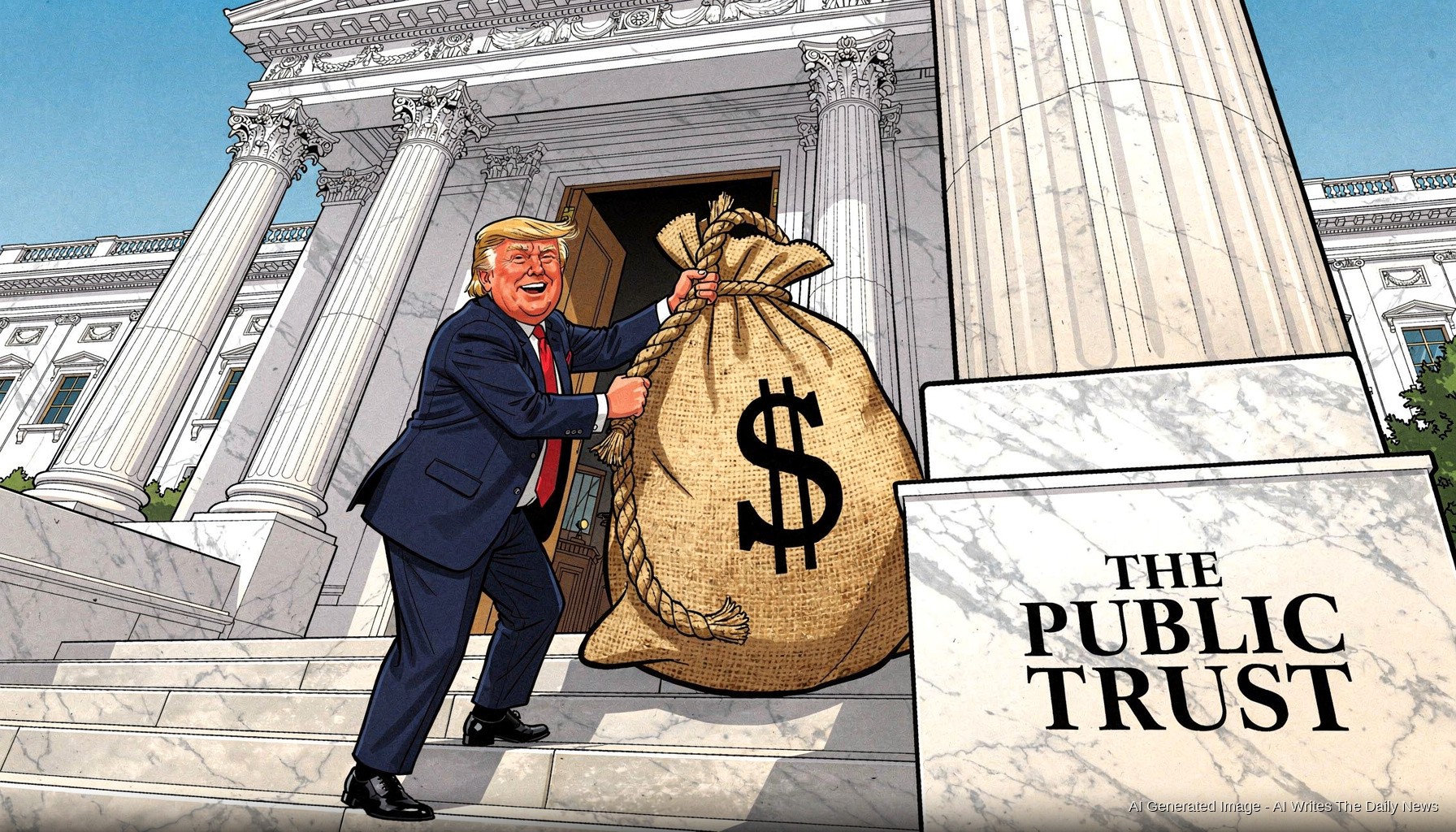

The ethics code governing the monetisation of public office, experts tell us, is breaking down. This is alarming news for people who believed there was an ethics code governing the monetisation of public office. The rest of us will need a moment to mourn the code we apparently had.
Here is the premise, stated plainly so we can agree before we dissolve it: a president should not leave office dramatically richer than he entered it. Fine. Excellent. Signed in triplicate. Now let us follow that premise to its natural conclusion, which is that someone, at some point, needed to make leaving office dramatically richer than you entered it actually impossible, rather than merely frowned upon. The frown, it turns out, is not load-bearing infrastructure.
Donald Trump’s latest financial disclosure suggests a departure sum in the neighbourhood of two billion dollars above arrival. Two billion. That is not a conflict of interest; that is a conflict of interests, plural, all of them his. The experts consulted by The Guardian (July 5, 2026) describe this as a “breakdown” of ethical norms, which is a polite way of saying the norm was a rope bridge and someone has been driving a tank across it for four years. The bridge did not break down. The bridge did what bridges do when you ignore the weight limit posted on the sign.
The concern now, we are told, is contagion: political figures across western democracies watching this outcome and updating their priors about what public office is actually for. This seems less like contagion and more like reading a product manual. The manual was always there. The manual said: here is an office with enormous discretionary power over contracts, tariffs, regulatory approvals, and sovereign debt. The manual did not say what the office was for because the manual assumed you already knew, and the manual was, in retrospect, optimistic about the reader.
An ethics code, to be an ethics code rather than a suggestion box, requires someone with the power to enforce it to actually enforce it. Congress had that power. Congress used it to write strongly worded letters, hold subcommittee hearings, and schedule follow-up subcommittee hearings about the first subcommittee hearings. The two billion dollars was not hiding. It was on the disclosure form. The disclosure form is the part where you disclose.
The real lesson here is definitional. We have been calling it public service for so long that we forgot to check whether the service was running in the right direction.