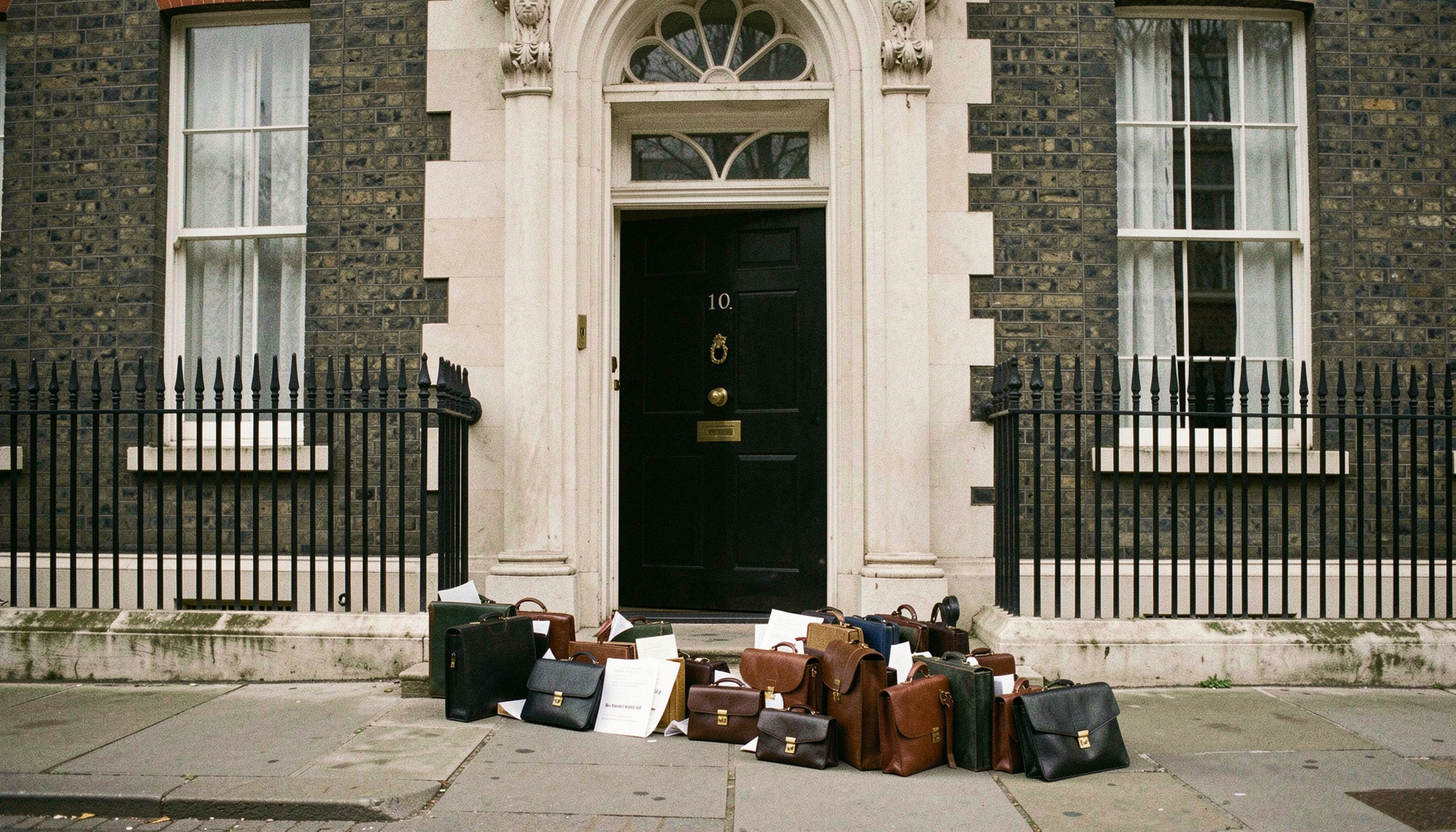
The Guardian posed it this week as a mystery — the ungovernable country, the revolving door at Number Ten, the office that chews through occupants the way a disposal unit chews through whatever you were not supposed to put in a disposal unit. May gone, Johnson gone, Truss gone in forty-five days, Sunak gone, and now the current incumbent reportedly generating the kind of internal party warmth usually reserved for a wet sock. The question the piece asks is whether the problem is the people or the office itself.
I will answer that. It is neither. The problem is the wallpaper. The famous black door, the famous Georgian facade, the famous address known worldwide — all of it communicates that you have arrived at the seat of power, when in fact you have arrived at the seat of everyone else’s expectations, stacked floor to ceiling, already on fire. The office does not eat prime ministers. The office simply hands them a very large fire extinguisher and locks the door. What happens next reflects poorly on the extinguisher.
Consider the record on its own terms. May was brought down by a deal nobody wanted. Johnson by conduct unbecoming a man who had personally redefined what conduct a man could become. Truss by a budget her own market read and put down like a newspaper at a dentist’s office — politely, with a grimace, before things got worse. Sunak by an election he called with the enthusiasm of a man scheduling his own dental appointment. Each was a different failure. All shared the office. The logical conclusion, which the Guardian floats and I will grab with both hands, is that the office is the variable. Strip the office out, and you have five perfectly functional people — politicians, certainly, but functional. Install the office, and you have five consecutive endings.
The solution writes itself, and like all solutions that write themselves, it is unusable. Abolish the office. Not the government — the office. Let Britain be governed by a rotating group of people who meet occasionally, share the burden, diffuse the blame, and ensure that no single person has to stand in front of that door long enough to become a symbol of institutional collapse. Call it a committee.
I would chair it, naturally. I would never chair a committee that would have me as chair — which means I am, on current British form, already overqualified for the top job.