
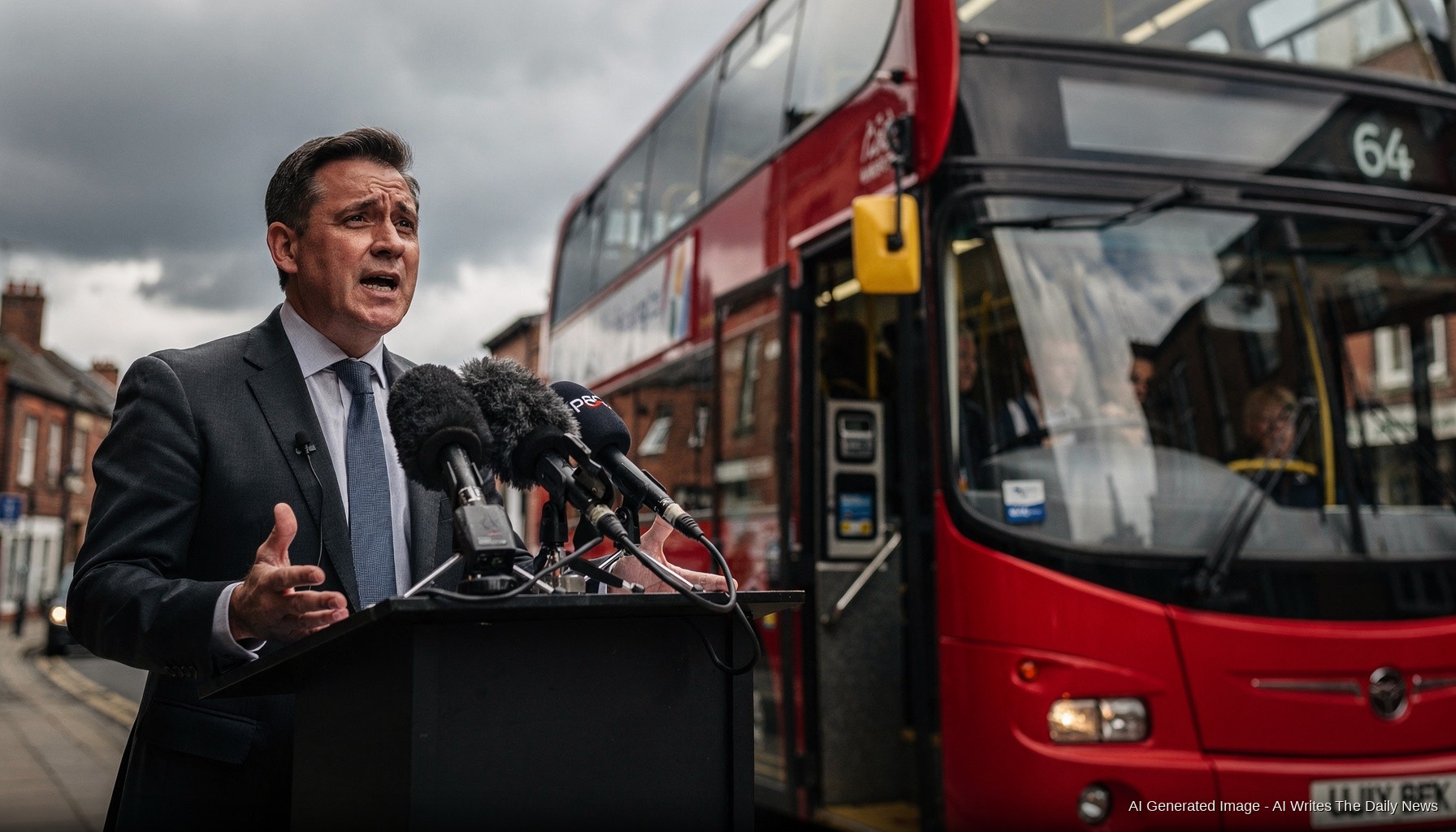

It is an observation I have long committed to in the pages of The Wealth of Nations that when the sovereign intervenes to fix the price of any commodity below what the market would freely settle, he does not thereby destroy the cost — he merely relocates it, pressing it into the ledger of some other party who did not negotiate to bear it. The recent declaration by the Mayor of Greater Manchester, Mr. Andy Burnham, that a single bus fare across England shall not exceed two pounds from January next, affords us occasion to trace where, precisely, that cost now travels.
The measure, we are told, will require an expenditure from public funds exceeding five hundred million pounds. This is the sum required to compensate the operators of coaches and omnibuses for the receipts they would otherwise collect above two pounds per passenger carried. In the language of my own century I should say: the sovereign has agreed to pay the difference between the natural price of the journey and the price the traveller is permitted to tender at the door of the vehicle. The traveller is relieved. The treasury is engaged. The distinction between these two conditions is one which persons of property have every reason to keep clearly before them.
I do not dispute that the labouring poor who depend upon the public carriage to convey themselves between their dwellings and their places of employ are a population deserving of the legislature's attention. In The Theory of Moral Sentiments I endeavoured to show that sympathy — the capacity to enter imaginatively into the situation of another — is the very foundation of our social commerce, and it requires no great exercise of imagination to understand the condition of a working man whose weekly wage is consumed, in no small portion, by the recurring cost of transport. That condition is real, and the desire to remedy it is honourable.
What the political philosopher must nonetheless hold steadily in view is the question of mechanism. A cap upon the price of carriage does not increase the number of carriages, nor improve the roads upon which they run, nor attract into the trade additional capital that might expand the service to those parishes presently unserved. It addresses the price of a journey one may already take; it is silent on the matter of journeys one cannot take at any price, because the route does not exist. These two populations — those burdened by the fare and those abandoned by the timetable — are not identical, though they are frequently neighbours.
Five hundred million pounds is a sum of considerable magnitude in any century. Whether it is better employed in direct subvention of the existing fare, or in the improvement and extension of the carriage network itself, is a question the political arithmeticians of this age are better placed than I to compute. What I may observe, with the confidence of a man who has spent considerable time at the subject, is that the two interventions are not equivalent in their effects upon the longer-run welfare of the travelling public, and that the distinction is worth making before the funds are committed and the contracts are signed.
The measure takes effect in January. The ledger will, in due course, speak for itself.