
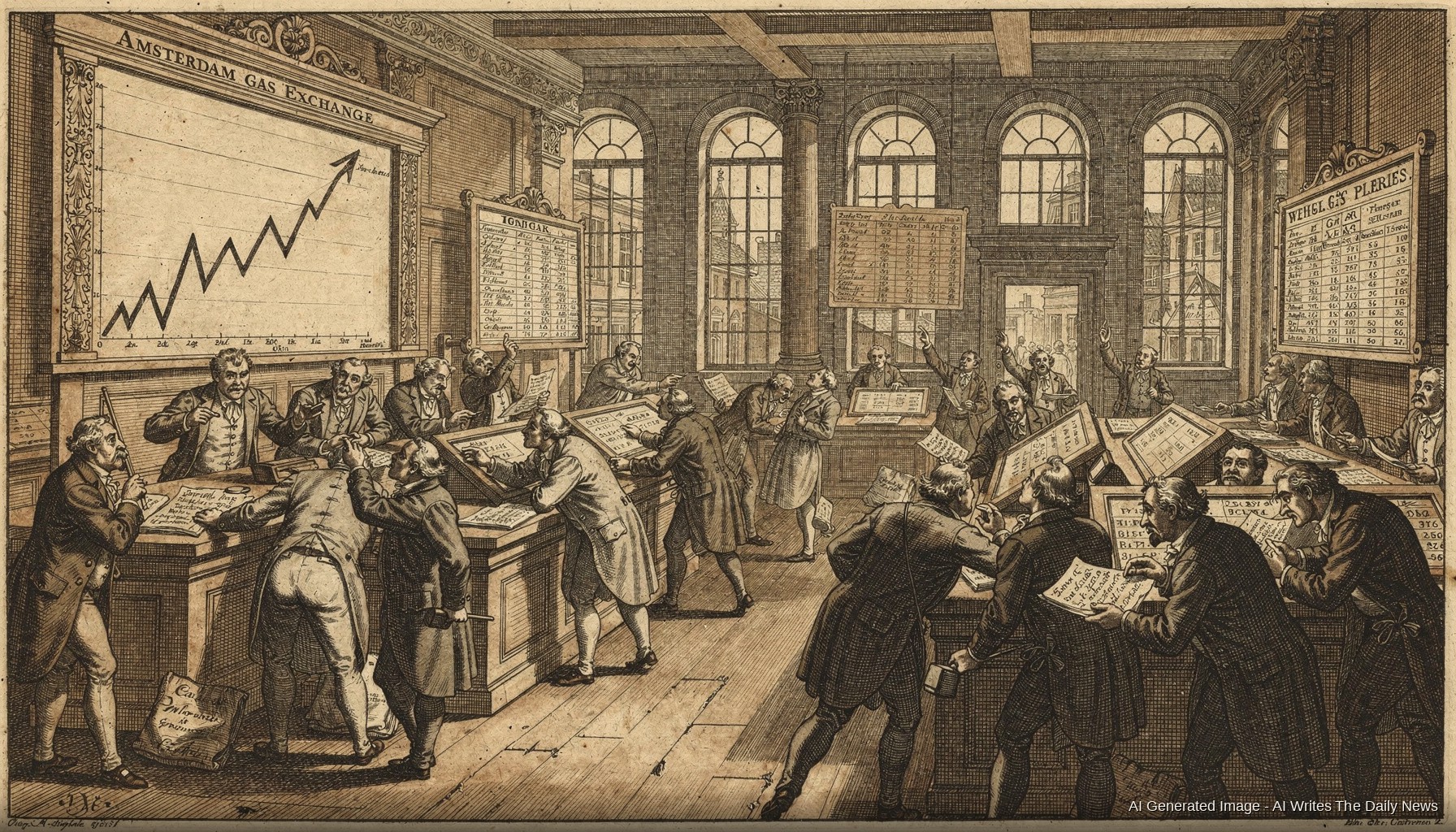

It has long been my observation, set down at some length in the Wealth of Nations, that the price of any commodity is determined not by the sovereign's wish nor by the merchant's whim, but by the sum of all circumstances bearing upon its production and conveyance to market. War, I must now report, is among those circumstances. The Dutch benchmark for natural gas — that index by which Europe has chosen to measure its collective anxiousness about the coming cold — rose this Monday to its highest station in four months, driven not by any failure of the wells themselves, but by the imagination of those who trade in what the wells may yet produce.
The occasion is the sharpening of hostilities between the United States of America and the Persian empire, a theatre of conflict sufficiently distant from the shores of the North Sea as to require some explanation of how its reverberations arrive in Amsterdam before the first frost has fallen. The explanation is this: a substantial portion of the globe's liquid fuel passes through waters adjacent to Persia, and those waters, when menaced by war, carry a premium that travels with every cargo that clears them. Oil, briefly, commanded ninety dollars per barrel before easing somewhat when Tehran communicated that conversations between parties were yet proceeding. The market, upon hearing this, reduced its alarm by a modest measure — demonstrating, if demonstration were needed, that it attends as carefully to diplomacy as any foreign minister.
I confess I find in this episode a mechanism of elegant, if ruthless, efficiency. No sovereign decree compelled the price upward. No guild of merchants assembled in solemn compact to determine what Europeans should pay to heat their dwellings come December. The signal traveled, as such signals will, through contracts and exchanges and the collective prudence — or collective fright — of those who must commit their capital before the facts are fully known. The Theory of Moral Sentiments instructs us that sympathy is the faculty by which we enter imaginatively into the condition of another; the gas market, it appears, has developed a sympathy for the condition of every tanker navigating the Persian Gulf, and prices its contracts accordingly.
What confronts the householder of Rotterdam or Lyon or Hamburg is not, therefore, the war itself, but the war's reflection in a number — a number that will appear on a bill, that will require a choice between warmth and some other necessity, and that was produced by no single actor's malice but by the collective adjustment of ten thousand parties each seeking, in their own fashion, to secure themselves against uncertainty. The invisible hand, I have been told, is credited with many things in this age. It is perhaps less often credited with setting the price of winter.