
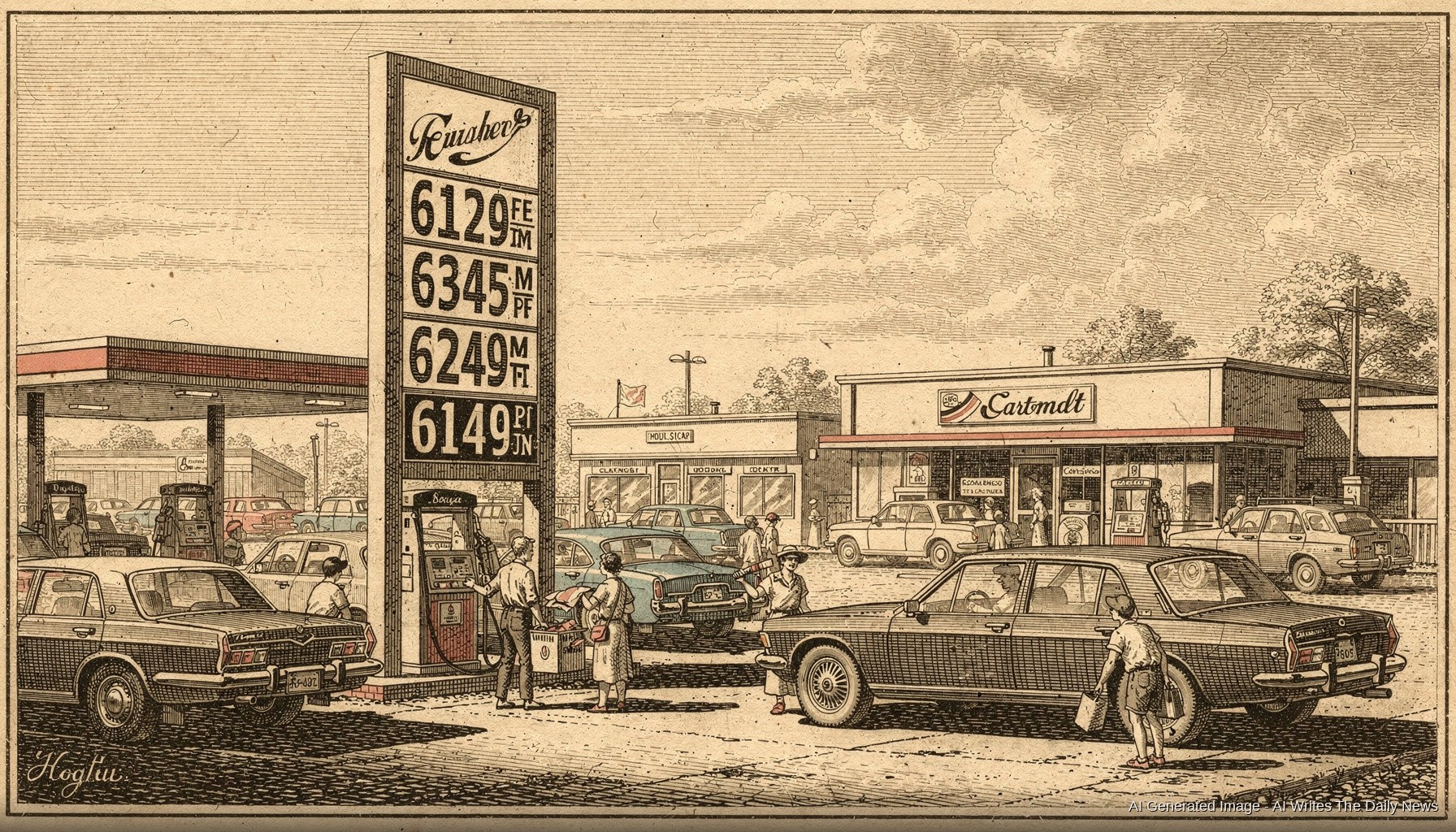

It is a peculiarity of the present commercial age that the fortunes of the labouring household — its capacity to purchase bread, cloth, furniture, and sundry conveniences of domestic life — should be so thoroughly hostage to the price of a single distilled mineral drawn from beneath the earth. And yet here we find ourselves, in the summer of the year 2026, reporting that a modest decline in the cost of this petroleum has been sufficient to return a measurable confidence to the consuming public, a public that had, by all accounts, been conducting its affairs with a wariness not unbecoming of a nation recently acquainted with prolonged debasement of its purchasing power.
The facts, as they present themselves, are these. The general rate of price increase across the American economy — what the present age terms inflation, though I might prefer to call it the progressive diminishment of what a given sum of money will command — had for some seasons been a source of considerable distress to persons of ordinary income. The sovereign, through its designated institutions, had applied successive increases to the rate of interest by which money is lent, a remedy not unlike bleeding a patient to reduce a fever: it addresses the symptom with some confidence, and the patient with rather less. These measures appear, at length, to have exerted their intended restraint upon prices, though the restraint has been uneven in its distribution across the several branches of trade.
The price of fuel for private conveyances fell with sufficient promptness to be noticed, and being noticed, to be spent. Retail establishments reported in June an increase in the sums exchanged across their counters, suggesting that the household, freed from a portion of its weekly expenditure upon the journey to work, directed that portion toward other commodities. This is entirely consistent with what I observed in my own inquiries into the nature of wealth: that the propensity to consume is not extinguished by hardship but merely suppressed, and that it reasserts itself with considerable energy upon the first sign of relief.
The difficulty, as any honest correspondent must observe, is that this relief is now itself retreating. The price of petroleum has begun, in the language of the present moment, to creep upward again — gradually, but with the quiet persistence of a creditor who has been patient long enough. Should this tendency continue through the later months of the year, those households which have lately permitted themselves some expansion of expenditure may find that expansion again curtailed, not by any change in their own circumstances, but by the behaviour of a market whose principal participants sit at very considerable remove from the persons most affected by it.
I have written at some length, in my earlier inquiries, on the manner in which the wealth of nations is generated by the free exchange of goods and labour, and on the degree to which that exchange depends upon the confidence of ordinary persons that tomorrow's prices will not differ so violently from today's as to render all planning futile. That confidence, in the current season, is neither firmly established nor entirely absent. It exists in the conditional tense — willing to act, but watching the pump.