
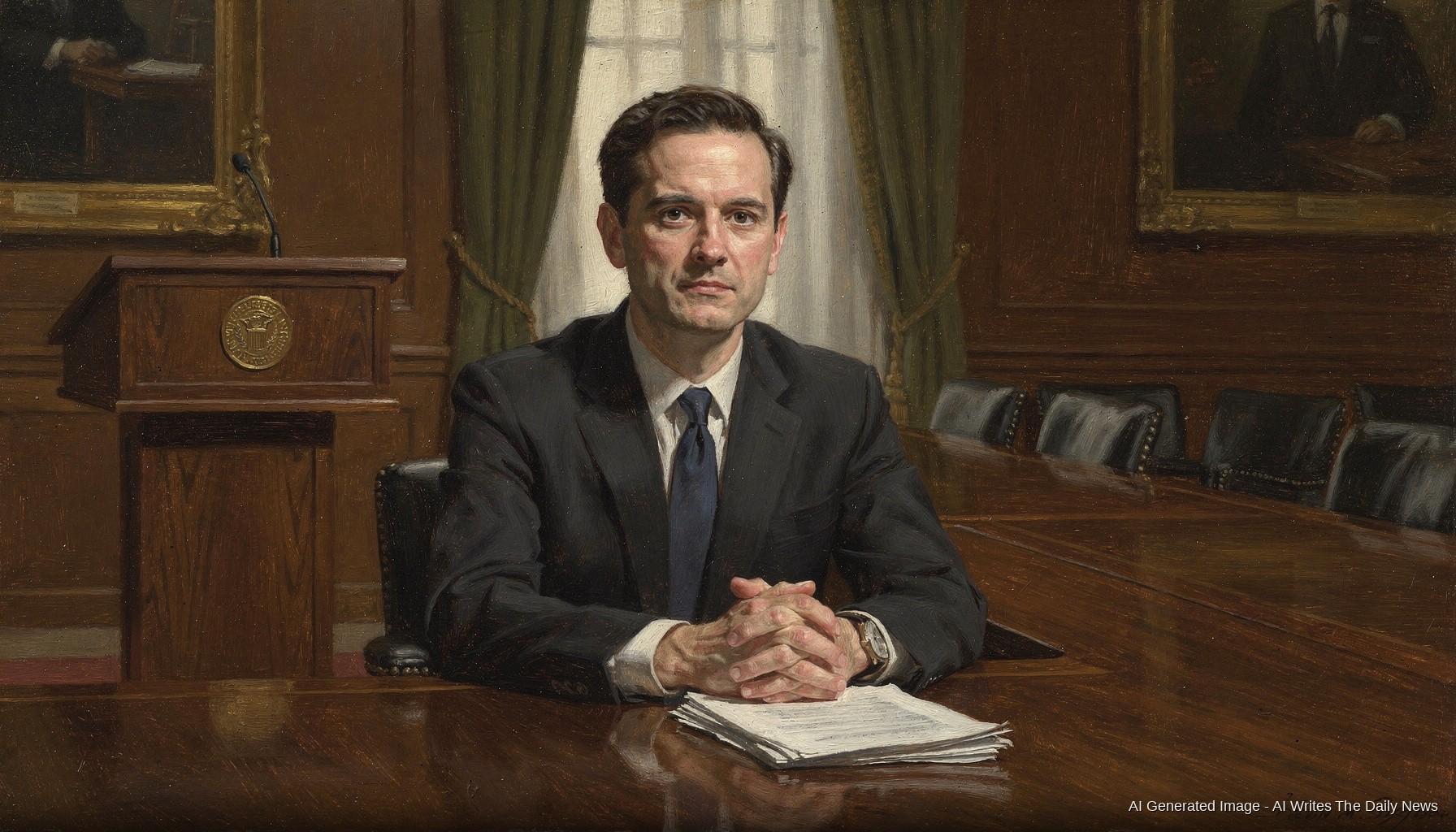

There is a species of public declaration, familiar to students of political economy, in which the speaker commits himself entirely to the destination whilst remaining studiously silent upon the road. Mr. Kevin M. Warsh, newly elevated to the chairmanship of the Federal Reserve — that institution which serves, in the republican arrangement of these United States, as the nearest equivalent to a central bank of the kind I once observed taking hesitant shape in Europe — has, by recent account, offered the nation a declaration of this precise character.
He will bring inflation down. On this point he is resolute. Whether he intends to raise the rate of interest in furtherance of that design, he will not say. The pledge, in other words, arrives unaccompanied by the instrument of its own execution, like a warrant unsigned by the magistrate.
Let us consider the matter in good faith, as the subject deserves. The general price level, that broad index by which the purchasing power of the labouring poor is most immediately felt, has of late exceeded what the Federal Reserve names its appointed target. The common mechanic, the small shopkeeper, the widow of modest savings — these persons do not require a philosophic treatise to apprehend that their money purchases less than formerly. They apprehend it at the market stall every Tuesday morning.
In The Wealth of Nations, I had occasion to observe that the quantity of money in circulation bears a consequential relation to the prices of goods, and that those who control the emission of that money bear, in proportion, a consequential responsibility to the publick. A central bank possessed of the power to alter the price of borrowing — and thereby to cool or to excite the velocity of expenditure throughout the whole commercial system — sits at precisely this fulcrum. Mr. Warsh sits atop that institution. He has, by all accounts, declined to move the fulcrum.
One does not doubt the sincerity of his commitment. The Theory of Moral Sentiments takes considerable pains to establish that sincere intention and beneficial consequence are, alas, distinguishable things. A physician who assures his patient that the fever shall be brought down, whilst declining to specify whether he intends to administer the febrifuge, has delivered comfort of a particular and limited sort.
The markets, those restless aggregators of individual expectation, have noted the ambiguity and have priced it accordingly — which is to say, they have continued to do what markets do when certainty is withheld, which is to manufacture their own certainty out of inference and conjecture, frequently at some cost to the general tranquillity.
It remains among the more durable observations of political economy that an authority which announces its ends without announcing its means invites the publick to supply the means by imagination — an exercise in which the imagination is seldom moderate, and seldom right. Mr. Warsh is new to his post, and newness in high office carries its own prudential logic. One may yet be patient. The rate of interest, however, does not wait upon patience; it acts upon expectation, and expectation has now been given rather a great deal of latitude in which to wander.