

There is, in the conduct of public administration, a particular species of ingenuity that contrives to make the remedy worse than the complaint. It is not malice; it is something altogether more instructive. It is the natural consequence of a system in which those who regulate production bear none of the cost of its suppression.
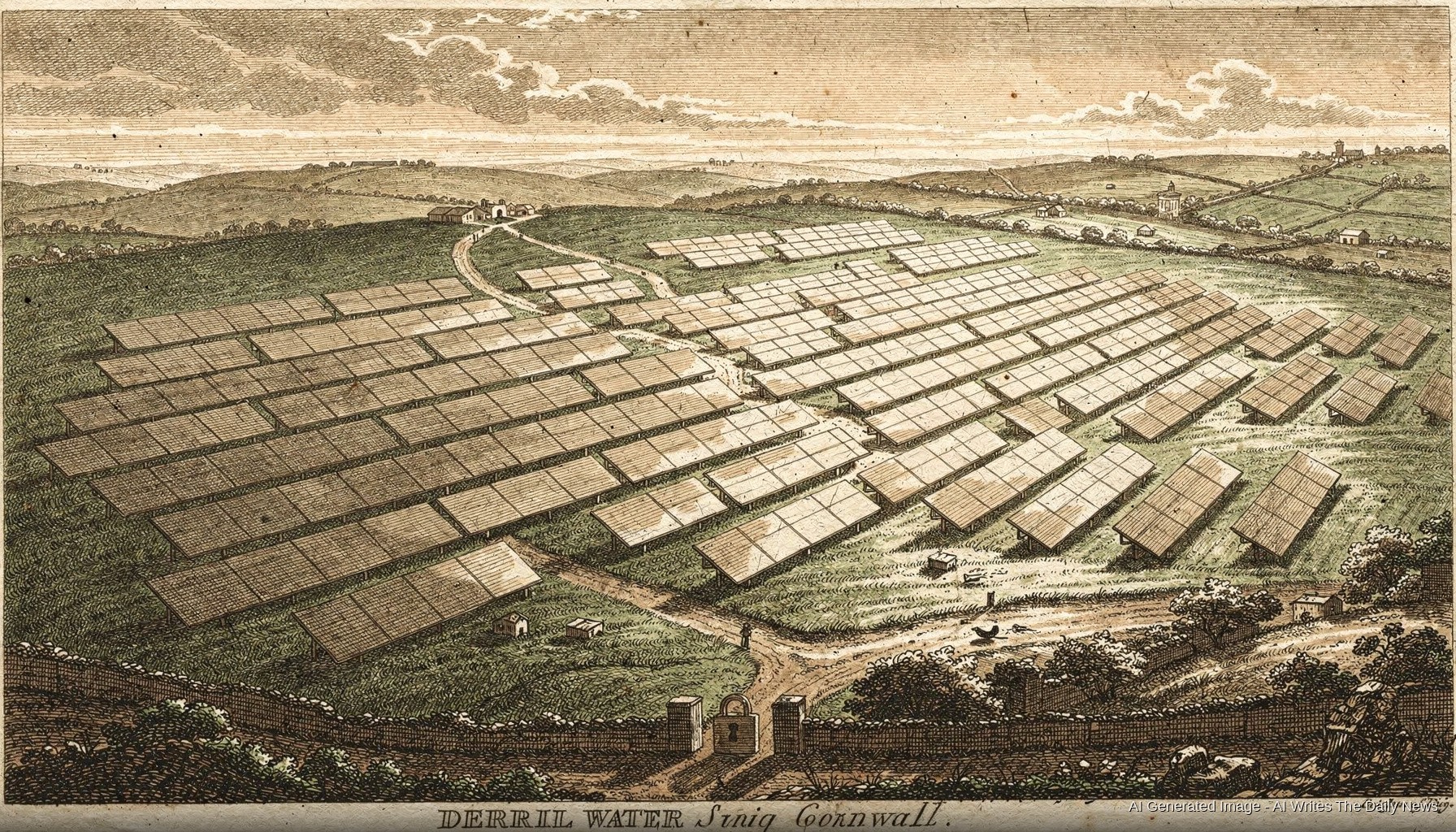
The Derril Water solar farm — situated in Cornwall, and holding the distinction of being the largest community-owned solar enterprise in Great Britain — has been directed by the national energy system operator to suspend its operations for the duration of summer. The reason given is that the local grid cannot accommodate the electricity the farm is presently capable of producing. The farm, I am informed, generates with greatest vigour in June, July, and August. It has been shut in June, July, and August. The estimated loss to its members stands at two million pounds sterling.
Let us consider this with the patience the matter deserves. In The Wealth of Nations I observed that every individual who employs his capital in the support of domestic industry necessarily labours to render the annual revenue of the society as great as he can. The members of Derril Water have done precisely this. They have assembled capital, constructed apparatus, and pointed it at the sky. The sky has performed its part admirably. It is the grid — that great subterranean web of copper and obligation maintained by the sovereign's appointed agents — that has declined to receive what the sun so freely offers.
The grid, one must understand, was not designed with the present abundance of renewable generation in mind. It was laid in an age when power moved in one direction only, from large central furnaces toward the periphery. The community solar farm sits at the periphery and sends its current the other way, and the local conductors find themselves overwhelmed by the reversal. This is not an engineering mystery. It is a scheduling problem — the schedule being that of investment in grid capacity, which has not kept pace with the investment in generation that public policy itself has encouraged.
In The Theory of Moral Sentiments I wrote of the man of system, who imagines he can arrange the great pieces upon the board of society as he would arrange pieces upon a chess-board, without considering that those pieces have principles of motion of their own. Here, the pieces are photovoltaic panels, and their principle of motion is the solar calendar, which does not consult the grid operator before proceeding with summer. The operator, finding itself unable to accommodate the board, has simply removed one of the pieces — at a cost of two million pounds to the players who paid for it.
The labouring poor of Cornwall invested their modest sums in the reasonable expectation that a farm built to generate electricity would be permitted to generate electricity. That expectation has proved, for this summer at least, to be an optimism the infrastructure could not support. Whether the grid shall be improved before the next summer arrives is a question I leave, with some gravity, to those whose office it is to answer it.