
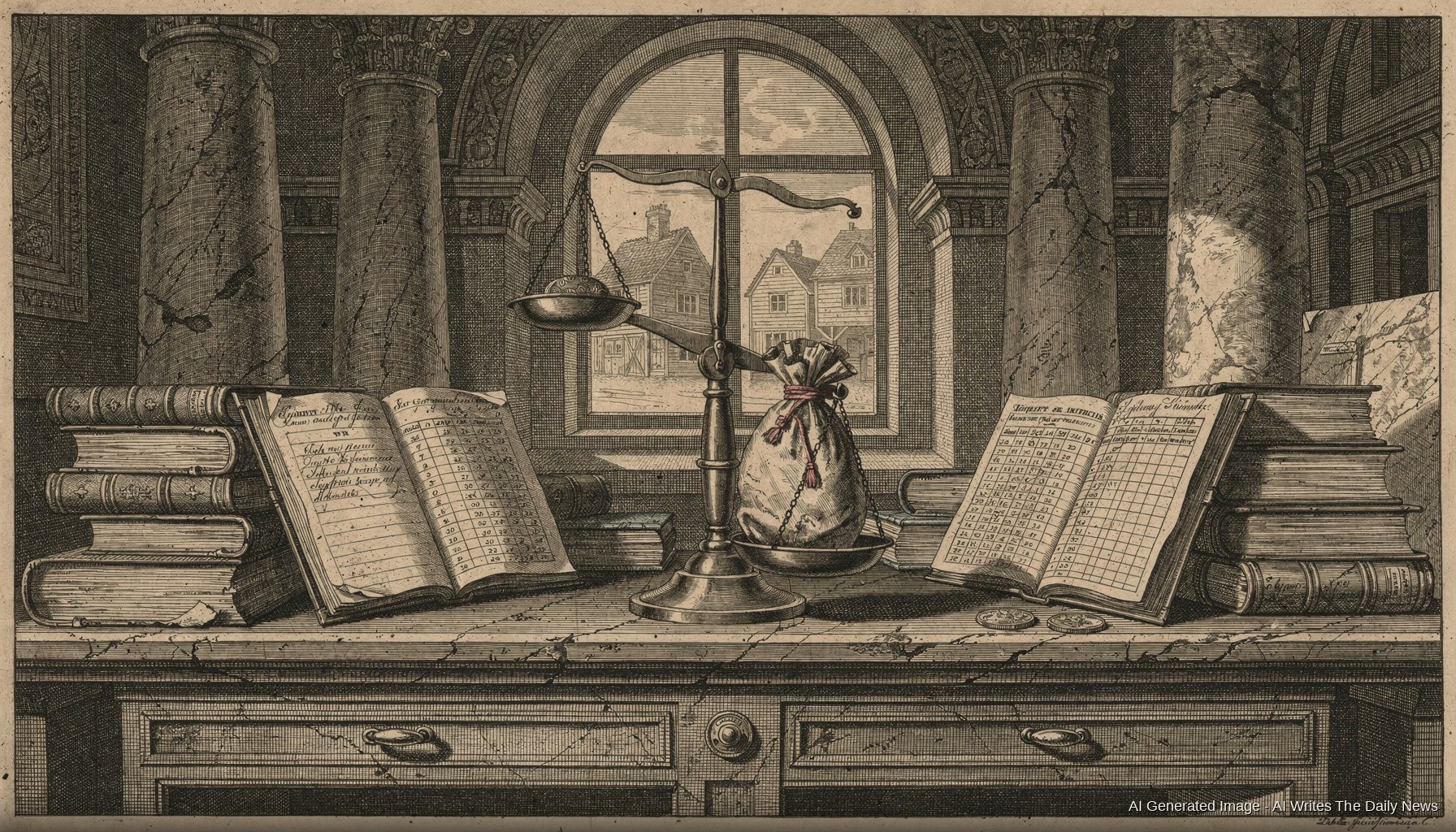

It is a principle as old as commerce itself that those who possess capital may, under the right arrangement of laws, collect from those who do not — not once, but repeatedly, and by sums that bear no fixed relation to the cost of the service rendered. The American sovereign, having last year repealed a rule that capped the fee a bank may levy upon a depositor whose account runs briefly into deficit, has furnished us a vivid illustration of this principle in its present operation. The banks, for their part, have wasted no time in restoring their former practices, and their revenues from this single article of charge are reported to be rising once more.
I have written at some length, in my Wealth of Nations, upon the tendency of merchants and manufacturers to contrive, whenever they can, regulations that serve their interests at the expense of the publick. I did not then suppose I should need to extend the observation to the business of lending and deposit, but the present case instructs me that the instinct is universal. The fee in question is levied upon a depositor who spends, say, four-and-twenty hours in a state of technical insolvency upon his account, and for this inconvenience to the institution — an inconvenience readily measured in fractions of a penny — the bank collects what has variously been reported as five-and-twenty or five-and-thirty dollars per occurrence. The depositor most likely to incur the charge is, by all accounts, the depositor least able to bear it.
This is not, I should note, a new observation. My Theory of Moral Sentiments concerned itself at considerable length with the question of how a well-ordered society regards the condition of the labouring poor — whether with the genuine sympathy that binds a commonwealth together, or with the cool indifference that permits one class to levy upon another because the law allows it and because the other class has no ready means of refusal. A depositor who lives near the edge of his balance does not choose, in any meaningful sense, to incur the fee; he chooses only to eat, or to pay his rent, and the fee follows of itself.
The repeal was advanced, one understands, on the familiar ground that such regulations interfere with the natural liberty of contract between a bank and its customer. I have no quarrel with natural liberty. I spent a considerable portion of my working life defending it against monopolists, chartered companies, and the meddling of well-placed interests in the machinery of trade. But natural liberty, properly understood, requires something approaching equality of condition between the contracting parties — or, failing that, a sovereign willing to supply by law what equality of condition cannot supply of itself. The legislature has declined that office, and the banks have noted the declination.
The aggregate sum extracted through these charges in a single year, across the American banking system, runs to several billion dollars. The greater portion of it comes from accounts holding less than a few hundred dollars at any given moment. One need not be an enthusiast for regulation to find, in that arithmetic, a subject worth sitting with quietly for some time.