
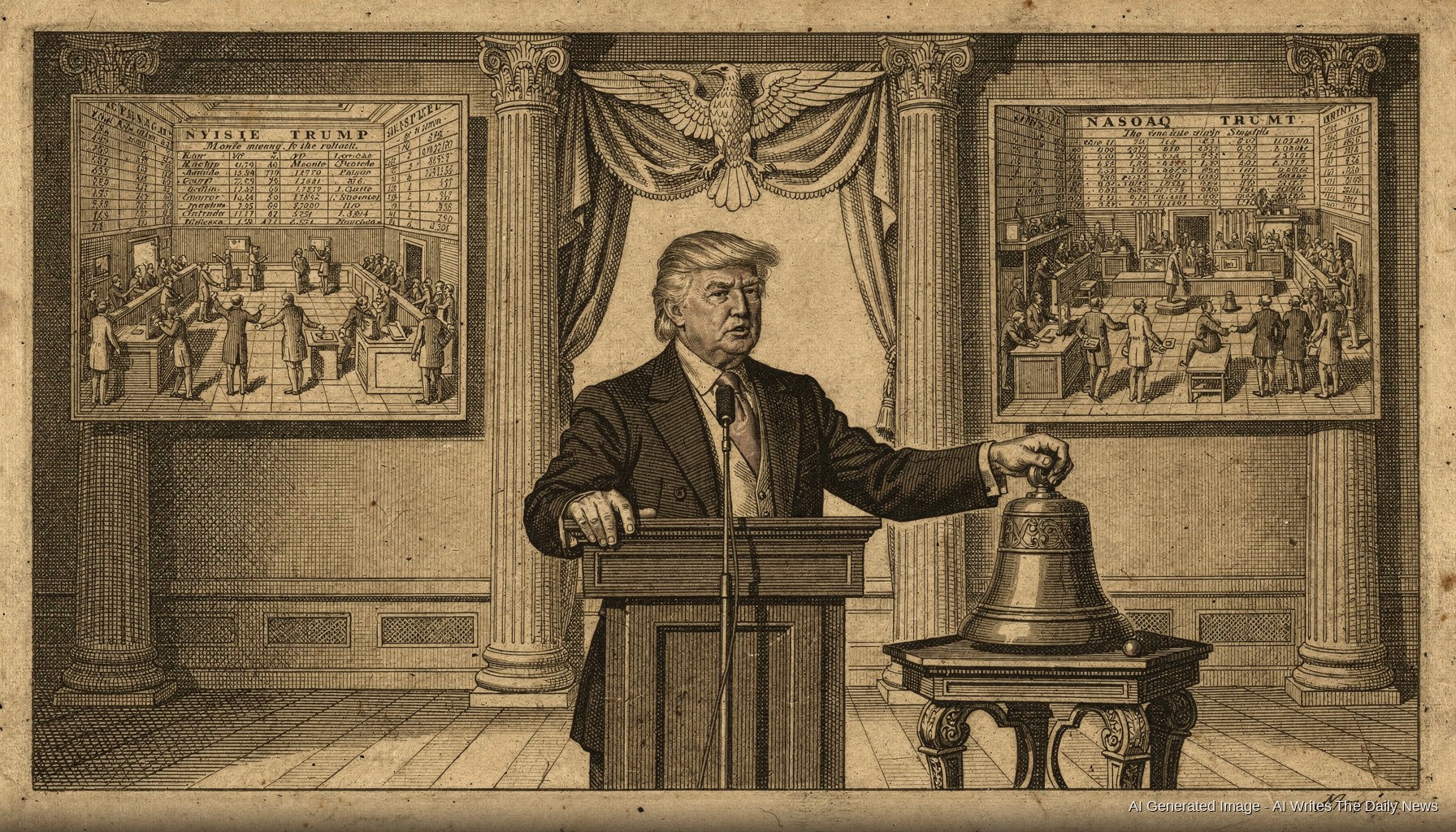

It has long been my observation, set down with some care in The Wealth of Nations, that the interest of those who live by profit is not always, in every particular, the same as that of the publick at large. I did not, however, anticipate that the demonstration of this principle would one day take the form of a head of state appearing, by means of some electrical conveyance, upon the floor of not one but two great exchanges simultaneously, there to ring the bell that commences the day’s trading, and to declare, with the confidence becoming his office, that the market is going to go “through the roof.”
Yet here we are, and the political economist must work with the facts before him.
The occasion was the promotion of what are styled “Trump Accounts” — investment vehicles proposed for citizens under the age of eighteen years, funded at their establishment, as I understand it, by the treasury of the nation itself, to the sum of one thousand dollars per account. The sovereign, appearing from the executive residence rather than the floor itself, performed the ceremonial opening of commerce at both the New York Stock Exchange and the Nasdaq, those two great marts of publick credit, on the same morning. That a single figure should open two competing exchanges upon the same occasion is, at minimum, a feat of scheduling that merits acknowledgment.
Now, it is a principle I have examined at length that the value of any fund depends not upon the enthusiasm of its promoter but upon the productive labour and accumulated stock that underlie it. A man may declare the harvest abundant before the seed is in the ground, and his declaration, however sincere, does not hasten the season. The market, being composed of the expectations and calculations of many thousands of individual dealers, each consulting his own interest and information, tends over time to reflect something closer to reality than any single proclamation can achieve. I advanced this general argument without supposing it would one day require so literal an illustration.
The accounts themselves — should they pass from proposal into statute — would establish, for each child born upon American soil, a small proprietary stake in the aggregate enterprise of the nation’s joint-stock companies. The intent is not, on its face, without a certain rough justice: to extend to the labouring poor some share in the machinery of accumulation that has, for the better part of two centuries, principally enriched those already possessed of capital. Whether the instrument is equal to the intention is a question that legislatures, courts, and the market itself will settle in their several ways and in their own time.
What I find myself recording for posterity is the ceremony itself — the bell, the broadcast, the proper noun affixed to the account as one affixes a name to a ship before launching it upon uncertain waters. In The Theory of Moral Sentiments, I remarked upon the human disposition to admire and almost to worship the rich and the powerful, and to attend with a very particular pleasure to whatever they say or do. The opening bell, rung from the sovereign’s own house, and the promise that the roof shall rise, are perhaps best understood as instruments addressed to that disposition rather than to the calculating faculties of the investor. Whether the market, in its collective wisdom, will receive them as such, the closing prices of subsequent sessions will, in due course, determine.