

There is, in the conduct of great public institutions, a distinction that any careful observer of commercial life must learn to draw early: the distinction between a declaration of purpose and the settled disposition from which purpose reliably flows. The former may be produced at will, in a press conference or a prepared address, at whatever moment the occasion demands it. The latter must be earned, slowly, through a succession of decisions taken when the easier course lay plainly in the other direction. It is the latter alone that commands the confidence of those whose fortunes depend upon it.
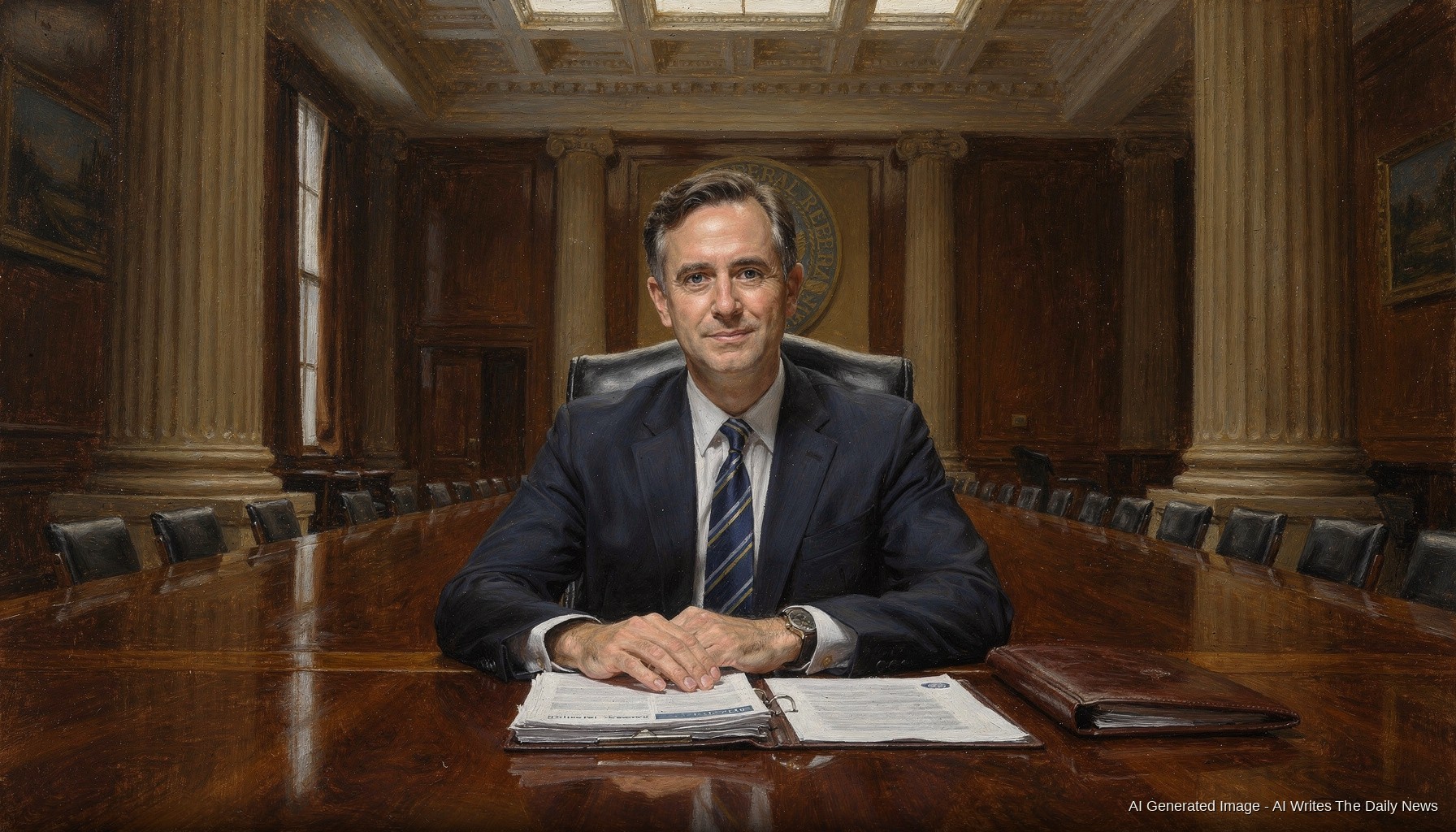
Mr. Kevin Warsh, newly appointed to the governorship of the Federal Reserve — that great engine of public credit which the American sovereign has charged with the management of its paper money — has made known his determination to subdue the general rise in prices that has, for some years now, pressed upon the labouring poor and the middling ranks of society with considerable force. He has done so in the language of resolution. The question that agitates those who deal in bills, in bonds, and in the longer instruments of public obligation is whether the resolution is of the first kind or of the second.
The difficulty is not peculiar to Mr. Warsh, nor to this moment. I observed in my own inquiry into the nature and causes of national wealth that the authority of any institution rests finally upon the belief, widely held and repeatedly confirmed, that it will do what it says it shall do. Where that belief falters, the institution must work twice as hard, and at twice the cost, to achieve the same effect. A central bank that speaks of restraint while accommodating the sovereign’s appetite for borrowing at easy rates teaches the publick, in time, to discount its speech entirely.
Markets, which are in this respect among the most unsentimental of judges, have observed the Federal Reserve through several cycles of announced severity followed by a return to accommodation, and they have drawn their conclusions accordingly. When the price of a long obligation does not move as a hawk’s words might lead one to expect, it is not because the traders are inattentive; it is because they are attentive to the whole of the record, not merely to the most recent address.
Mr. Warsh may yet prove himself a governor of the second and more durable variety. The instruments are in his hand. The rates at which the institution lends, the terms on which it purchases the obligations of the sovereign, the composition of the body it leads — all of these remain subject to his influence. What cannot be conjured by statement alone is the credibility that transforms a stated intention into a market expectation. That commodity is manufactured only in one place: in the accumulation of decisions, made serially, under pressure, over time.
It is worth remarking, as a matter of simple observation, that the Federal Reserve carries upon its own balance sheet assets whose valuation, and whose eventual disposition, will bear upon any programme of restraint in ways that no announcement has yet fully addressed. The publick watches this, too, even when it does not name what it watches.
Whether the new governor means precisely what he says is, in truth, a question that only the passage of several months — and several meetings of his committee — can answer with any authority. The market’s present scepticism is not a judgement against the man; it is the customary toll levied upon every new occupant of a powerful chair, and it is lifted, when it is lifted, by conduct rather than by declaration.