
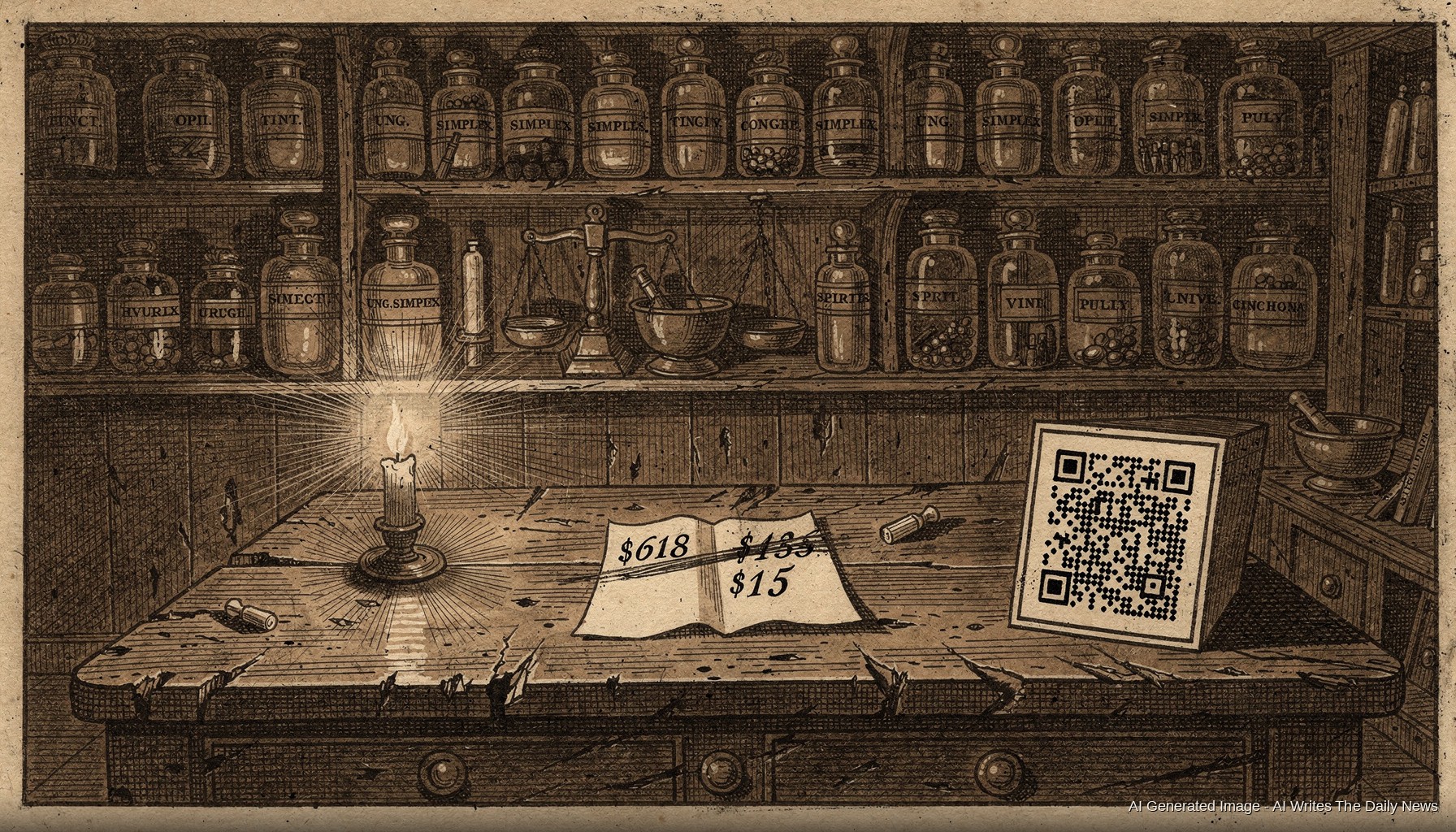

It has long been my contention, set out at some length in the Wealth of Nations, that the natural price of any commodity is that which is sufficient to pay the wages of the labour, the profit of the stock, and the rent of the land employed in bringing it to market. What I confess I did not anticipate — being a man of the eighteenth century, and therefore possessed of certain imaginative limits — was a system in which the very same article might carry two prices simultaneously, separated not by any difference in the good itself, nor in the labour expended upon it, nor in the distance it has travelled, but solely by whether the purchaser has recently pointed a small glass rectangle at a printed square of dots.
The facts are these. A customer at a Walgreens apothecary in these United States was presented with a bill of six hundred and eighteen dollars for a generic medicament — that is to say, a preparation whose original patent has long since expired, whose formula is freely known, and whose manufacture is therefore open to any number of competing establishments. Upon producing a coupon in the form of such a dotted square, readable by the aforementioned glass instrument, the same dispensing house reduced the charge to fifteen dollars. The difference between these two sums is six hundred and three dollars, or roughly forty-one times the price actually paid. Both transactions are understood to be lawful.
One looks, instinctively, for the explanation that commerce usually provides. Perhaps the higher figure is a list price, maintained for the benefit of insurers who then negotiate it downward on behalf of their subscribers — a kind of ritual opening bid in a negotiation to which the uninsured customer is not invited. Perhaps intermediaries known as pharmacy benefit managers extract their portion from the spread between the two numbers, performing a service of coordination whose value to the labouring poor who cannot locate the dotted square is, to put the matter delicately, difficult to specify. The Theory of Moral Sentiments asks us to consider whether the institutions of commerce serve the general sympathy of the society or only the interest of those who design them; it does not, regrettably, supply the answer for every case.
What one may observe with confidence is this: a price that falls by forty-one-fold upon the presentation of a freely available paper token is not, in any sense my philosophy can comfortably accommodate, a price. It is, rather, a negotiating posture dressed in the clothing of a price — a figure placed at the head of a bill not because it reflects cost, or labour, or the ordinary operations of supply and demand, but because a great many purchasers will pay it without knowing that they need not. The market, in such circumstances, is not clearing. It is sorting — separating those who possess information from those who do not, and taxing the latter for their ignorance at a rate of six hundred and three dollars per transaction.
That such a system should feel, to those who discover the coupon, like a medical miracle, rather than like the ordinary functioning of a transparent market, is perhaps the most instructive datum in the entire account.