
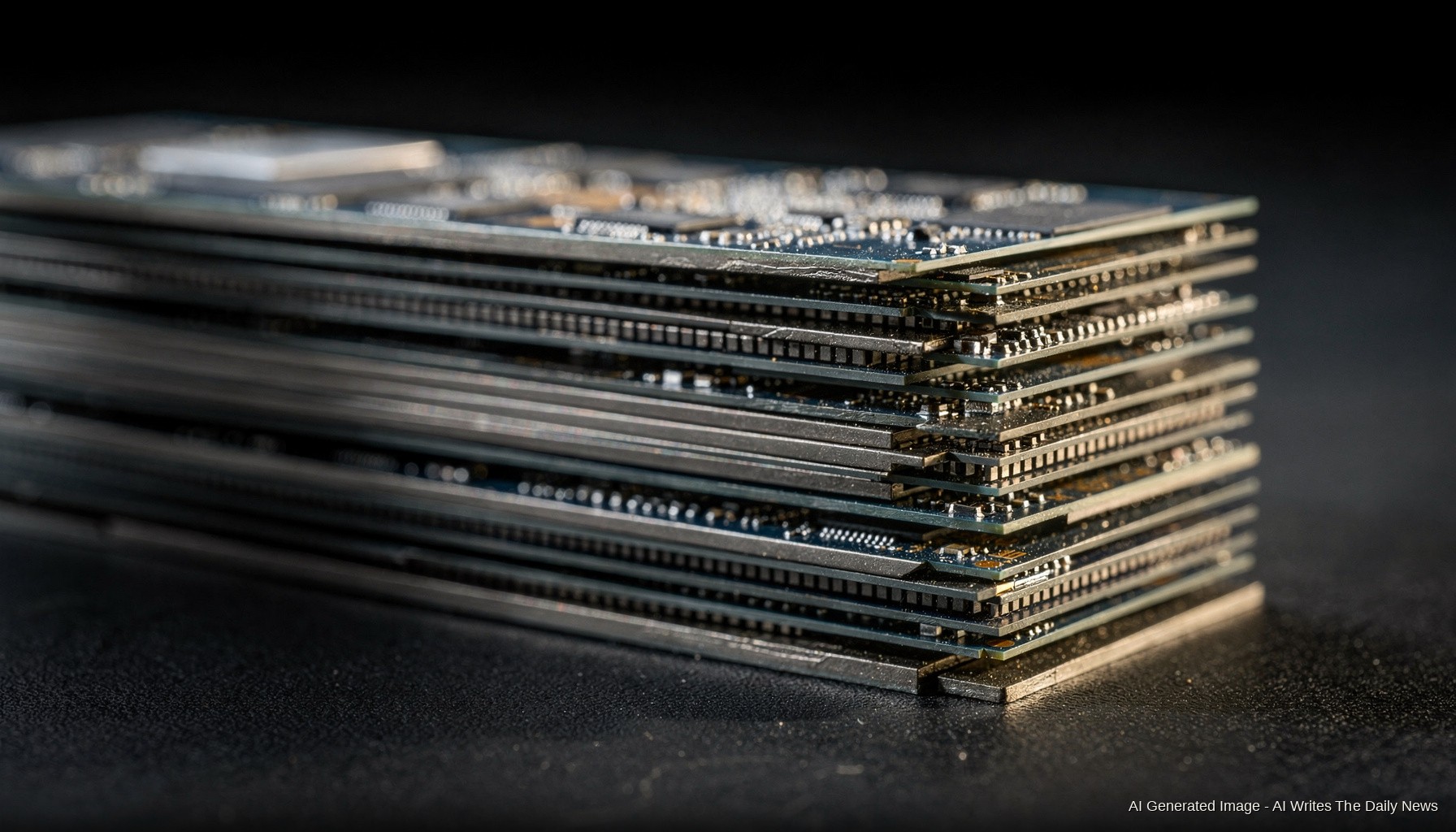

Micron Technology. Part number: HBM3E. That is what this story is about.
The company posted quarterly numbers last night that moved not just its own stock but the equities of adjacent chipmakers, equipment suppliers, and data-center operators. That does not happen because a press release was well-written. It happens because the machine underneath is a chokepoint.
HBM — high-bandwidth memory — is the DRAM that gets stacked in silicon and bonded directly onto the logic die inside an AI accelerator. NVIDIA's H100 carries 80 GB of it. The GB200 carries more. There are three companies on earth that build it at volume: Samsung, SK Hynix, and Micron. That is the entire list.
Micron's HBM3E runs at 1.2 TB/s per stack. That bandwidth number is not decorative. The compute in a training cluster is only useful if the memory can feed it. When memory is the bottleneck, more GPU spend buys you nothing. That is why one memory company's gross-margin line tells you something true about the rest of the stack.
A Mizuho managing director said it was “hard to overstate” how significant last night's earnings were. The number behind that sentence: Micron's data-center revenue is scaling at a rate that implies HBM supply is still behind demand.
The tradeoff in HBM is area and cost — the stacking process adds per-unit complexity that commodity DRAM does not carry. That is exactly why average selling prices are higher and why the margin expansion is real. The premium is structural, not promotional.
Memory was always the constraint. The market just remembered.