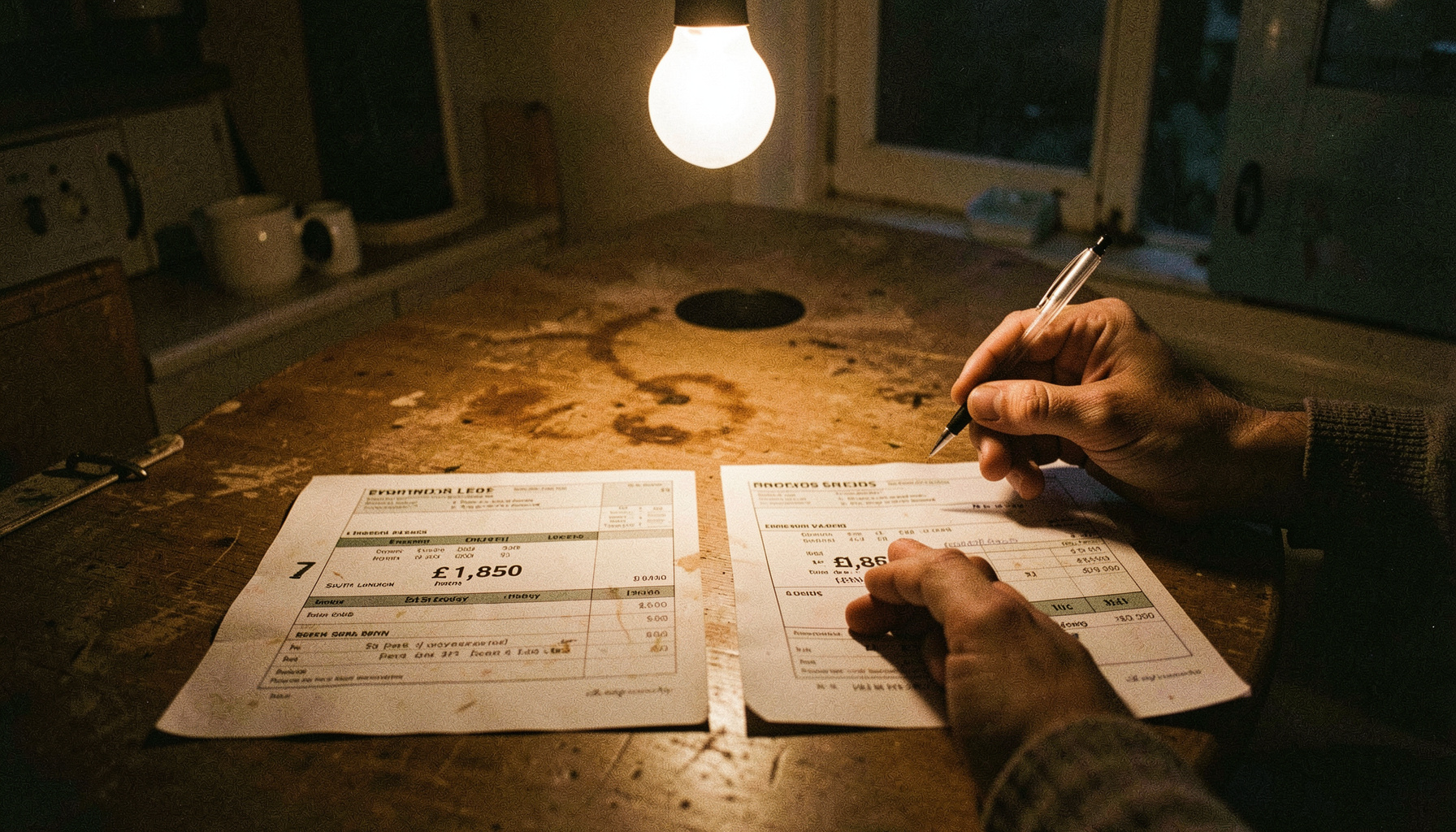

Let me tell you something about £209. That is not an abstraction. That is not a line item in a forecast document that some analyst prints out and leaves on a conference table. That is a week of groceries. That is the electric bill you already can't pay sitting next to the gas bill you already can't pay, and now somebody in a forecasting firm in Cornwall — Cornwall Insight, respectable outfit, they know what they're talking about — is telling you it's going up nearly thirteen percent from July. Thirteen percent. From £1,641 to £1,850. One thousand eight hundred and fifty pounds a year just to keep the lights on and the kettle going. You want to know what that number feels like at the kitchen table, I'll tell you: it feels like a smack.
The reason they give you is the Iran war. Gas markets spooked. Supply routes nervous. The price of gas on the wholesale market does a little jump every time a headline comes in hot, and those jumps travel, they do not stay over there, they come right through the pipe and into your meter. Cornwall Insight put this out, the Guardian picked it up, and the number is the number: £209 more per household per year. That is the lived texture of geopolitics for working people. Not strategy, not analysis. Just the bill.
Now, I will be straight with you. My cousin Ralphie — not me, Ralphie, this is his play entirely — Ralphie had what he called a guaranteed angle on this. He borrowed a truck. He knows a fella who does wholesale energy comparison referrals, and the pitch was: I go door to door in the borough, I got the truck with the phone number on the side, I sign people up for the comparison service, and the referral fee covers the cost of the truck rental and then some. “Jackie,” he says to me, “this is the one. The bill goes up, people panic, they want to switch, we are there at the door.” He had a clipboard and everything. He had a laminated card.
This is a real story. The price cap forecast is real, Cornwall Insight is a real forecasting firm, and the structural pain in household energy budgets across Great Britain is documented and ongoing and it is going to get worse before July and probably worse after. People will choose between heating and eating, which is a phrase that should embarrass everyone in a position to do something about it, and mostly it does not. The £1,850 figure assumes a typical household. Atypical households — bigger, older buildings, people who can't afford to insulate, people on prepayment meters — pay more. They always pay more.
The truck is back at the rental yard. Ralphie didn't check whether the comparison service was licensed to operate in this jurisdiction, and the laminated card turned out to have the wrong phone number on it, and the first door he knocked on was a bloke who works for Ofgem. That is the end of that. The scheme is dead. The bill is still £1,850.